OpenRouter runs one router, openrouter/free, over a rotating catalog of :free-priced models. Every free account shares the same 20-requests-a-minute ceiling.
A one-time $10 credit purchase lifts the daily cap from 50 to 1,000 requests, confirmed against OpenRouter's own documentation on August 26, 2026.
That ceiling decides whether the free tier holds up for a given project. The model name behind it on a given day decides much less.
Read the cap below, then decide.
Account status | Requests per minute | Requests per day | Source |
|---|---|---|---|
No credits purchased | 20 | 50 | OpenRouter Help Center, rate limits article, retrieved 2026-08-26 |
$10 or more in lifetime credits purchased | 20 | 1,000 | OpenRouter Help Center, rate limits article, retrieved 2026-08-26 |
Note: figures above are vendor-published limits, not independently tested throughput. OpenRouter's Help Center caps every free account at 20 requests a minute. With no credits purchased, the daily ceiling is 50 requests.
Once $10 or more in lifetime credits has been purchased, that daily ceiling rises to 1,000 requests, per OpenRouter's rate limits help article, retrieved 2026-08-26. A lifetime credit total, once past that $10 mark, keeps the 1,000-a-day ceiling even if the account balance later drops back toward zero.
The measurement basis for this piece is Basis 2: aggregated. We collected every number in it from OpenRouter's own documentation, help center, and product pages. That collection ran between August 11 and August 26, 2026.
We ran no test of our own against any model named here. Five sources anchor this piece: OpenRouter's free router documentation, its rate limits help article, its provider-logging privacy guide, its BYOK use-case guide, and its free-models collection page. Each is cited at first use with its retrieval date.
Where the arithmetic here goes beyond a straight copy of a published number, we show the formula next to the result. We present no figure below as a benchmark score, because none of our sources measure benchmark performance for these specific free-priced models.
Three axes carry the ranking in this piece: the request-rate ceiling, whether tool calling survives the router's random model selection, and the data-handling toggle applied to free requests. Speed and accuracy carry no ranking here. No independent test of the free-priced catalog exists to cite.
openrouter/free is a router, not a model
A router picks which model answers a request. A model generates the answer. OpenRouter's own documentation names openrouter/free as the Free Models Router.
That documentation states the router "automatically selects a free model at random from the available free models on OpenRouter." It adds that the router filters first.
That filter step keeps only models that support what a request needs, such as image understanding, tool calling, or structured outputs.
Calling openrouter/free directly differs from calling one specific :free-suffixed model ID. The router can hand two identical prompts to two different underlying models on two different days.
A pinned :free model ID stays fixed until that model leaves the catalog.
OpenRouter states the router itself carries no charge. Requests it forwards carry no charge either.
Routing through OpenRouter is one path to a model. Calling a provider such as Google or Anthropic directly is another. A tool call can fail even though the router filtered correctly
OpenRouter's own documentation confirms the router filters down to models that expose tool calling at request time, before it selects one. That filtering rule carries a consequence the documentation does not spell out directly.
On any day when zero of the free-priced models in rotation advertise tool calling, a tool-using request has nothing left to route to. It fails, rather than quietly falling back to a model without that capability.
That gap is a documented consequence of the filtering rule above, not a separately published failure mode. It is the likely explanation behind "no tool-capable model found"-style errors reported by users of coding agents such as OpenClaw, Cline, and Hermes agent when those tools point at openrouter/free.
The fix does not require abandoning the free tier. Pin a specific :free model ID known to support tool calling, instead of routing through openrouter/free. A pinned model ID does not disappear from underneath a request the way the router's rotating selection can.
What was actually free on August 26, 2026
Five models in OpenRouter's free-models collection carried $0 pricing for both prompt and completion tokens, cross-checked against OpenRouter's public model list on the same day.
They were Ox Alpha, from a provider listed only as "stealth"; Inkling, from Thinking Machines; and Nemotron 3.5 Lightning, from NVIDIA.
Two more rounded out the five: Dots3-Note Preview, from Dots Studio, and Laguna S 2.1, from Poolside. Context windows across those five ranged from 262,144 tokens for Laguna S 2.1 to 1,048,576 tokens for Ox Alpha and Inkling. That is a four-times spread among models that all share the same $0 price tag.
The chart below carries one caveat worth reading first. OpenRouter's collection lists at least one free-priced model with a stated removal date. Treat every name here as a dated snapshot, not a standing recommendation.
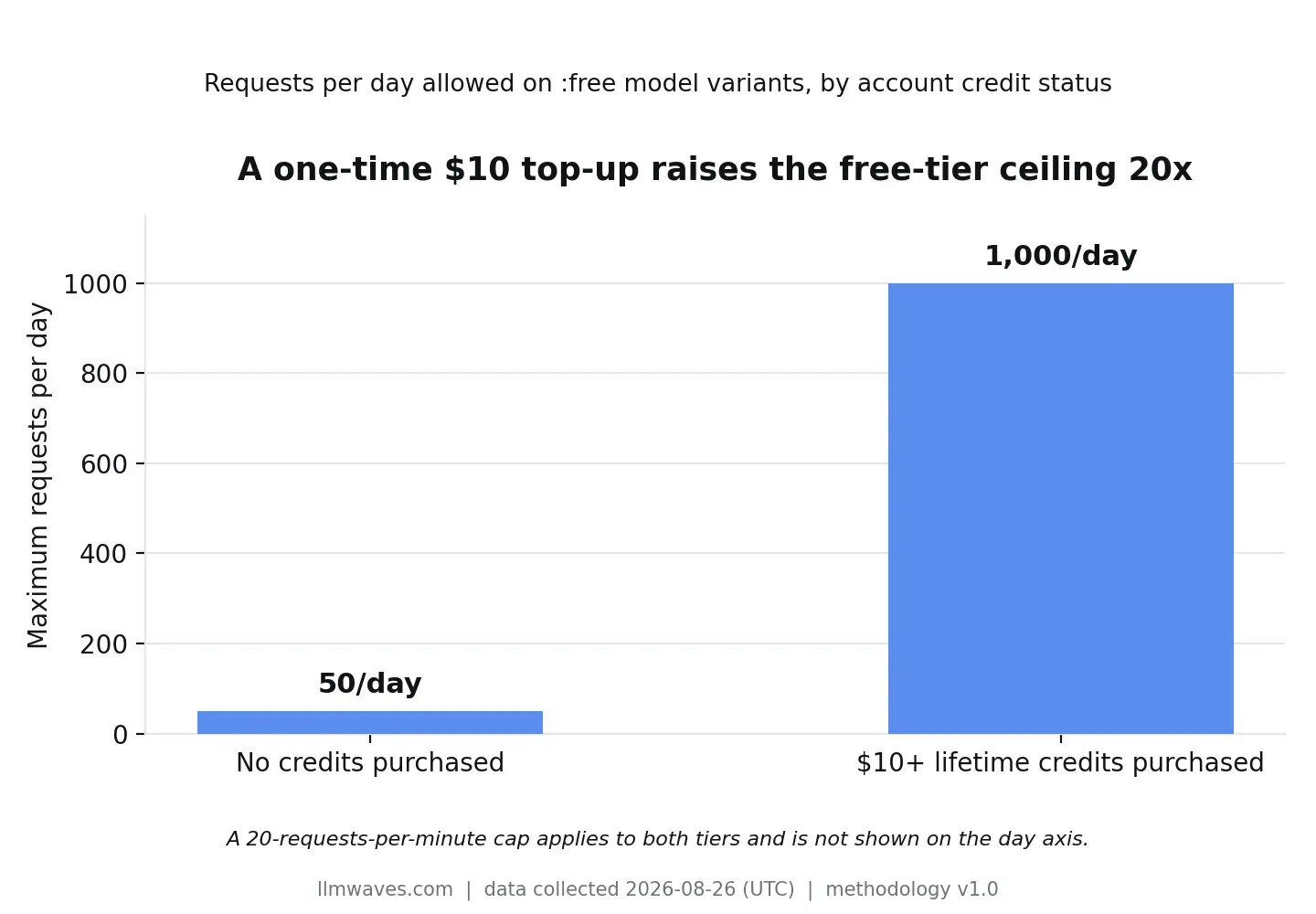
Ox Alpha and Inkling topped this snapshot's context-window figures at 1,048,576 tokens each. That is four times larger than Laguna S 2.1's 262,144-token window, based on OpenRouter's free-models collection retrieved 2026-08-26.
None of these five carries an independently published accuracy or speed score as of this retrieval. This chart ranks context window only, not output quality. All five also appear in LLM Waves' model index, cross-referenced by provider.
Free does not mean the same data policy as paid
OpenRouter's privacy documentation names one specific control. It states that account settings hold a toggle for routing to providers that may train on submitted data.
That training use follows "their own policies," per the same documentation.
OpenRouter states plainly that "there are separate settings for paid and free models." OpenRouter does not publish what each setting defaults to.
A free-tier user who cares about training exposure has one job the price tag will not do automatically. Check both toggles, not only one. OpenRouter configures them independently.
Free-router requests and BYOK are two different mechanisms
Two paths on OpenRouter both get described online as "free." They are not the same mechanism.
The first path is what this piece covers throughout: :free-suffixed models, or the openrouter/free router. That path caps out at 20 requests a minute. It caps out at 50 to 1,000 requests a day, depending on lifetime credit purchased.
The second path is BYOK, bring your own key. A BYOK request runs on a provider key supplied by the account holder, rather than OpenRouter's own capacity.
OpenRouter's BYOK documentation states a flat 5% fee applies to BYOK usage, charged in OpenRouter credits. A monthly list-price allowance applies before that fee starts, and its exact threshold is plan-specific.
BYOK is not a second free tier. The underlying provider still bills the account holder's own key at that provider's standard rate, and OpenRouter's 5% sits on top of that.
A BYOK request can reach the same model through a different host than the free router would pick. Same Model Different Providers covers what else changes when that happens.
Averaged across 24 hours, the 1,000-requests-a-day ceiling for a funded free account works out to 1,000 divided by 1,440 minutes.
That is roughly 0.7 requests a minute sustained around the clock, well under the 20-per-minute burst cap. That average, not the burst number, is the one worth planning a project around. A burst of 20 in one minute leaves nothing for the other 1,439 minutes of the day if the daily ceiling is 50.
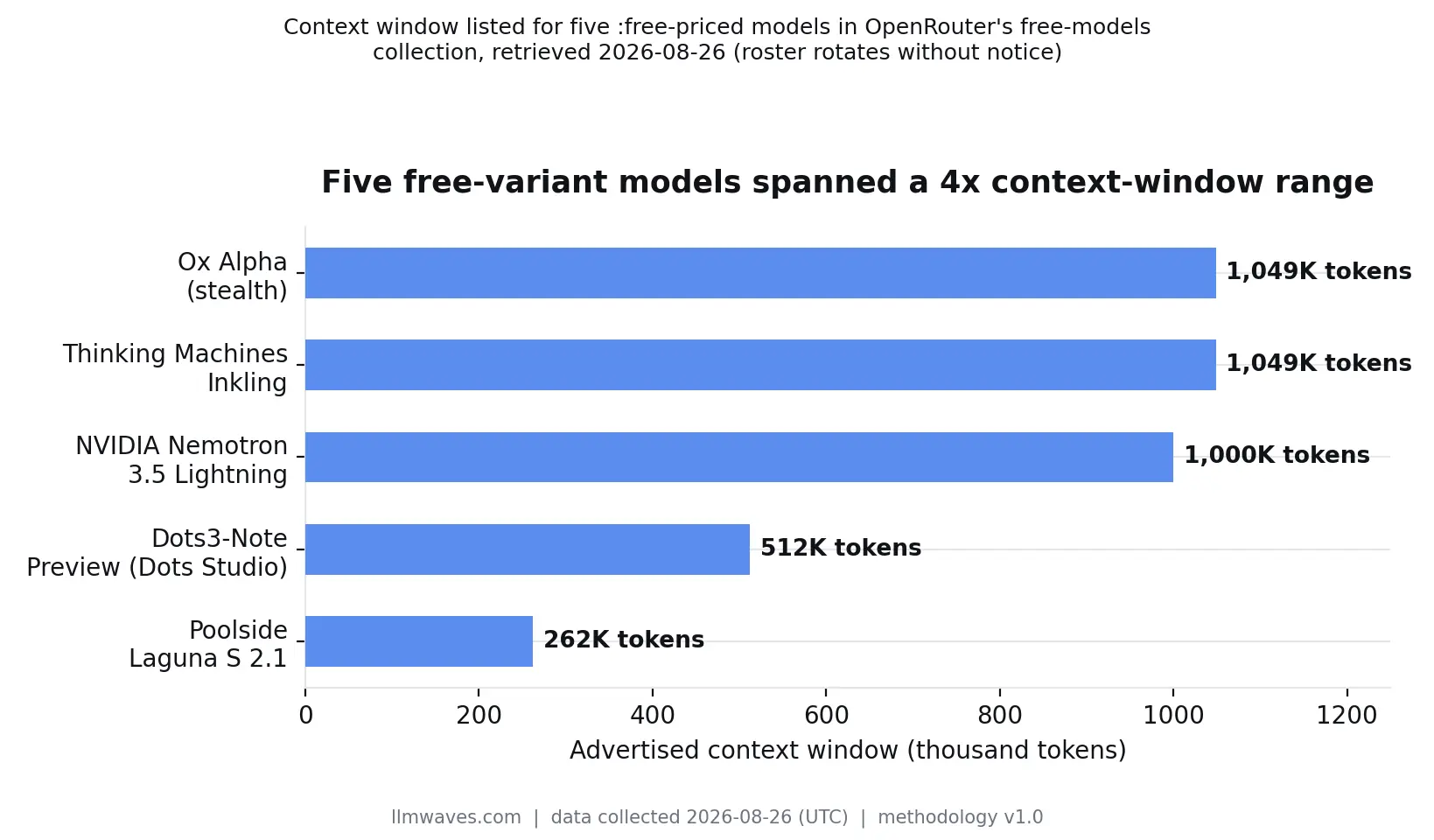
A $10 lifetime credit purchase raised the daily ceiling twenty times over, from 50 to 1,000 requests, per OpenRouter's Help Center rate limits article retrieved 2026-08-26. The 20-requests-a-minute cap did not move at either tier. That is why the daily number, not the per-minute number, is the one that changes with spend.
What this piece did not measure
No accuracy, speed, or output-quality score in this piece was independently tested against any free-priced model named above.
Every model-specific figure here is a vendor-published spec, not a benchmark result.
No figure in this piece confirms the exact live count of free models at any single moment. The catalog is documented to rotate, and this piece reflects one retrieval on 2026-08-26.
No source cited here measures behavior under sustained concurrent load beyond the documented 20-requests-a-minute cap.
No source cited here measures non-English or code-switched output quality for any free-priced model. No source cited here confirms the exact dollar threshold of OpenRouter's BYOK monthly free allowance, since OpenRouter's own documentation states the threshold is plan-specific.
Which free-tier path fits which reader
Developers building coding agents
Verdict: situational. The router matches a request to whichever free-priced model exposes tool calling at request time. On a day when none does, code that worked the day before returns an error.
The router path is the wrong pick if the agent cannot tolerate an occasional routing failure. Pin a specific tool-capable :free model ID instead of calling openrouter/free directly, if that risk is not acceptable.
Roleplay and chat apps such as Janitor AI or SillyTavern
Verdict: insufficient data. Janitor AI and SillyTavern both accept a standard OpenRouter API key, so a :free-only key works there in principle. No independently published benchmark scores this catalog on long-form character consistency, though.
The free rotation is the wrong pick under one condition: a character card that depends on one specific model's writing style. That exact model carries no guarantee of staying in the free rotation from one day to the next.
High-volume or production traffic
Verdict: not recommended. Even after a $10 top-up, 1,000 requests a day averages to roughly 0.7 requests a minute sustained around the clock. This is the wrong pick for any endpoint a team needs to plan capacity around.
Self-hosting or BYOK power users
Verdict: best value. BYOK routes a provider key already held by the account through OpenRouter's unified API for a flat 5% fee, billed in OpenRouter credits. It bypasses the 20-requests-a-minute free-router cap entirely.
This is the wrong pick for anyone expecting a second free tier, though: the underlying provider still bills its own standard rate on top of that 5%.
Non-English or code-switched use
Verdict: insufficient data. No source cited in this piece measures free-priced model output quality in any language other than English.
Does OpenRouter have any free models?
Yes. OpenRouter lists a rotating set of models priced at $0 for both input and output tokens. Each is reachable directly by a :free-suffixed model ID.
Each is also reachable through the openrouter/free router. OpenRouter's own documentation describes that router as selecting "a free model at random from the available free models on OpenRouter." The roster changes without notice. OpenRouter's free-models collection page is the live source, not any single article.
Which AI model is completely free?
No single model holds that position on OpenRouter for long. Five free-priced entries observed on August 26, 2026 were Ox Alpha, Inkling, Nemotron 3.5 Lightning, Dots3-Note Preview, and Laguna S 2.1. OpenRouter's own collection has flagged at least one free-priced entry for removal on a stated future date. That is evidence against treating any one name as a lasting answer.
Are there any free OpenRouter models for Janitor AI?
Janitor AI accepts any standard OpenRouter API key, including one drawing only on :free-suffixed models. The free router applies there the same as anywhere else. No independently published benchmark ranks this catalog on roleplay or long-form character consistency.
The 20-requests-a-minute cap applies to chat traffic the same as any other request type.
What is the cheapest OpenRouter model?
Among priced, non-free models, the lowest per-token rate rotates with the catalog the same way the free list does. OpenRouter's own pricing page is the source worth checking, rather than a number reprinted here.
Among free-priced options, cheapest and free collapse into the same $0 answer. The 20-requests-a-minute and 50-to-1,000-a-day ceilings stand in as the real constraint.
Why does OpenRouter offer models for free?
Free-priced entries most often come from a provider covering its own inference cost, often to promote a new release. Some come from OpenRouter absorbing a small amount of traffic in exchange for usage data that feeds its public rankings.
OpenRouter states that requests can route to providers that train on submitted data, according to those providers' own policies. Account settings hold separate toggles for free and paid models to control that routing.
The catalog above will look different by the time this is read
Everything in this piece traces to a single retrieval window: August 11 to August 26, 2026. OpenRouter's free-models collection, rate limits, and privacy toggles are the live sources. They change without a changelog of their own. Check OpenRouter's own free-models collection before building anything that depends on one specific name staying in rotation.
Raw data: the source list, retrieval dates, and both chart datasets behind this piece are indexed on the methodology page.