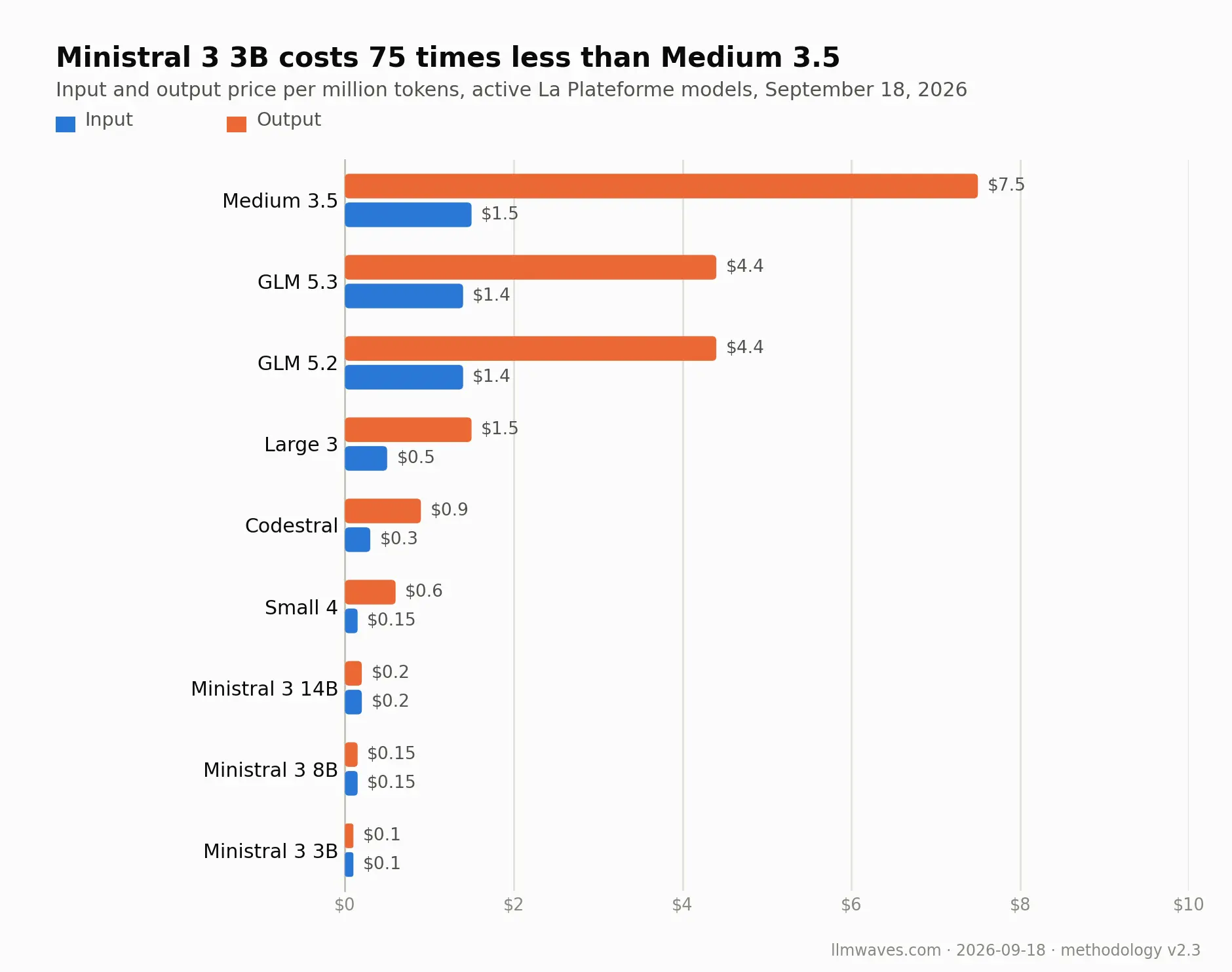
Mistral's La Plateforme prices eight active models as of September 18, 2026, from Ministral 3 3B at $0.10 per million tokens in and out to Medium 3.5 at $1.50 in and $7.50 out.
Five model families, Magistral, Devstral, Pixtral, Mistral NeMo, and Mixtral, sit in Mistral's own deprecated table.
Skip any tracker still pricing them as live.
Model | Vendor | Input $/M | Output $/M | Cached input |
|---|---|---|---|---|
Mistral Medium 3.5 | Mistral | $1.50 | $7.50 | 90% off† |
Z.ai GLM 5.3 | $1.40 | $4.40 | $0.14 (90% off) | |
Z.ai GLM 5.2 | $1.40 | $4.40 | 90% off† | |
Mistral Large 3 | Mistral | $0.50 | $1.50 | 90% off† |
Codestral | Mistral | $0.30 | $0.90 | 90% off† |
Mistral Small 4 | Mistral | $0.15 | $0.60 | 90% off† |
Ministral 3 14B | Mistral | $0.20 | $0.20 | 90% off† |
Ministral 3 8B | Mistral | $0.15 | $0.15 | 90% off† |
Ministral 3 3B | Mistral | $0.10 | $0.10 | 90% off† |
† Mistral states the 90 percent cached-input discount as a blanket rate across its standard models. The model page for GLM 5.3 is the only row where a per-model cached figure, $0.14 per million tokens, could be confirmed directly. Z.ai GLM 5.2 and 5.3 run on Mistral's rate card as third-party models, not Mistral's own architecture.
Nine rows, three price bands. Medium 3.5 leads at $7.50 output, Ministral 3 3B floors the table at $0.10 flat, input and output priced the same.
The two GLM models price between Large 3 and Medium 3.5, despite belonging to Z.ai. Codestral, Mistral's coding-specific model, prices closer to Small 4 than to Large 3, at $0.30 in and $0.90 out.
Measurement Basis 2 governs this article, aggregated entirely from Mistral's own published pages. We collected every rate above from Mistral's own pricing page at https://mistral.ai/pricing, its model overview, and its per-model pages, each retrieved September 18, 2026, in UTC. We ran no benchmark, latency test, or throughput test for this pass. We performed only unit conversion and the per-call and per-page arithmetic shown below, built directly from Mistral's own published rates. Three cross-vendor figures cited later carry their own retrieval dates from earlier sessions, since they fall outside this baseline window. Full methodology, source list, and dataset: https://www.llmwaves.com/methodology
Cost per million tokens sorts Mistral's language models below, while cost per call or per page sorts the tools in a separate section, since a chat model and a document processor do not share a price axis.
Nine rate cards span a 75-times range between Mistral's cheapest and priciest active listing.
What this article did not measure
This article did not run a latency test, a throughput test, or an output-quality benchmark against any model discussed.
Mistral's lineup by use case
Use case | Top pick | Rate ($/M in / out) | Verdict |
|---|---|---|---|
For developers | Mistral Small 4 | $0.15 / $0.60 | Best value |
For startups | Ministral 3 8B | $0.15 / $0.15 | Best value |
For enterprise | Mistral Medium 3.5 | $1.50 / $7.50 | Top pick |
For high volume | Ministral 3 3B | $0.10 / $0.10 | Best value |
For self-hosting | Mistral Small 4 or Ministral 3 | Apache 2.0, Hugging Face | Top pick |
For on-device | Ministral 3 3B | $0.10 / $0.10, downloadable | Top pick |
For low latency | NR | NR | Insufficient data |
For non-English | NR | NR | Insufficient data |
Mistral Small 4 and the Ministral 3 family publish downloadable weights on Hugging Face under an Apache 2.0 license, confirmed against the official mistralai organization page on Hugging Face.
Mistral Large 3 and Medium 3.5 carry no equivalent public weights release found in this pass. Low latency and non-English performance both carry Insufficient data labels, not a rank, since this article ran no benchmark of either. NR marks a cell with no benchmark behind it.
Five model families disappeared from Mistral's active roster
Magistral, Devstral, Pixtral, Mistral NeMo, and Mixtral all sit in a single deprecated table on Mistral's own model overview page at https://docs.mistral.ai/getting-started/models/models_overview, retrieved September 18, 2026, with no shutdown date attached to any of them. The five names still work as search terms. They no longer work as line items on a current rate card.
Mistral's model overview documents Small 4 as covering instruct, reasoning, and coding in one listing, the capability set the retired Magistral and Devstral lines used to split across two separate products.
Vision capability moved into the Ministral 3 family and into Medium 3.5 rather than staying a standalone Pixtral release.
Buyers pricing a project against Magistral, Devstral, Pixtral, or the older Mistral NeMo and Mixtral lines are pricing five products Mistral itself no longer sells as current.
A tracker still quoting those five names as active is describing a page Mistral removed from its own roster, not a live rate.
Mistral's own current-generation model pages, including Mistral Large 3, are indexed at https://www.llmwaves.com/models/mistralai/mistral-large.
Z.ai GLM 5.3 and 5.2 run on Mistral's rate card, not Mistral's models
GLM 5.3 and GLM 5.2 are built by Z.ai, priced at $1.40 input and $4.40 output per million tokens on Mistral's own model pages, and hosted alongside Mistral's first-party lineup as ordinary catalog entries.
Mistral did not build either one. GLM 5.3 carries a 1,000,000-token context window and a 128,000-token output ceiling, both confirmed on Mistral's model page for it, retrieved September 18, 2026.
Mistral's own documentation describes GLM 5.3 as a third-party open source text model from Z.ai, not a Mistral architecture wearing a different name.
Buyers researching "Mistral API pricing" now price a model Mistral did not train.
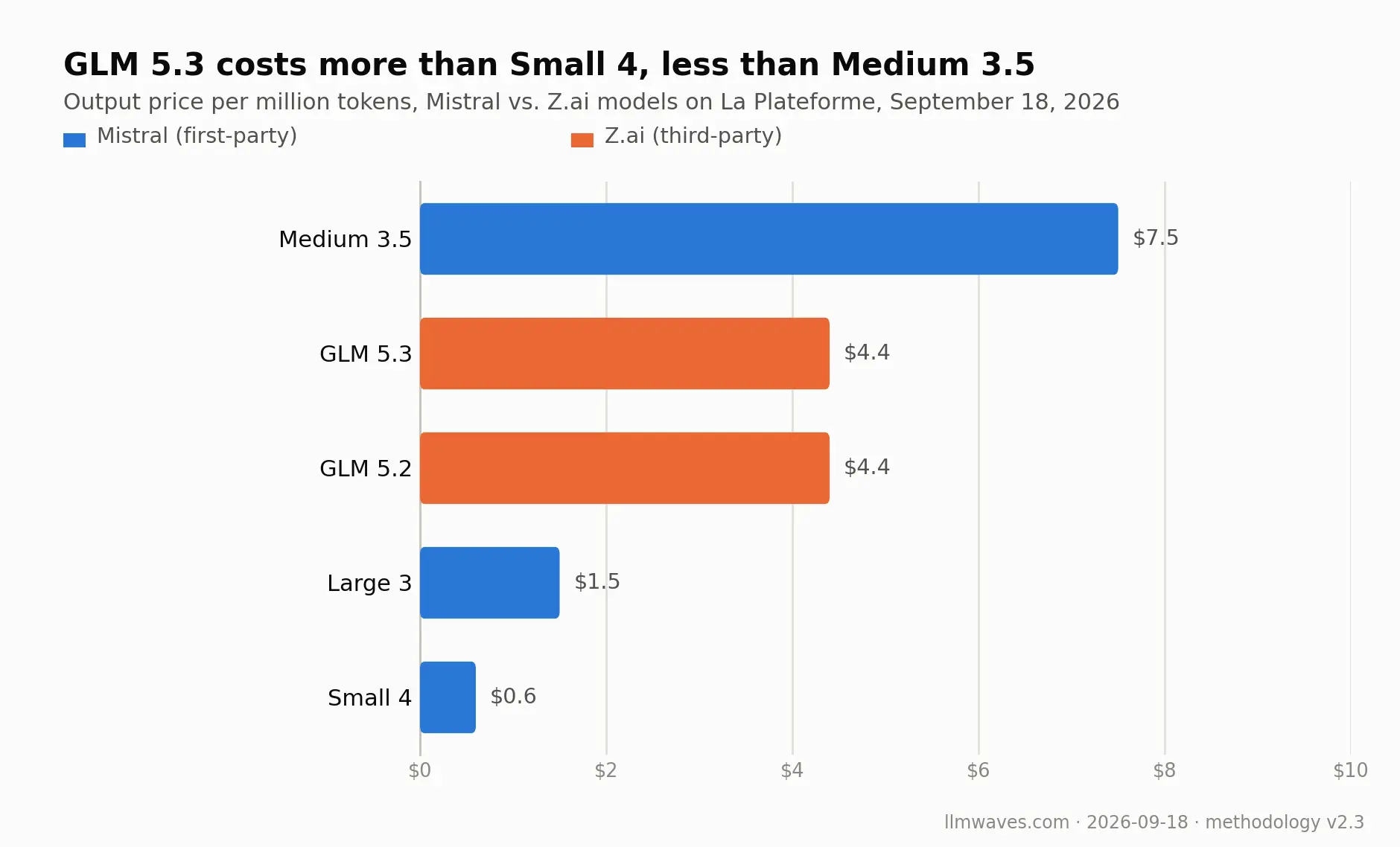
The context window for GLM 5.3 doubles the context window for Mistral Large 3, and the GLM 5.3 rate sits below the Medium 3.5 rate on both input and output, a combination no page ranking for this seed states plainly.
A third-party model now sits inside Mistral's own price ladder, between Large 3 and Medium 3.5.
Four agentic tool calls carry their own separate price
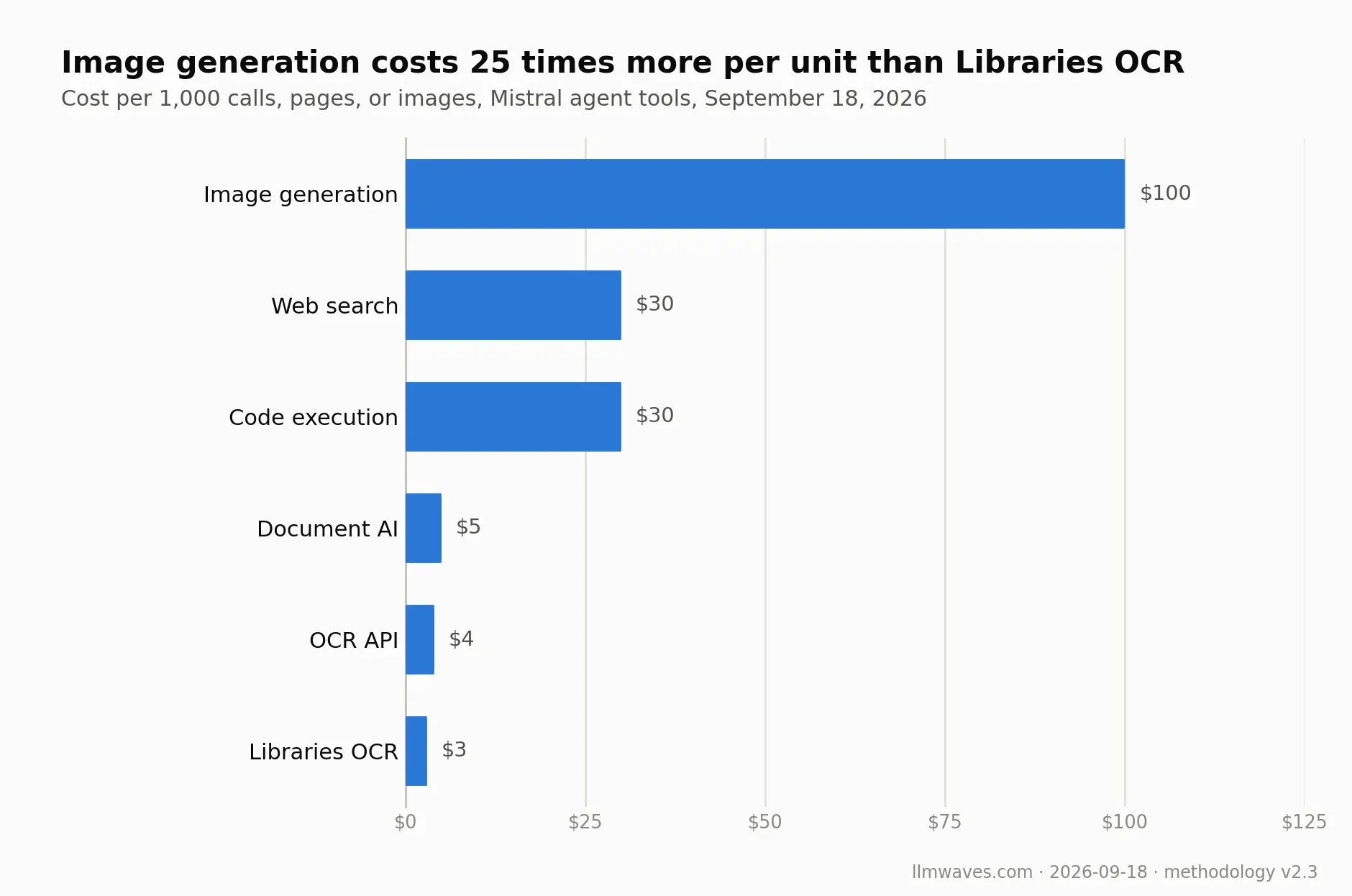
Code execution, web search, image generation, and three separate document rates each meter outside the token prices in the table above.
None of these six charges share a unit with the token prices above, so a workload mixing chat completions with tool calls needs both meters added, not one substituted for the other.
Document tools price by the page, not by the token
OCR API bills $4 per 1,000 pages, Document AI bills $5 per 1,000 pages, and Libraries bills $3 per 1,000 pages for OCR plus $1 per million tokens for indexing, all confirmed on Mistral's own pricing page September 18, 2026. Several pages ranking for this seed still quote a $2 per 1,000 pages OCR rate.
That figure is Mistral's old OCR 3 rate. The current OCR 4.1 rate, the one active on the pricing page today, is double the superseded figure.
Code execution, web search, and image generation are priced by the call
Code execution and web search both bill a flat $30 per 1,000 calls. Image generation bills $100 per 1,000 images, over three times either flat-call rate. Size does not change any of the three.
Four tool calls meter separately from every token price named above.
Mistral Moderation 2 is free, and one rate still circulates for the retired paid version
Mistral Moderation 2, the current moderation model, carries no charge on Mistral's own pricing page, retrieved September 18, 2026. At least one tracker ranking for this seed still lists a $0.10 per million token moderation rate.
That figure belongs to a superseded moderation model, not the current one. A team budgeting moderation calls into a project plan is adding a line item Mistral removed.
Mistral publishes no public rate limit table
OpenAI and xAI both publish a numbered rate limit ladder tied to cumulative spend. Mistral does neither.
Mistral's own rate limit documentation at https://docs.mistral.ai/deployment/laplateforme/tier, retrieved September 18, 2026, states that limits are set at the workspace level and defined by usage tier, then directs every reader to a private console page for the actual numbers.
A buyer cannot compare Mistral's throughput ceiling against a rival vendor's before signing up for a workspace.
Mistral's subscription product also changed names this quarter.
Mistral's own help center confirms Le Chat became Vibe on August 12, 2026, split into Vibe Chat, Vibe Work, and Vibe Code, while the Free, Pro at $14.99 per month, Team at $24.99 per user per month, and Enterprise plans carried over unchanged under the new name.
Mistral's creator profile on this site runs at https://www.llmwaves.com/creators/mistralai.
Four vendors each publish a floor-price model, and Mistral's sits far below the other three.
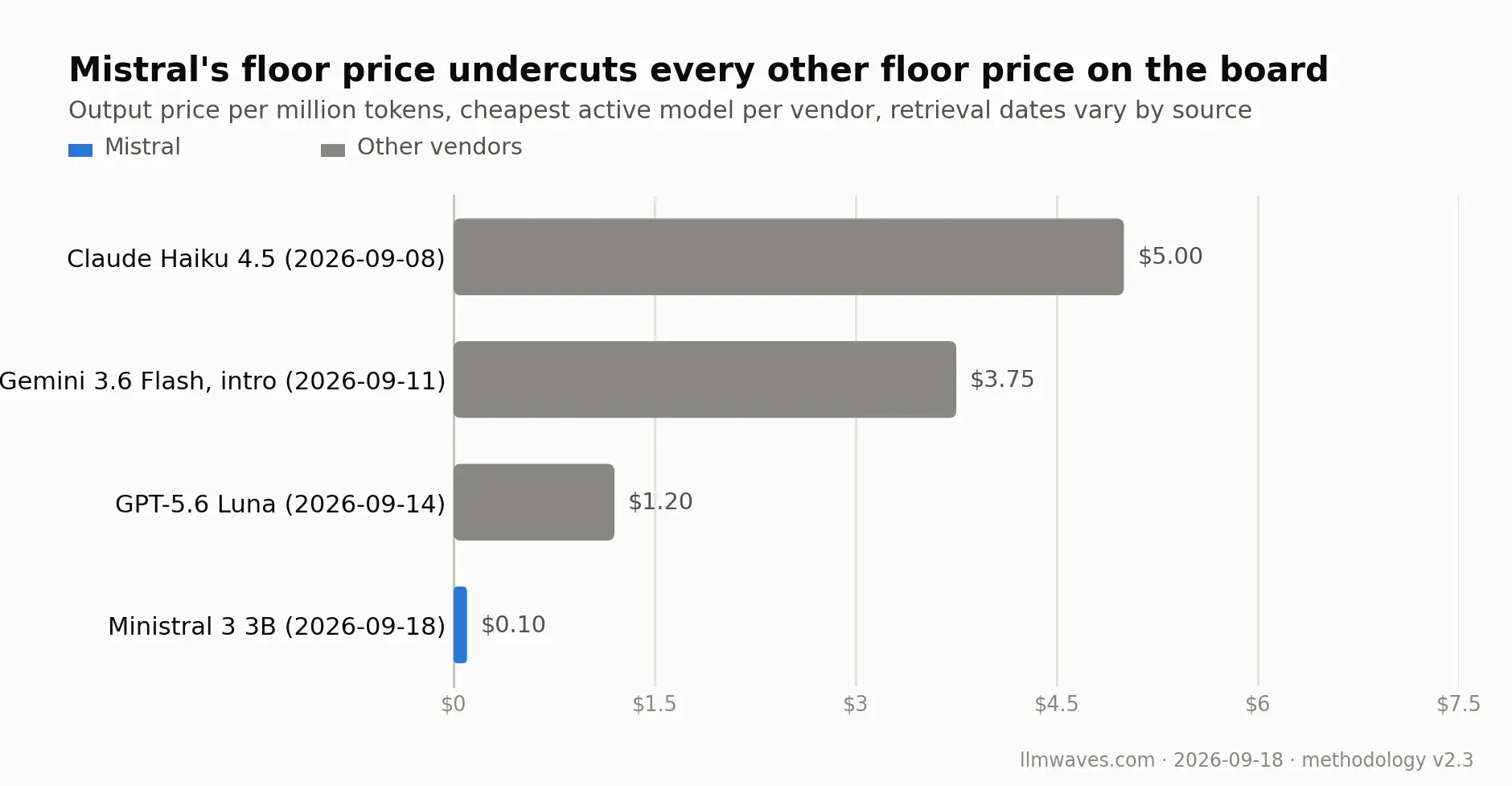
Every price named in this section for Mistral traces to mistral.ai and docs.mistral.ai, retrieved September 18, 2026.
The full cross-vendor picture, including every current OpenAI, Anthropic, and Google tier, runs in a dedicated comparison covering the whole market.
How much does the Mistral API cost per million tokens?
Nine active listings range from $0.10 to $7.50 per million tokens, depending on direction and model. Ministral 3 3B is the cheapest at $0.10 flat for input and output.
Mistral Medium 3.5 is the most expensive listed model, at $1.50 per million input tokens and $7.50 per million output tokens.
Is there a free tier for the Mistral API?
Mistral Moderation 2 runs at no charge. Every language model on the table above bills per token, with no free monthly allowance published on Mistral's pricing page as of September 18, 2026.
Which Mistral model is cheapest right now?
Ministral 3 3B, at $0.10 per million tokens for both input and output, is the cheapest active model on Mistral's own rate card.
Is Mistral cheaper than OpenAI or Claude?
On floor price alone, yes. The Ministral 3 3B output rate of $0.10 sits below the $1.20 rate for GPT-5.6 Luna and far below the $5.00 rate for Claude Haiku 4.5. On flagship price, the comparison flips: the Medium 3.5 output rate of $7.50 sits inside the same band as GPT-5.6 Sol and Claude Sonnet 5, not below them.
The full cross-vendor table lives at https://www.llmwaves.com/blog/llm-api-pricing-compared.
Does Mistral train on API data by default?
Mistral's own Zero Data Retention documentation, retrieved September 18, 2026, lists stateless endpoints, chat completions, embeddings, moderation, classification, OCR, and audio as covered by Zero Data Retention when a workspace enables it.
Agents, Batch files, Conversations, Libraries, and Vibe Work are explicitly excluded from that coverage, since Mistral states these services must store data to function.
A default retention period for workspaces that never enable Zero Data Retention could not be confirmed on any Mistral page checked in this pass.
Full policy: https://docs.mistral.ai/admin/monitor-comply/zero-data-retention
Why do different pages quote three different prices for "Mistral Large"?
Three distinct products share the "Mistral Large" name in search results: Mistral Large 2, priced at $2 input and $6 output in the generation that preceded it; Large 2411, an identically priced snapshot of that same generation; and Mistral Large 3, the current model, at $0.50 input and $1.50 output.
A page dated after the release of Large 3 still quoting $2 and $6 is describing a retired generation at a price four times the current one.
Five names still rank. None of them still bill.
Mistral's own pages, not the trackers ranking for this seed, are the record checked here.
Recheck Mistral's pricing and documentation pages before building a budget on any figure above; Mistral has already moved five model families off its active roster once this year, and workspace-level rate limits mean the number that matters most for a production deployment never appears on a public page at all.