As of October 5, 2026, premium requests, the old count of your Copilot prompts, ended for every plan except annual Pro and Pro+.
AI credits worth $0.01 each replaced them on June 1, 2026.
Annual Pro users get 300 requests, and annual Pro+ users get 1,500, then pay $0.04 for each extra one. If you pay monthly, stop here.
Table 1: Included AI credits by Copilot plan. Data collected 2026-10-05 (UTC).
Plan | Included credits (per month) | Credit value (USD) | Plan price (USD per month) | Credits per USD of plan price |
|---|---|---|---|---|
Copilot Max | 20,000 | 200 | 100 | 200 |
Copilot Pro+ | 7,000 | 70 | 39 | 179 |
Copilot Enterprise (per user) | 3,900 | 39 | 39 | 100 |
Copilot Business (per user) | 1,900 | 19 | 19 | 100 |
Copilot Pro | 1,500 | 15 | 10 | 150 |
Copilot Free | Not published | Not published | 0 | n/a |
Credit value is included credits times $0.01. On Pro, Pro+, and Max, included credits are base credits plus flex credits, and GitHub says flex credits will vary over time. "Not published" means GitHub lists no number. "n/a" means the column does not apply.
A prompt is one message you send to Copilot, and GitHub used to count each one as a premium request.
Copilot Max includes 20,000 credits, worth $200, for $100 a month.
Copilot Pro+ includes 7,000 credits, worth $70, for $39 a month, and Copilot Pro includes 1,500, worth $15, for $10.
Where these numbers come from
Every price here comes from GitHub's documentation and announcements, collected on October 5, 2026 (UTC), and its page on what changed with billing sets the June 1, 2026 date.
LLM Waves Research did not run these plans, so the work here is collecting the figures and showing the math, and our methodology page lists every source.
Plans below are ordered first by included credits and second by the price of extra use.
Every individual plan includes more credits than it costs, and part of that extra amount can change.
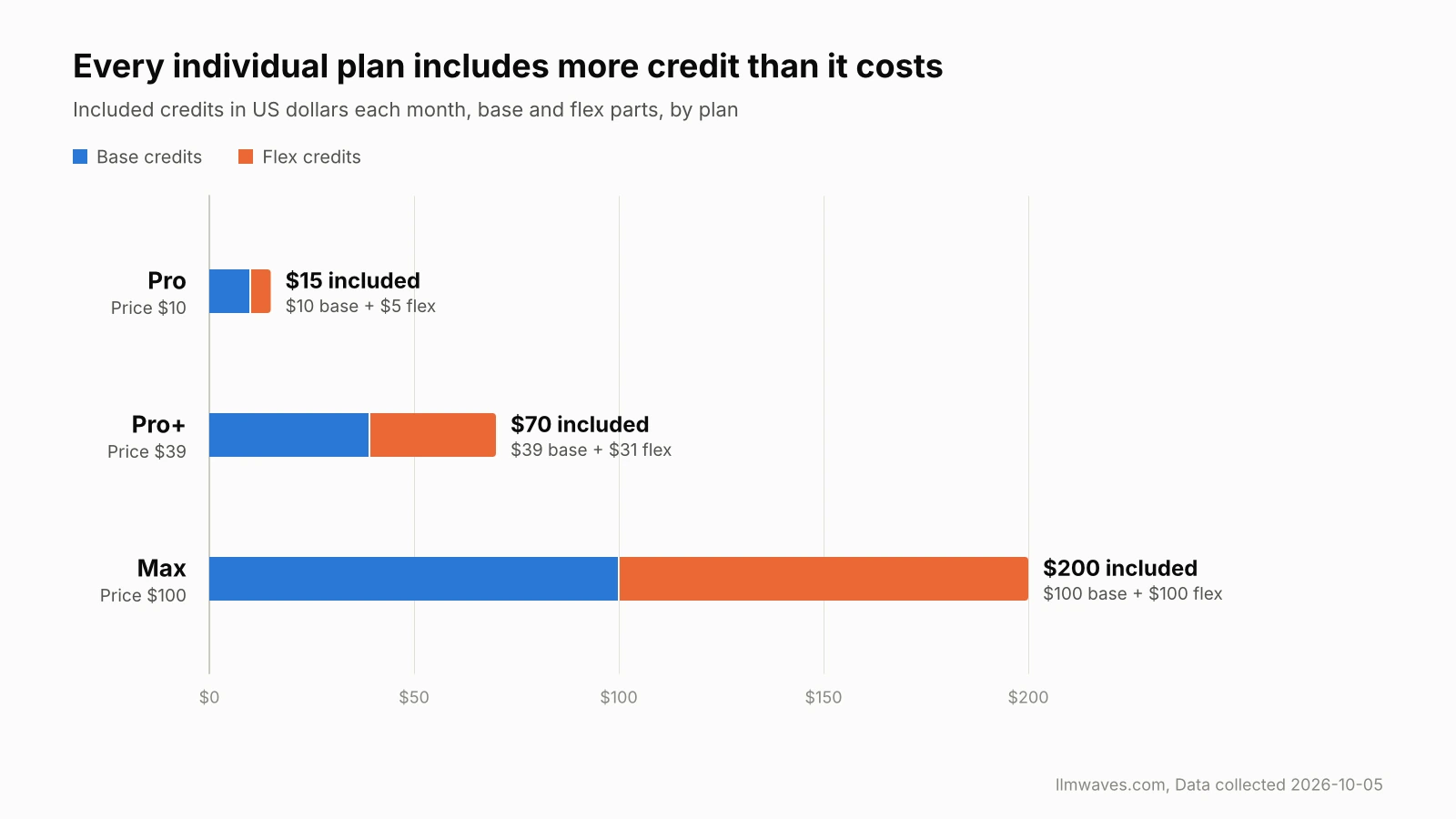
Base credits equal the plan price: $10, $39 and $100.
Flex credits add $5, $31 and $100, and GitHub's billing page for individuals calls that part variable.
Which billing system applies to you
A billing system is the rule that sets what one prompt costs you.
Monthly Pro, Pro+ and Max users
Situational: Pro+ is the first individual plan that includes Claude Opus 5.5. Premium requests do not apply to you, and credits do: 1,500 on Pro, 7,000 on Pro+, and 20,000 on Max.
GitHub's September 22, 2026 announcement lists Pro+, Max, Business, and Enterprise for Claude Opus 5.5, so Pro cannot use it.
If you pay for Pro and want that model, this pick fails.
Our model leaderboards rank models on published scores and on cost per task.
Annual Pro and Pro+ users
Situational: keep counting requests only if you mostly use models with a multiplier below 1.
Your plan counts premium requests, and each model has a multiplier, the number of requests one prompt costs.
On Pro, 300 requests cover 909 prompts on GPT-5 mini (multiplier 0.33) but only five on GPT-5.5 (multiplier 57). If you use GPT-5.5, this pick fails.
Business and Enterprise admins
Situational: choose by credits per user, because both plans include 100 credits for each dollar of plan price.
Business includes 1,900 credits and Enterprise includes 3,900. Extra usage is on by default, so switch it off first if you cannot accept an extra bill.
Free and Student users
Insufficient data: GitHub publishes no credit amount for Copilot Free. GitHub's individual plans page lists up to 2,000 code completions, limited chat and agent use, and auto model selection only, where Copilot picks the model for each prompt.
Copilot Student has unlimited code completions and the same auto model selection.
Annual plans keep premium requests, and the model sets the cost
A premium request is one prompt to Copilot, counted by the multiplier of the model you pick. GitHub's multiplier table for annual plans lists 16 models.
Claude Sonnet 4.6 has a multiplier of 9, Claude Opus 4.8 has 27, and GPT-5.5 has 57, while GPT-5 mini, GPT-4o, and Claude Haiku 4.5 each have 0.33.
To find your prompts, divide the included requests by the multiplier.
On Pro+, 1,500 divided by 57 is 26.3, so GPT-5.5 covers 26 whole prompts. One extra prompt costs 57 times $0.04, which is $2.28.
Table 2: Prompts covered by included requests on annual plans, rounded down, and the cost of one extra prompt. Data collected 2026-10-05 (UTC).
Model | Multiplier | Prompts on annual Pro (300 requests) | Prompts on annual Pro+ (1,500 requests) | One extra prompt (USD) |
|---|---|---|---|---|
GPT-5.5 | 57 | 5 | 26 | 2.280 |
Claude Opus 4.8 | 27 | 11 | 55 | 1.080 |
Claude Sonnet 4.6 | 9 | 33 | 166 | 0.360 |
GPT-5 mini | 0.33 | 909 | 4,545 | 0.013 |
GPT-5.5 covers 26 prompts on Pro+ and five on Pro. Claude Opus 4.8 covers 55 and 11. GPT-5 mini covers 4,545 and 909.
The same 1,500 requests stretch a long way on a small model and not far on a large one.
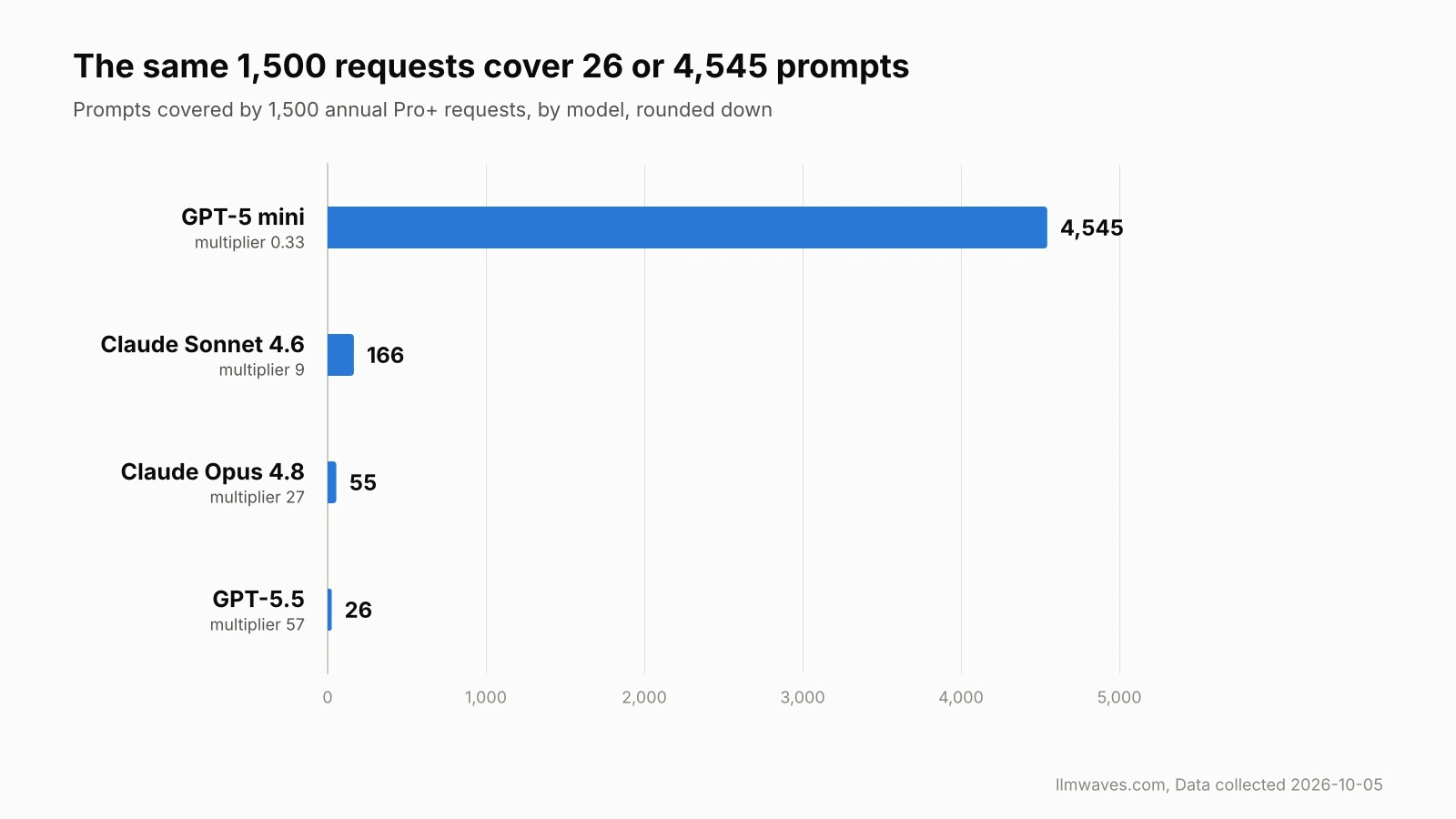
Pro+ has five times the requests of Pro. GPT-5.5 costs 172.7 times more per prompt than GPT-5 mini, which is 57 divided by 0.33.
The model you pick matters more than the plan you pay for.
An annual plan renews into Copilot Free unless you act first
An annual plan is a Copilot plan you paid for as one whole year. GitHub's documentation states that when your annual plan ends, you are automatically downgraded to Copilot Free.
You have three options. You can stay on the plan until it ends.
You can cancel for a prorated refund, which is money back for the time you did not use, and subscribe to the monthly plan if you want.
You can also move to a monthly paid plan and get prorated credit for the rest of the year.
The page is silent on whether annual plans receive new models. It says only that your plan keeps counting requests with multipliers until it ends.
No plan falls back to a cheaper model when credits run out
The limit is the point where your included credits reach zero. GitHub's April 27, 2026 announcement states that "Fallback experiences will no longer be available." When credits run out, you can upgrade, pay for more usage, or wait for the reset on the first day of the month at 00:00:00 UTC.
Under an upgrade, GitHub states in its June 17, 2026 announcement that you get the new plan's total included usage minus what you already used.
If you used all 1,500 credits on Pro and move to Pro+, you have 7,000 minus 1,500, which leaves 5,500.
Extra usage may be capped, so you must pay off any extra usage you already used to keep working.
To see your credits, open github.com/settings/billing and choose the AI usage page, which lists the credits each model used.
One example prompt costs from 0.65 to 11 credits, depending on the model
A token is a small piece of text that a model reads or writes. Input tokens are what you send, and output tokens are what the model writes back. GitHub's pricing table bills each model at a list price per million tokens, and one credit is $0.01.
Take one example prompt with 10,000 input tokens and 2,000 output tokens.
On Claude Sonnet 5.5, input costs $2 per million tokens. Ten thousand tokens is 0.01 million, so input costs $0.02. Output costs $10 per million, and 2,000 tokens is 0.002 million, so output costs $0.02. The total is $0.04, which is four credits.
Table 3: Credits for one example prompt of 10,000 input and 2,000 output tokens. GPT-5.5 is the default tier, up to 272K input tokens. Data collected 2026-10-05 (UTC).
Model | Input price (USD per 1M tokens) | Output price (USD per 1M tokens) | Credits for the example prompt |
|---|---|---|---|
GPT-5.5 | 5.00 | 30.00 | 11 |
Claude Opus 5.5 | 4.00 | 20.00 | 8 |
Claude Sonnet 5.5 | 2.00 | 10.00 | 4 |
GPT-5 mini | 0.25 | 2.00 | 0.65 |
GPT-5.5 uses 11 credits for the example prompt, Claude Opus 5.5 uses eight, and GPT-5 mini uses 0.65.
Cached input costs less, so a real prompt can use fewer credits than the table shows.
The example prompt costs 16.9 times more on GPT-5.5 than on GPT-5 mini, which is 11 divided by 0.65.
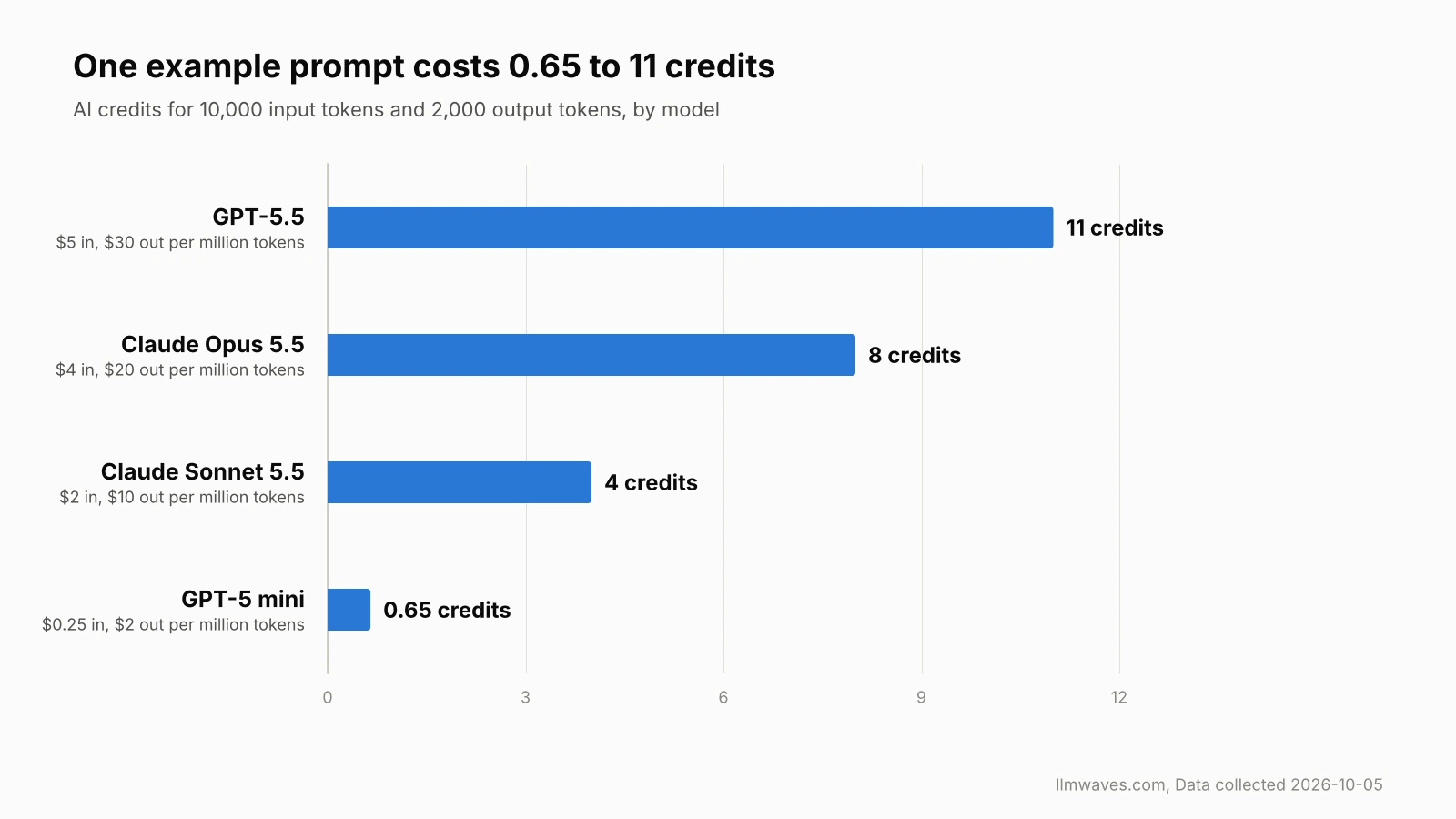
Pro's 1,500 credits cover 375 Claude Sonnet 5.5 prompts of this size (1,500 divided by four), and a paid plan gets 10% off model costs with auto model selection.
GitHub lists Gemini 3.7 Flash and Gemini 3.8 Flash at $0.75 input and $3.75 output through December 31, 2026.
GitHub bills at list prices, and our LLM API pricing comparison covers 15 models.
Earlier Claude Opus 5 and Claude Sonnet 5 prices are in our Claude API pricing guide.
Business and Enterprise users lost their promotional credits after September 1, 2026
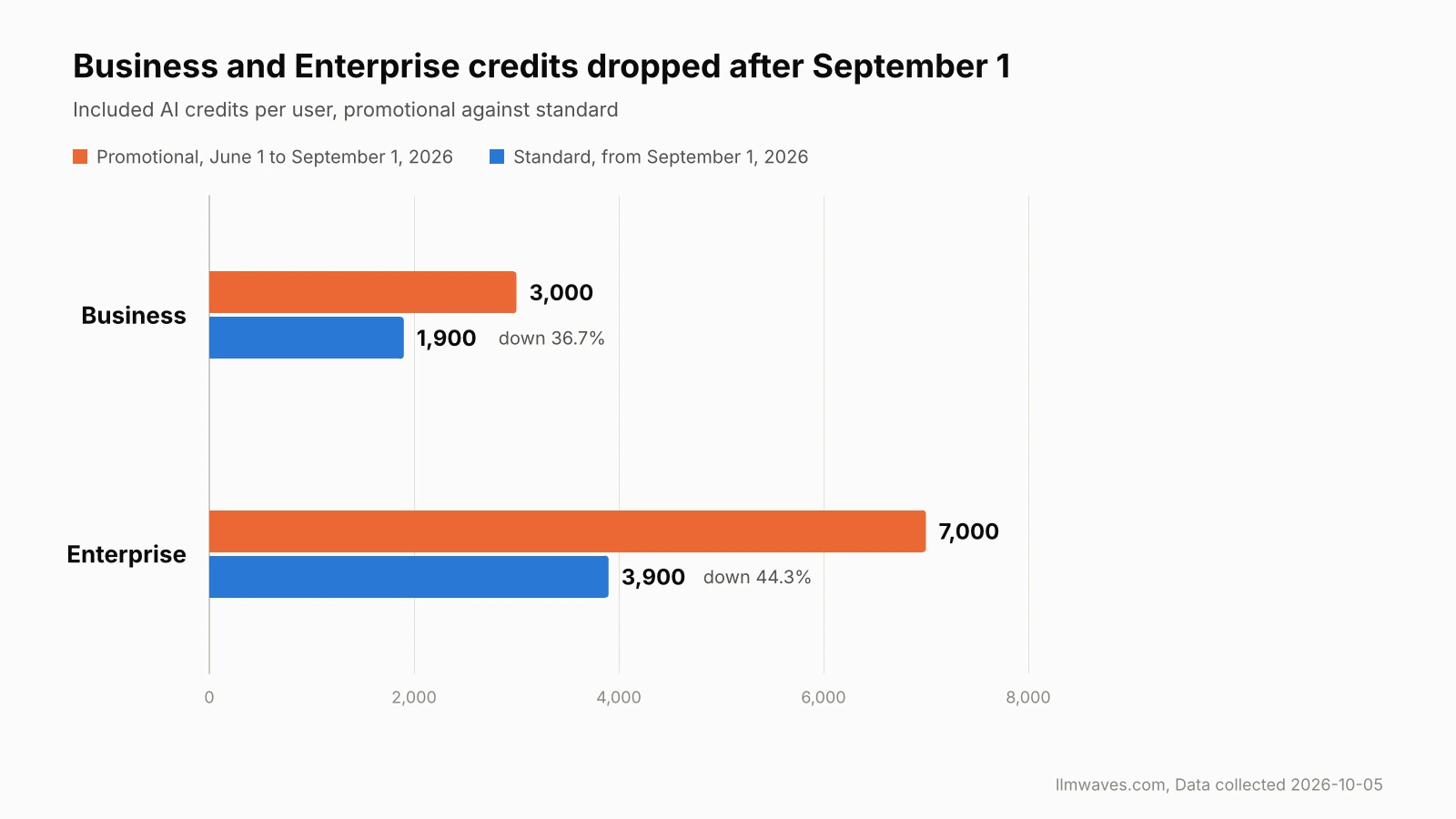
A pool is one shared bucket of credits for a whole company. GitHub's page for organizations says an enterprise with 100 Business users gets a pool of 190,000 credits, which is 100 times 1,900, or $1,900 at $0.01 each.
Existing customers got more from June 1 to September 1, 2026: 3,000 credits per Business user and 7,000 per Enterprise user.
After September 1, 2026, the amounts went back to 1,900 and 3,900.
For Business, 3,000 minus 1,900 is 1,100, and 1,100 divided by 3,000 is 36.7%.
For Enterprise, 7,000 minus 3,900 is 3,100, and 3,100 divided by 7,000 is 44.3%.
Extra usage is on by default, and an admin must turn off the AI credits paid usage policy to stop extra charges. A $0 budget blocks a user at once.
What we did not measure
We did not measure how many credits a real Copilot session uses.
GitHub publishes prices per token, not credits per prompt, so the 0.65 to 11 credit range comes from one made up prompt size.
We did not test answer quality or speed on any model. We did not confirm the credit amount for Copilot Free, because GitHub does not publish it.
Does GitHub Copilot still use premium requests?
Only on annual Pro and Pro+ plans. Every other plan has used AI credits since June 1, 2026. If you pay monthly, the numbers 300 and 1,500 do not apply to you.
What is considered a premium request in GitHub Copilot?
On an annual plan, a premium request is one prompt multiplied by the multiplier of the model. GitHub lists chat with premium models, large context windows, the cloud agent, and Spark app creation as uses.
One cloud agent session uses one request, and one code review uses 13.
How much does GitHub Copilot Premium cost?
GitHub's plans page lists no plan named Premium, so the price depends on the plan. Pro costs $10 a month, Pro+ costs $39, and Max costs $100.
Business costs $19 per user per month, and Enterprise costs $39. Pro+ adds access to premium models.
Is GitHub Copilot 100% free?
No. Copilot Free costs nothing and includes up to 2,000 code completions with auto model selection only. Verified students get Copilot Student for free.
GitHub says verified teachers and maintainers of popular open source projects may be eligible for free Copilot Pro.
When do Copilot premium requests and credits reset?
Both reset on the first day of each calendar month. GitHub lists 00:00:00 UTC for annual plan requests, and unused requests do not carry over.
Credits on monthly plans reset at the same time, and unused credits are lost.
Your own billing page holds the number that counts
GitHub publishes prices per token, and your bill depends on what you send.
The AI usage page on your account shows the credits you used, by model.
Trust that page over any table here, including ours.