Qwen3.7-Flash costs the least of 10 models priced from vendor pages on November 16, 2026. 1,000 requests of 2,000 input and 500 output tokens cost $0.125.
Ministral 3 3B follows at $0.250. If your prompts stay under 32,000 tokens and price is all you need.
The table ranks paid models from the lowest cost for 1,000 requests to the highest.
Table 1: Cost for 1,000 requests of 2,000 input and 500 output tokens, paid rows only, lowest cost first. Qwen3.7-Flash and Qwen3.8-Flash use the Singapore tables, and Gemini rows use text input rates. Bold marks the lowest cost.
Model | Input ($/1M tokens) | Output ($/1M tokens) | Cost for 1,000 requests ($) | Price step listed |
|---|---|---|---|---|
Qwen3.7-Flash (lowest cost) | 0.03 | 0.13 | 0.125 | Rises above 32,000 tokens |
Ministral 3 3B | 0.10 | 0.10 | 0.250 | None |
GLM-4.7-FlashX | 0.07 | 0.40 | 0.340 | None |
Gemini 2.5 Flash-Lite | 0.10 | 0.40 | 0.400 | None |
GPT-6 Luna (tied) | 0.10 | 0.50 | 0.450 | Rises above 272,000 tokens |
Claude Haiku 5.5 (tied) | 0.10 | 0.50 | 0.450 | Rises above 100,000 tokens |
Qwen3.8-Flash | 0.15 | 0.47 | 0.535 | None |
DeepSeek-V4.1-Flash-1017, off peak | 0.15 | 0.60 | 0.600 | Peak hours double the rates |
DeepSeek-V4.1-Flash-1017, peak | 0.30 | 1.20 | 1.200 | Off peak hours halve the rates |
Gemini 3.1 Flash-Lite | 0.25 | 1.50 | 1.250 | None |
Gemini 3.5 Flash-Lite | 0.30 | 2.50 | 1.850 | None |
The Alibaba Cloud Singapore table lists Qwen3.7-Flash at $0.03 for input and $0.13 for output, per 1 million tokens.
For 1,000 requests, that is $0.125. Ministral 3 3B costs $0.250, which is $0.125 more.
GPT-6 Luna and Claude Haiku 5.5 tie at $0.450 until a prompt passes 100,000 tokens.
The price of Qwen3.7-Flash steps up above 32,000 tokens.
How the figures were collected
Every rate comes from the vendor price page named in the sentence that uses it, read on November 16, 2026. LLM Waves Research collected these figures and did not run the models.
The methodology page covers how this site handles list prices, and the raw data file at the end lists each source page and read date.
Paid models are ranked by cost for 1,000 requests, then by the prompt size at which the price changes.
The 11 rows span $0.125 to $1.850.
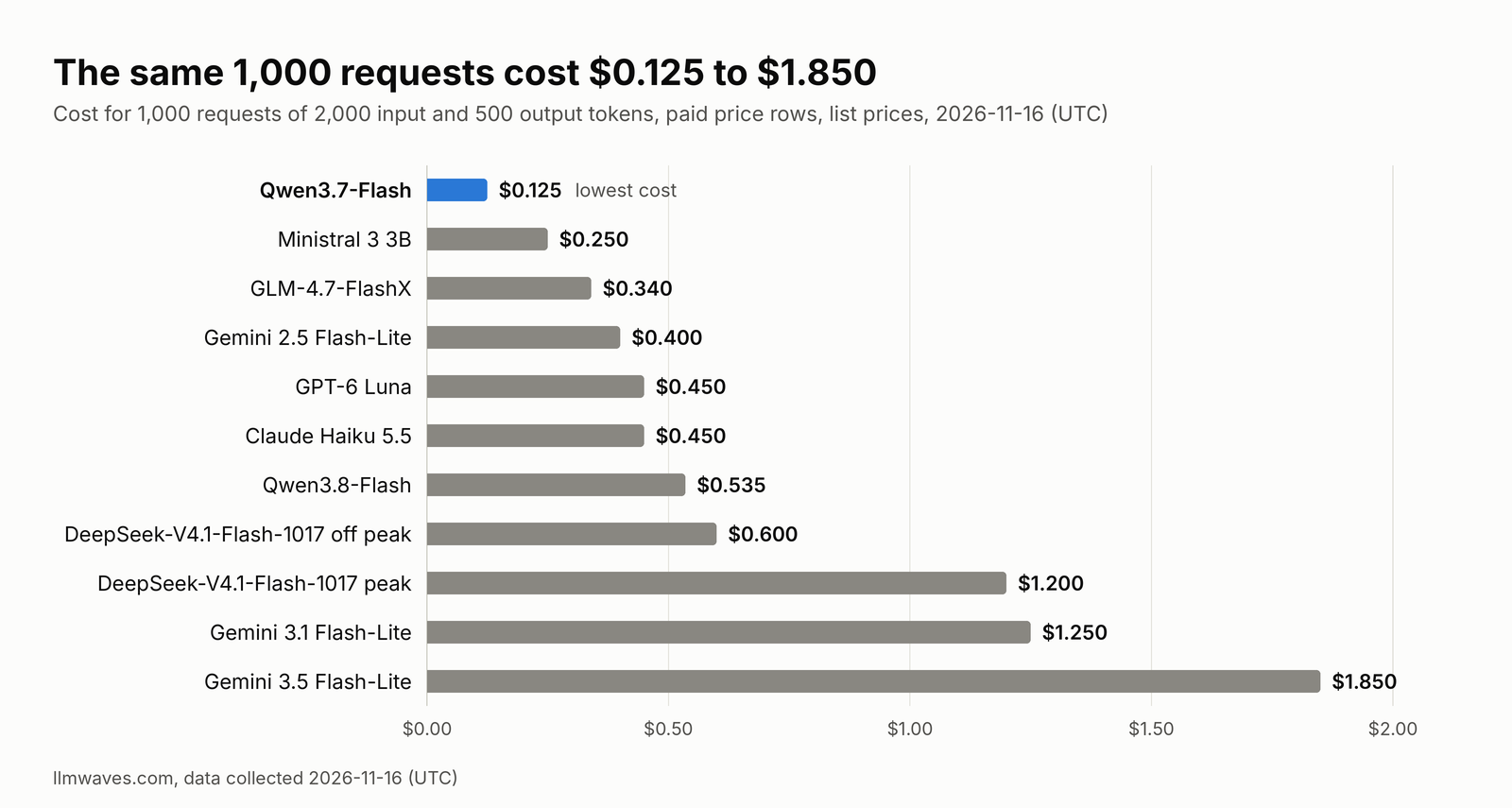
The highest row costs $1.725 more than the lowest row for the same 1,000 requests.
What we did not measure
This article did not run a latency test, a throughput test, or an output-quality benchmark against any model discussed.
Prices from gateways and resellers are not in the table. The Cheapest per task board lists Ling 3.1 Flash at $0.02 and MiMo-V2.6-Flash at $0.03. Neither model was priced on a vendor page for this article.
Only the two Alibaba Cloud pages show an update date: November 13 and November 5, 2026. Pages from Anthropic, OpenAI, Google, DeepSeek, Mistral, and Z.ai show none. For those rates, November 16, 2026 is the only date.
Qwen3.7-Flash has the lowest rate, and its page lists two higher rates for longer prompts
Price bands
Alibaba Cloud lists Qwen3.7-Flash at $0.03 for input and $0.13 for output for prompts up to 32,000 tokens. The next band covers prompts up to 256,000 tokens at $0.10 and $0.40. The top band covers prompts up to 1 million tokens at $0.20 and $0.80.
The page lists the band limits as 32k and 256k, with no exact token counts. It does not say whether a band price covers the whole request or only the tokens inside the band.
Cost at 20,000 and 50,000 tokens
The figures below use the higher reading, where the band price covers the whole request.
Each request carries 500 output tokens.
At 20,000 input tokens, Qwen3.7-Flash costs $0.665 for 1,000 requests.
At 50,000 input tokens, the band price is $0.10 and $0.40, and 1,000 requests cost $5.200.
The Mistral price page lists Ministral 3 3B at $0.10 for input and $0.10 for output. At 50,000 input tokens, 1,000 requests cost $5.050. That is $0.150 less than the $5.200 for Qwen3.7-Flash on the higher reading.
On the lower reading, only the tokens above 32,000 take the higher band price, and Qwen3.7-Flash stays below Ministral 3 3B at 50,000 tokens.
The page leaves the reading open.
Two of four rows swap places between 20,000 and 50,000 input tokens on the higher reading.
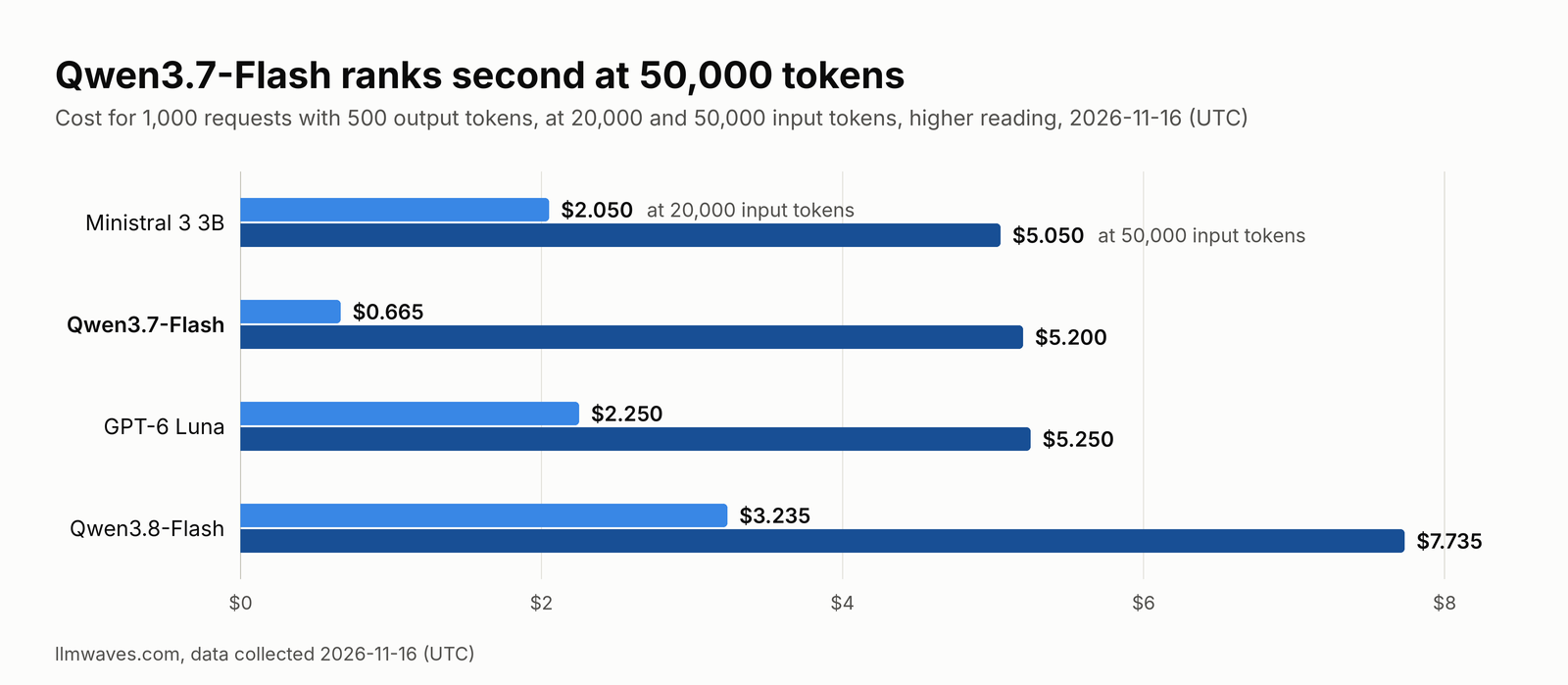
At 50,000 input tokens, Qwen3.7-Flash costs $5.200. That is $0.150 more than Ministral 3 3B and $0.050 less than GPT-6 Luna.
The Alibaba Cloud page lists Qwen3.8-Flash at one rate for every prompt length: $0.15 for input and $0.47 for output.
The page shows an update date of November 5, 2026.
Claude Haiku 5.5 and GPT-6 Luna tie at $0.10 and $0.50 until a prompt passes 100,000 tokens
Claude Haiku 5.5 above 100,000 tokens
The Anthropic pricing page lists Claude Haiku 5.5 at $0.10 for input and $0.50 for output. Those rates hold up to 100,000 prompt tokens.
Above that, the page lists $0.50 and $2.50 for the whole request. Cache reads count toward the 100,000.
At 100,000 input tokens and 2,000 output tokens, one request costs $0.011.
At 120,000 input tokens, the rates jump to $0.50 and $2.50. One request then costs $0.065.
GPT-6 Luna above 272,000 tokens
The OpenAI page lists GPT-6 Luna at the same $0.10 for input and $0.50 for output. Above 272,000 input tokens, the page sets a multiplier of 2 on input and 1.5 on output for the full request, which gives $0.20 and $0.75.
At 120,000 input tokens, GPT-6 Luna stays at $0.10 and $0.50. One request costs $0.013.
The gap between the two models at 120,000 input tokens is $0.052 for each request.
Five prompt sizes show where the two prices separate.
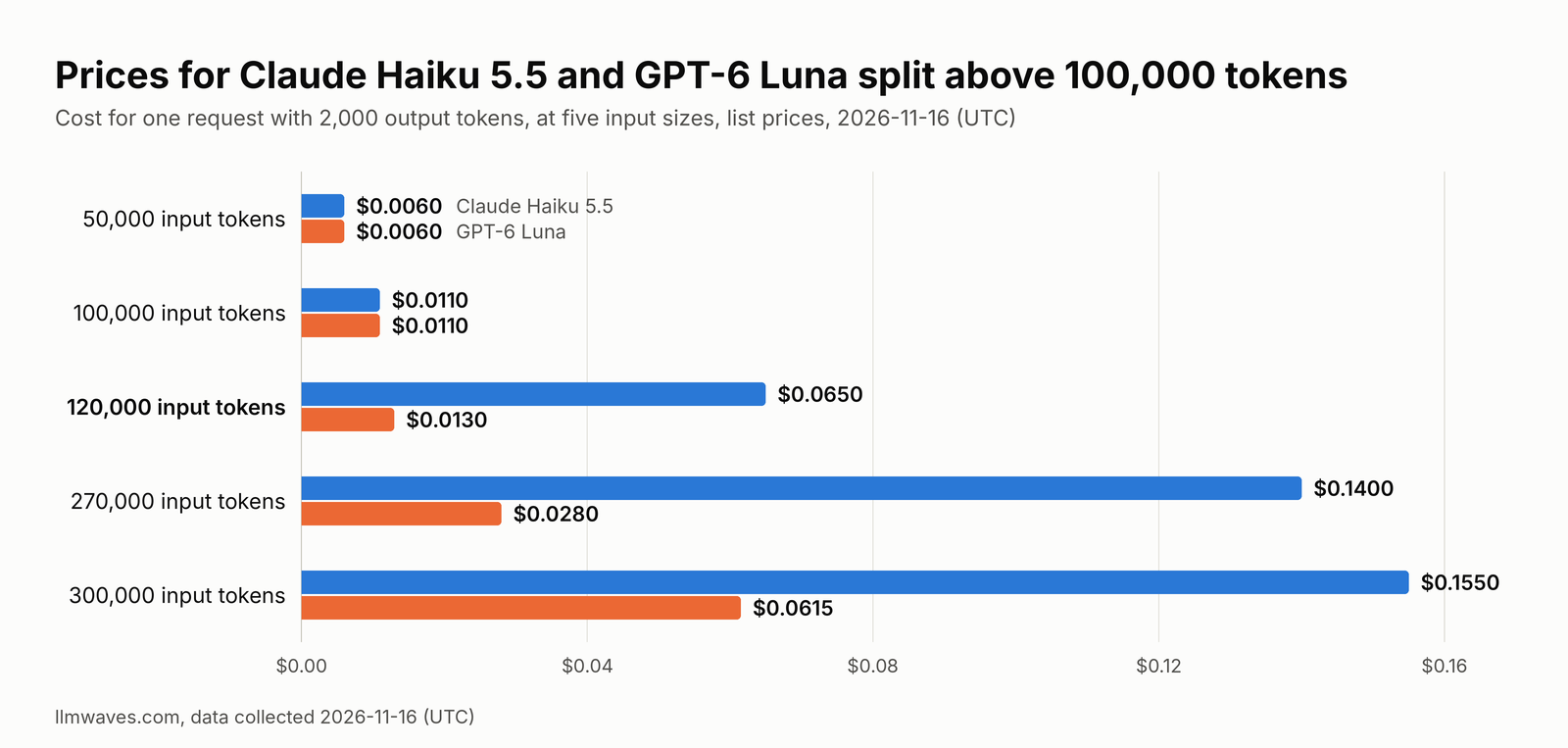
At 120,000 input tokens, one request costs $0.065 on Claude Haiku 5.5 and $0.013 on GPT-6 Luna.
Above 100,000 tokens, GPT-6 Luna costs less at every prompt size listed on the two pages.
DeepSeek-V4.1-Flash-1017 costs half as much outside its 35 peak hours a week
Peak and off-peak rates
The DeepSeek pricing page lists DeepSeek-V4.1-Flash-1017 at $0.15 for input and $0.60 for output off-peak. Peak rates are $0.30 and $1.20.
Peak hours run 01:00 to 04:00 and 06:00 to 10:00 UTC, Monday through Friday, except Chinese public holidays. Peak runs 3 hours from 01:00 and 4 hours from 06:00, which is 7 hours a day.
Over 5 weekdays, that is 35 hours of the 168 hours in a week.
Cost for 1,000 requests
Take 1,000 requests of 2,000 input and 500 output tokens.
Off peak, they cost $0.600. At peak, they cost $1.200.
Spread evenly over a week, 133 hours bill off-peak and 35 hours bill at peak, so 1,000 requests cost $0.725 in total.
Three traffic patterns give three bills for the same 1,000 requests.
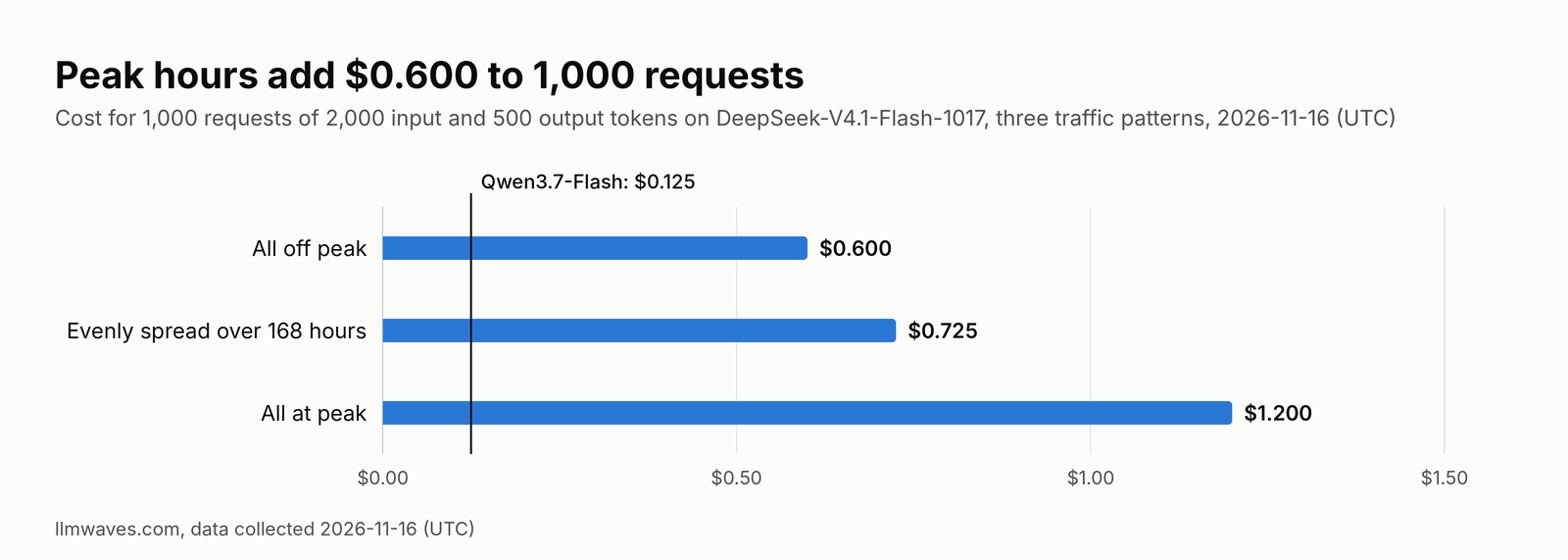
Peak traffic costs $0.600 more than off-peak traffic for 1,000 requests. Even off-peak, the bill sits $0.475 above Qwen3.7-Flash.
A cache hit costs $0.003 for input off-peak and $0.006 at peak.
Requests to the retired names deepseek-v4-flash and deepseek-v4-flash-vision-exp are served by DeepSeek-V4.1-Flash-1017 at its price.
Batch halves GPT-6 Luna and Gemini 2.5 Flash-Lite, and both still cost more than Qwen3.7-Flash
The GPT-6 Luna page lists batch and flex at 50% of the standard rates. That puts GPT-6 Luna batch at $0.05 for input and $0.25 for output.
The Google pricing page lists batch for Gemini 2.5 Flash-Lite at $0.05 for input and $0.20 for output, half of the standard $0.10 and $0.40.
With batch, 1,000 requests of 2,000 input and 500 output tokens cost $0.225 on GPT-6 Luna.
On Gemini 2.5 Flash-Lite, the same 1,000 requests cost $0.200 with batch.
Qwen3.7-Flash costs $0.125 at the standard rate. Alibaba Cloud lists Qwen3.7-Flash batch prices only in its China (Beijing) tables.
Batch pricing lowers two rows without changing the lead.
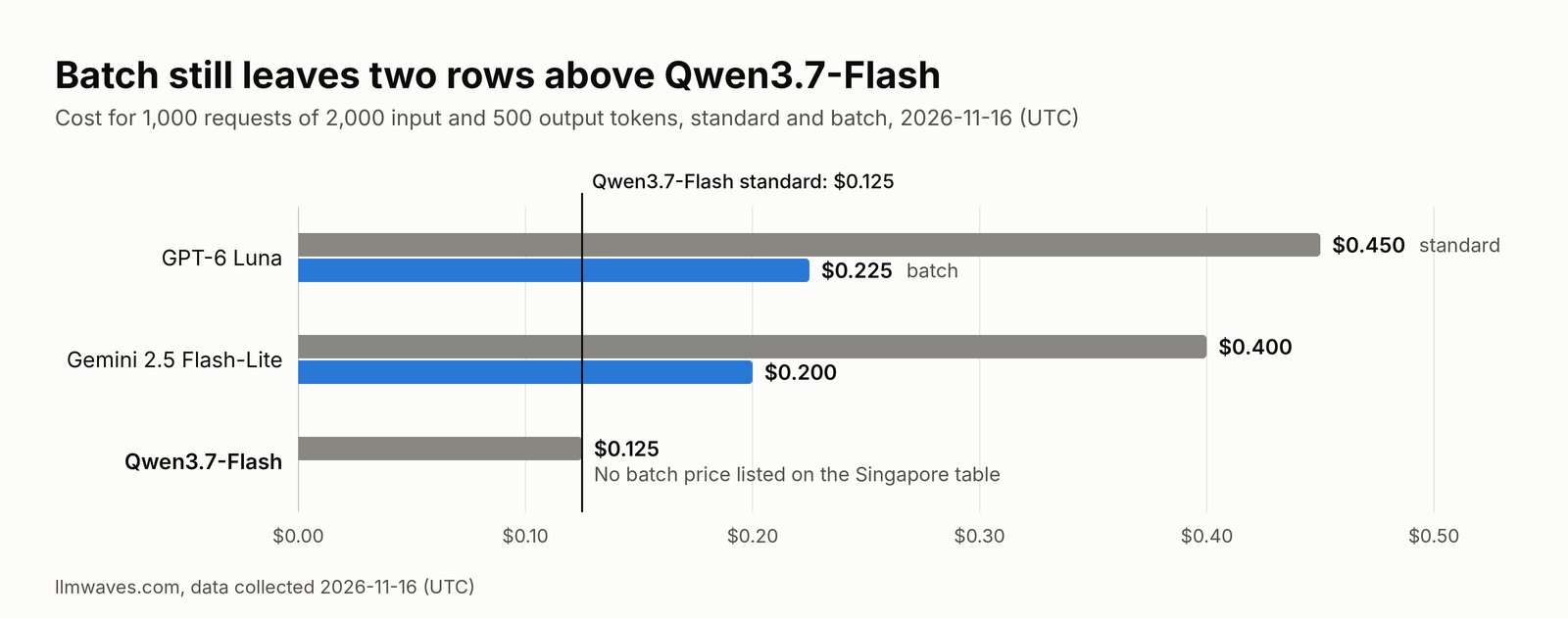
Batch leaves GPT-6 Luna $0.100 above Qwen3.7-Flash and Gemini 2.5 Flash-Lite $0.075 above it.
GLM-4.7-Flash and GLM-4.5-Flash are listed at $0, and three Gemini rows are listed as free plans
The Z.ai page lists GLM-4.7-Flash and GLM-4.5-Flash as free for input, cached input, and output. The page states no rate limit and no concurrency cap for either row.
The cheapest paid text row on that page is GLM-4.7-FlashX at $0.07 for input and $0.40 for output. For 1,000 requests, that is $0.340.
Google lists a free plan for Gemini 2.5 Flash-Lite, Gemini 3.1 Flash-Lite and Gemini 3.5 Flash-Lite. Free plan limits and data terms were not read for this article.
Free rows are not ranked, so Table 1 leaves them out.
Claude plans include monthly API credit, and $100 covers 222,222 requests on Claude Haiku 5.5
The Claude Platform page lists a monthly API credit of $100 for Max and $200 for Ultra. Team plans get $20 for each Standard seat and $100 for each Premium seat, pooled and capped at $500.
The credit covers the Claude API, Claude Managed Agents, the Claude Agent SDK, and the Playground in the Claude Console.
It does not cover Claude Code, extra usage in the Claude apps, or Claude Platform on AWS, Bedrock, Google Cloud, and Microsoft Foundry.
Unused credit expires at the end of each billing cycle. A new subscriber can claim it after 7 days on an eligible plan. The page names no model limit.
Claude Haiku 5.5 costs $0.450 for 1,000 requests of 2,000 input and 500 output tokens.
A $100 credit covers 222,222 requests.
GPT-6 Luna and Claude Haiku 5.5 add 10% when the data location is fixed
The GPT-6 Luna page lists a 10% premium for regional processing where available. The Anthropic page lists a multiplier of 1.1 on all token prices for US-only inference on Claude 4.6 and later models.
That covers the higher prices above 100,000 tokens on Claude Haiku 5.5.
At the base price, 1,000 requests cost $0.450 on each model. With the 10% premium, they cost $0.495.
Alibaba Cloud lists Qwen3.8-Flash at $0.113 for input and $0.382 for output on its Global scope rows for US (Virginia) and Germany (Frankfurt).
Its US scope and EU scope rows list $0.15 and $0.47. For 1,000 requests, the Global rows cost $0.417. The other rows cost $0.535.
Qwen3.7-Flash lists $0.028 and $0.11 on its Global scope rows for prompts up to 32,000 tokens. For 1,000 requests, that costs $0.111, which is $0.014 less than the Singapore figure.
Verdicts by workload
High volume, prompts under 32,000 tokens. Best value: Qwen3.7-Flash at $0.125 for 1,000 requests. If your prompts reach 50,000 tokens, this pick is wrong for you on the higher end. Ministral 3 3B costs $5.050 for 1,000 requests there, which is $0.150 less.
Long prompts above 100,000 tokens. Best value: GPT-6 Luna at $0.013 for one request of 120,000 input and 2,000 output tokens, against $0.065 on Claude Haiku 5.5. If your prompts stay under 100,000 tokens, this pick adds nothing.
Both models cost $0.011 for one request at 100,000 input and 2,000 output tokens.
One steady bill with no price step. Situational: Ministral 3 3B at $0.250, Gemini 2.5 Flash-Lite at $0.400, and Qwen3.8-Flash at $0.535 list no price step. If your jobs cannot use batch, ignore the $0.200 batch figure for Gemini 2.5 Flash-Lite and plan on $0.400.
A Claude Max or Team plan. Situational: Claude Haiku 5.5 on the monthly credit, which covers 222,222 requests of the 2,000 and 500 workload for $100. If you need credit to carry over, this pick is wrong for you. Unused credit expires each billing cycle.
Hobby and testing. Situational: GLM-4.7-Flash and GLM-4.5-Flash at $0. If you need a stated usage limit, this pick is wrong for you. The Z.ai page states none.
Quality first. Insufficient data: no quality score was collected for this article. The Cheapest per task board covers models scoring 30 or more on the Intelligence Index. It lists Claude Haiku 5.5 and GPT-6 Luna at $0.04, and Ling 3.1 Flash at $0.02.
Larger models. Insufficient data: none were priced for this article. LLM API pricing comparison lists larger models with prices collected on October 1, 2026.
Low latency, non-English, on-device and self-hosting. Insufficient data: no speed, language or hosting figures were collected.
What is the cheapest LLM API?
Among the 10 models priced for this article, Qwen3.7-Flash costs the least at $0.125 for 1,000 requests of 2,000 input and 500 output tokens. That rate holds for prompts up to 32,000 tokens.
Above that size, Alibaba Cloud lists higher rates. At 50,000 tokens at the higher rate, Ministral 3 3B costs less.
Which LLM API is totally free?
GLM-4.7-Flash and GLM-4.5-Flash list $0 for input, cached input, and output on the Z.ai page. Gemini 2.5 Flash-Lite, Gemini 3.1 Flash-Lite and Gemini 3.5 Flash-Lite list a free plan on the Google page.
The limits and data terms behind these free rows were not read.
Why is my LLM API bill higher than the price per million tokens?
Three rules raise a bill above the headline rate. Longer prompts hit price steps on Qwen3.7-Flash, Claude Haiku 5.5, and GPT-6 Luna. Peak hours raise the rates on DeepSeek-V4.1-Flash-1017.
A fixed data location adds 10% to GPT-6 Luna and Claude Haiku 5.5. Output rates also sit above input rates on nine of the 10 models.
What is the cheapest LLM API with good quality?
No quality score was collected for this article, so the table cannot answer that. The Cheapest per task board covers models scoring 30 or more on the Intelligence Index.
It lists Claude Haiku 5.5 and GPT-6 Luna at $0.04 for each task.