Grok 4.6 bills $2 per million input tokens and $6 per million output tokens as of September 15, 2026, but only below 200,000 prompt tokens.
Cross that line and every current Grok model doubles, cached tokens included. xAI publishes no free API tier. Check the table below before estimating a bill.
Model | Context window | Input ≤200K ($/M) | Cached ≤200K ($/M) | Output ≤200K ($/M) | Input >200K ($/M) | Cached >200K ($/M) | Output >200K ($/M) |
|---|---|---|---|---|---|---|---|
grok-4.6 | 500K | 2.00 | 0.50 | 6.00 | 4.00 | 1.00 | 12.00 |
grok-4.5 | 500K | 2.00 | 0.30 | 6.00 | 4.00 | 0.60 | 12.00 |
grok-4.3 and the grok-4.20 family (incl. grok-4.20-multi-agent) | 1M | 1.25 | 0.20 | 2.50 | 2.50 | 0.40 | 5.00 |
grok-build-0.1 | 256K | 1.00 | 0.20 | 2.00 | 2.00 | 0.40 | 4.00 |
Long-context rates apply to the entire request once the prompt reaches 200,000 tokens, not only to the tokens past that point.
The table above carries four live model families and both pricing bands each one uses. grok-4.6 is the current flagship at $2.00 input and $6.00 output. grok-4.5 sits at an identical headline rate with a lower cached-input price.
The grok-4.3 and grok-4.20 family runs cheaper per token and reaches a full 1,000,000-token context window. grok-build-0.1 is the lowest sticker price of the four, with the smallest context window at 256,000 tokens.
This article's basis and method
This article uses Measurement Basis 2: aggregated figures, not original testing. Every rate above is xAI's own published number, fetched directly on September 15, 2026.
Two figures reported elsewhere, xAI's consumer SuperGrok subscription price and the exact list of grok-4.20 variant names, would not render from a direct fetch of xAI's own pages.
Both are marked accordingly below. The cost-per-task figures further down are this article's own arithmetic.
They are built from xAI's published per-token and per-call rates against three hypothetical request shapes; the formula sits inline next to the table it produces.
Sources, each fetched September 15, 2026:
xAI's pricing documentation: token, tool, storage, and violation rates; page dated September 7, 2026
xAI's rate-limit documentation: spend-tier table
xAI's model roster documentation: live model roster
x.ai/api: billing-model confirmation
docs.x.ai/grok/faq: subscription-versus-API-credit language
No figure here comes from a test LLM Waves Research ran itself. Full sourcing detail, with retrieval dates, lives on the methodology page.
The comparisons below rank on cost per million tokens inside and outside the 200,000-token band.
That single threshold moves more of a Grok bill than any other variable xAI documents.
Why the same model can cost double, depending on where you land
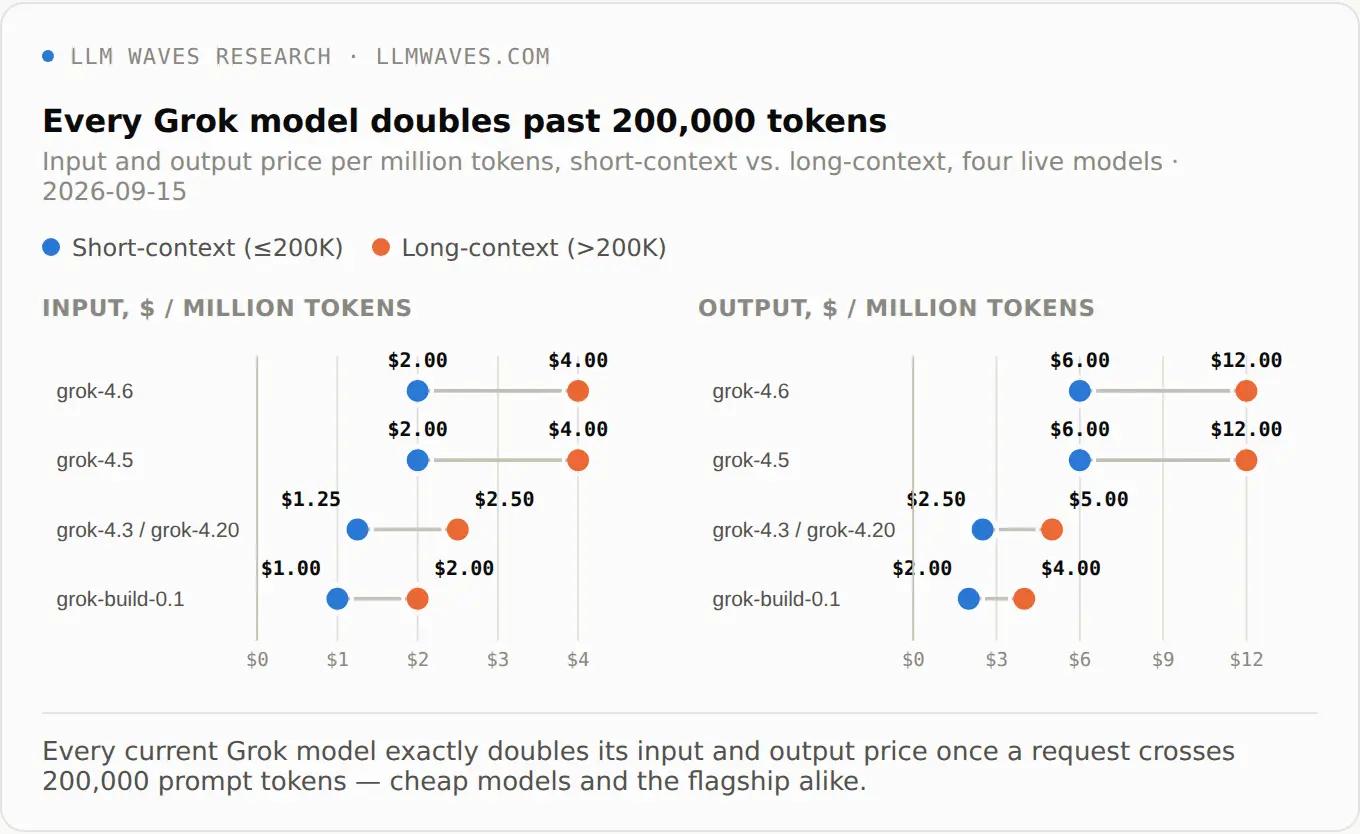
Every current Grok model is priced in two tiers, split at 200,000 prompt tokens. Below that line, grok-4.6 charges $2.00 per million input tokens and $6.00 per million output tokens.
Cross it, and the entire request bills at the higher rate, not only the tokens past the line: $4.00 input, $12.00 output.
The same doubling applies to every live model. grok-4.5 moves from $2.00/$6.00 to $4.00/$12.00.
The grok-4.3 and grok-4.20 family moves from $1.25/$2.50 to $2.50/$5.00. grok-build-0.1 moves from $1.00/$2.00 to $2.00/$4.00.
Cached input carries a separate story. grok-4.5 bills cached tokens at $0.30 per million. grok-4.6 raised that to $0.50, a 67 percent increase, while its headline $2.00 and $6.00 rates held steady across the same release.
A workload built to lean on caching got more expensive on an upgrade that looked, from the headline number alone, like no price change at all.
Cached tokens still count toward the tokens-per-minute ceiling covered below, despite the reduced price.
Is there a free Grok API tier?
No. xAI's own API page states plainly that "API usage is billed per token rather than free," and nothing on docs.x.ai lists a complimentary token allowance for new accounts. The Grok FAQ separates the two billing surfaces explicitly: SuperGrok subscription charges and API usage are billed independently, and API credits, once purchased, are non-refundable. A subscription does not carry API credits with it.
That has not stopped a cluster of sites from advertising a $25 signup credit plus $150 a month for enrolling in a data-sharing program.
No page on x.ai or docs.x.ai describes such a program, under that name or any other.
A Playground environment ships with every Console account for trying models before paying, which is the closest thing to a free tier the documentation confirms.
Tool calls and X Search cost more than the token price suggests
Grok's tool calls bill separately from tokens, per invocation. Web search, X search and code execution each cost $5.00 per 1,000 calls today.
Collections search runs $2.50 per 1,000 calls, and file attachments cost $10.00 per 1,000 calls. A request that calls three tools alongside its tokens pays for both.
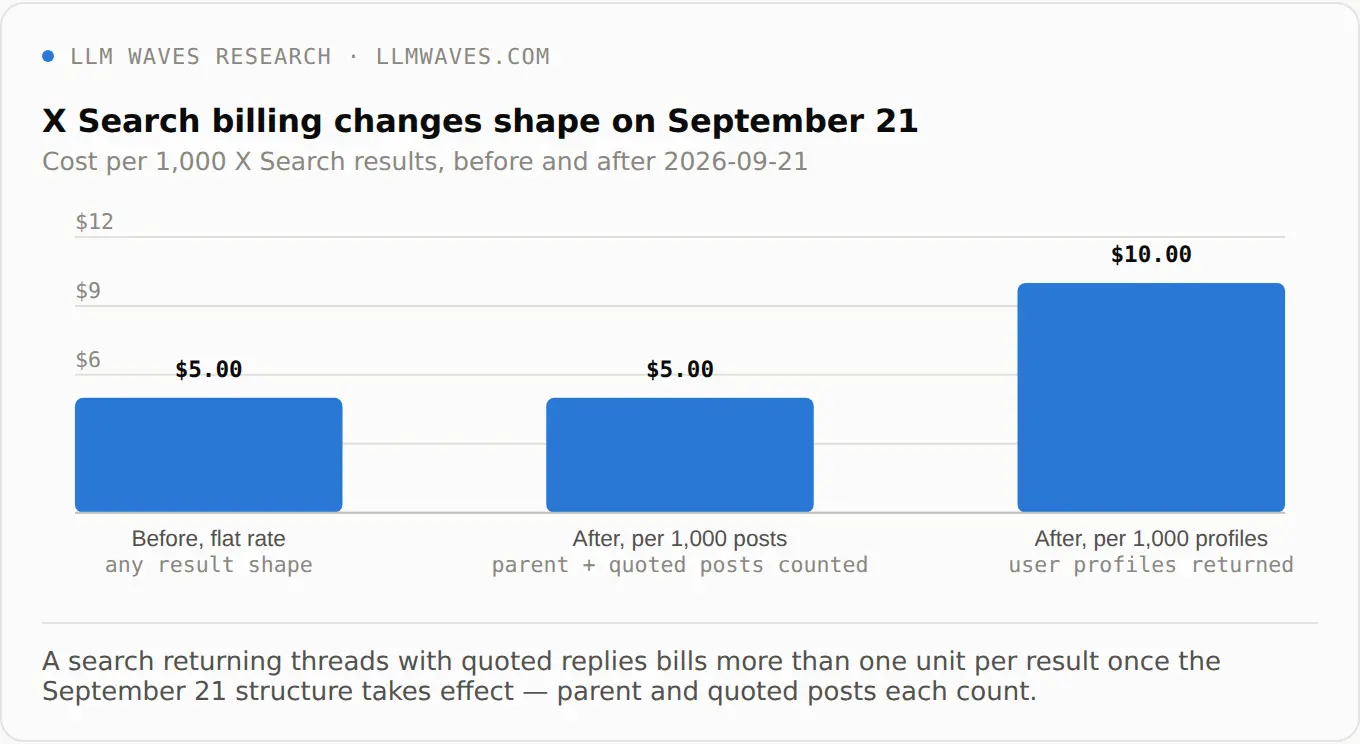
X Search pricing changes on September 21, 2026. The flat $5.00-per-1,000-calls rate is replaced by $5.00 per 1,000 posts returned and $10.00 per 1,000 user profiles returned.
xAI's documentation specifies that every parent post and every quoted post in a result counts toward that total.
A single search that surfaces a thread with quoted replies can bill for several units under the new structure, not one.
Storage adds a third meter token math tends to skip. Files cost $0.025 per GiB per day to store and $0.20 per GiB to download.
Collections cost four times the storage rate, $0.10 per GiB per day, plus the same $0.20 per GiB on download.
A request that fails xAI's usage guidelines before it generates a response still costs $0.05, charged once per blocked attempt.
Rate limits are gated on lifetime spend, and they never come back down
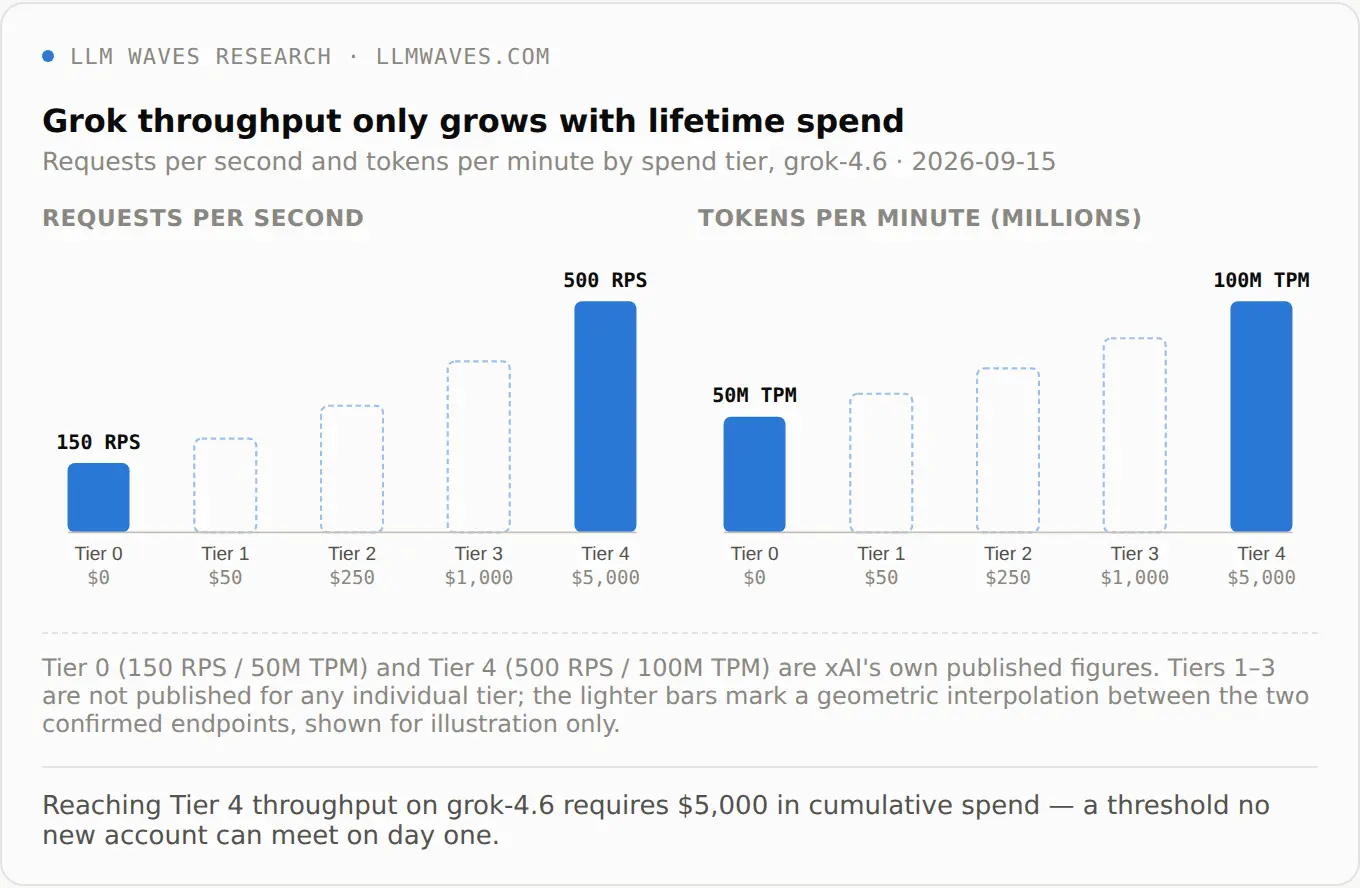
xAI sorts every account into one of six rate-limit tiers, based on cumulative spend since January 1, 2026, not on current usage.
Tier 0 is the default: on grok-4.6, that is 150 requests per second and 50 million tokens per minute.
Tier 4 requires $5,000 in lifetime spend and raises the ceiling to 500 requests per second and 100 million tokens per minute on the same model.
An Enterprise tier sits above that, available on request.
Qualification counts prepaid credit purchases and paid invoices, and once an account reaches a tier, it stays there. A quiet month does not drop a Tier 3 account back to Tier 1.
Both requests-per-second and tokens-per-minute apply at once, and the tokens-per-minute counter includes cached tokens, reasoning tokens, and every modality, not fresh prompt text alone.
A launch that needs Tier 2 throughput on day one has to reach $250 in spend before day one arrives, which for a brand-new account is not possible.
What a real workload costs, compounded
Sticker prices describe single tokens. A real request mixes fresh input, cached input, output and tool calls, and the 200,000-token cliff moves all of them at once.
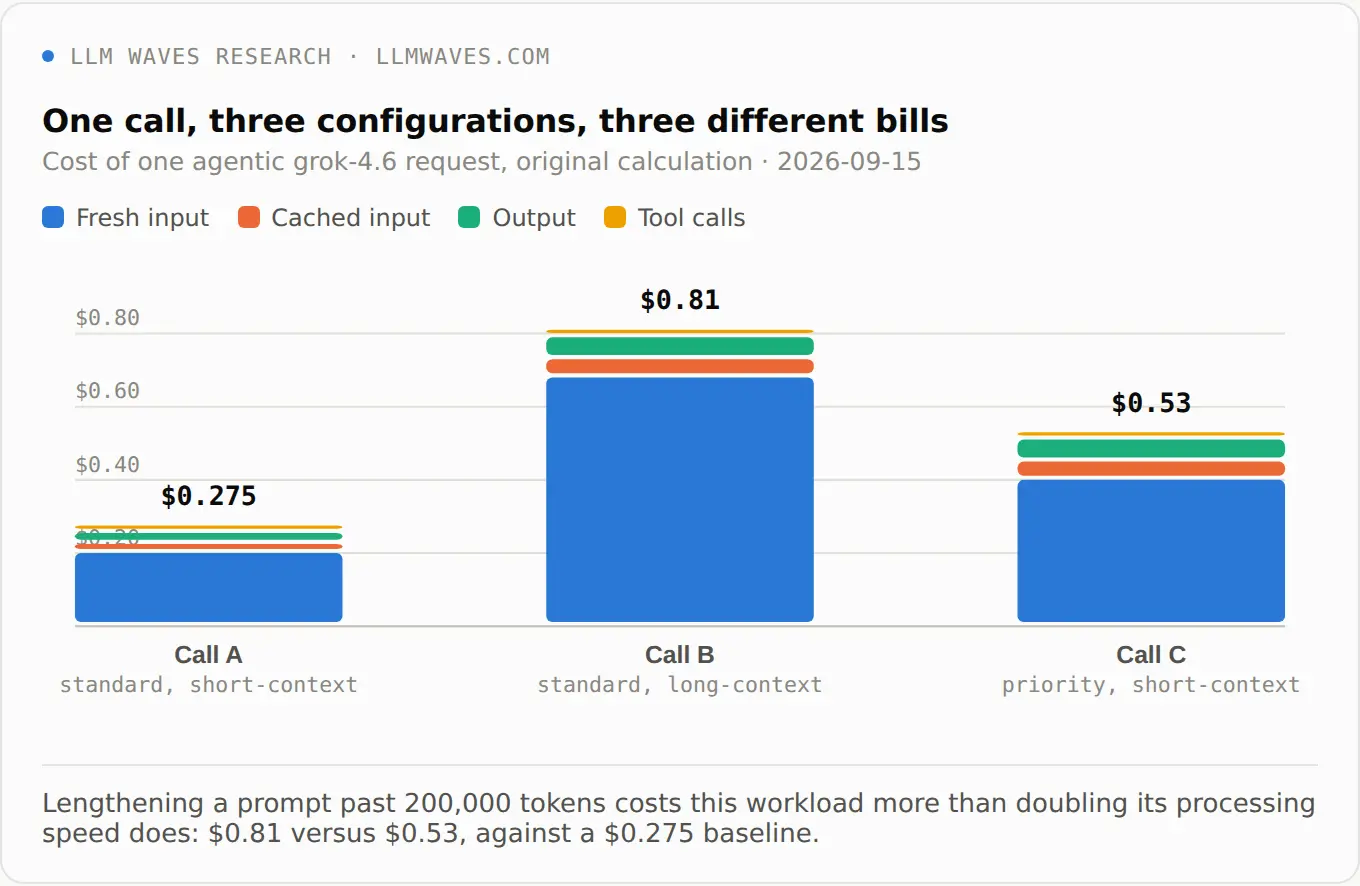
Three versions of one agentic call on grok-4.6, standard processing unless stated, show how that compounds.
Call A stays under the cliff: 100,000 fresh input tokens, 50,000 cached input tokens, 5,000 output tokens, two code-execution calls and one file attachment.
Fresh input costs $0.20, cached input $0.025, output $0.03, tool calls $0.02. Total: $0.275.
Call B lengthens the prompt to 170,000 fresh input tokens, pushing the total past 200,000.
The entire request now moves to the long-context rate, cached tokens included: $0.68 fresh input, $0.05 cached input, $0.06 output, plus the same $0.02 in tools. Total: $0.81, nearly triple Call A for a 47 percent longer prompt.
Call C repeats Call A under priority processing, which doubles every token price but leaves tool-call fees alone: $0.51 in tokens, $0.02 in tools.
Total: $0.53, a 93 percent increase, not the full 100 percent the flat multiplier suggests, because tools are billed per call, not per token.
What this article did not measure
This article did not run a latency test, a throughput test, or an output-quality benchmark against any model discussed. Every price above is xAI's own published rate, not an independently timed or scored result.
The $25-signup-credit claim was checked against xAI's primary documentation and found unconfirmed there. It was not tested against a live account, since walking a specific promotional signup path was outside this session's scope.
SuperGrok's consumer subscription price rests on independent trackers rather than a directly fetched vendor page and is marked as such wherever it appears.
Which Grok tier fits which reader
For developers
Best value: the grok-4.3 and grok-4.20 family, at $1.25 input and $2.50 output with a full 1,000,000-token window, before tool and storage fees are added on top.
For startups
Situational: grok-build-0.1's $1.00 floor price is the cheapest entry point, but Tier 0's 150 requests per second is the ceiling until spend history says otherwise.
For enterprise
Top pick: grok-4.6, provided the long-context doubling and per-call tool fees are budgeted as separate line items rather than folded into a single per-token estimate.
For high volume
Situational: Tier 4 throughput needs $5,000 in prior spend. A high-volume launch on a new account starts at Tier 0 regardless of its projected traffic.
For low latency
Insufficient data: xAI publishes throughput ceilings by tier, not latency figures, on either its pricing or rate-limit pages.
For on-device or self-hosting
Not recommended: Grok ships no open-weight release, so there is nothing in this lineup to run outside xAI's own infrastructure.
For non-English workloads
Insufficient data: no per-language pricing or accuracy figures appear on any page cited here.
What is the cheapest active Grok model?
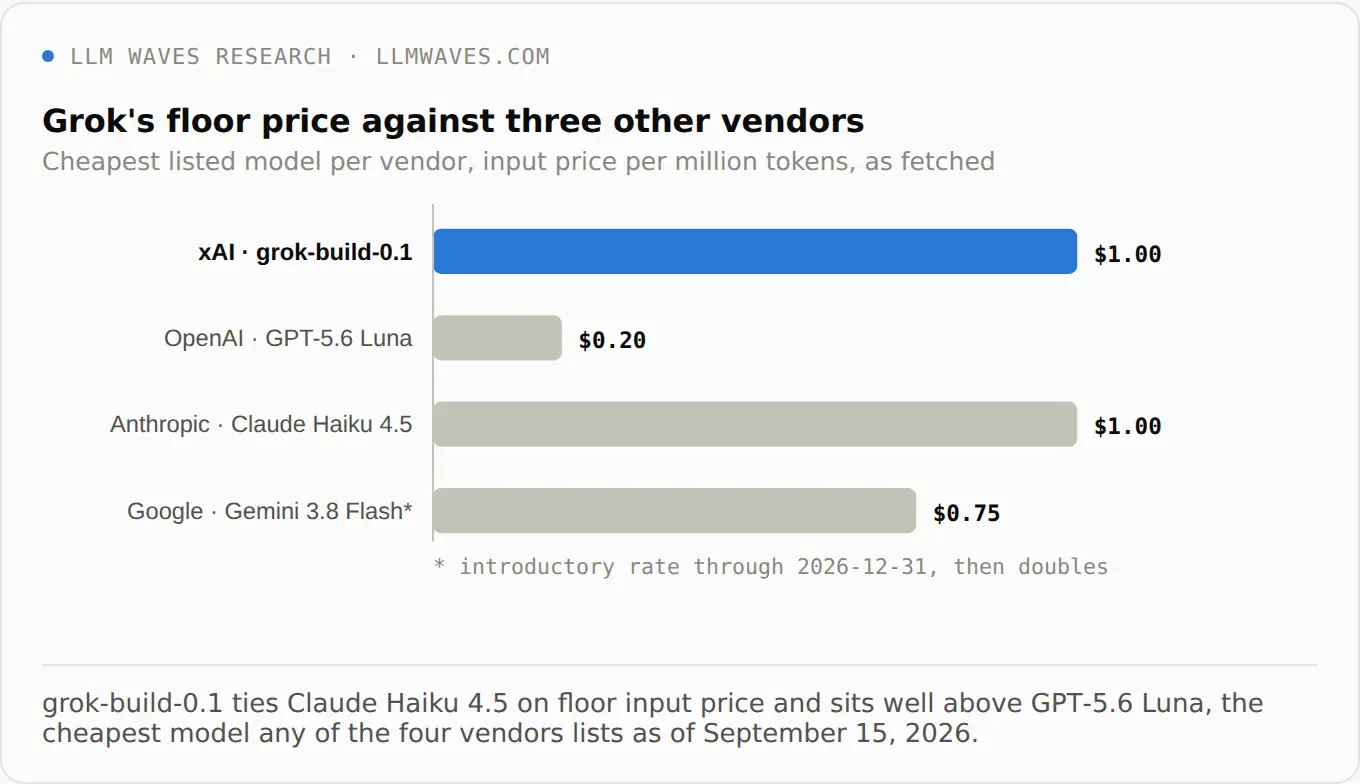
grok-build-0.1, at $1.00 input and $2.00 output per million tokens below 200,000 prompt tokens, doubling to $2.00 and $4.00 above it.
It carries a 256,000-token context window, smaller than the other three live families, and does not qualify for the 20 percent batch discount that grok-4.3 and the grok-4.20 family receive.
Does the Grok API support prompt caching?
Yes, on every live model, at a separate and lower per-token rate than fresh input. grok-4.6 charges $0.50 per million cached tokens against $2.00 for fresh input, a 75 percent discount.
Cached tokens still count toward the tokens-per-minute rate limit, and the discount narrows in relative terms once a request crosses the 200,000-token cliff, since the cached rate doubles there too.
Is Grok cheaper than Claude Opus 5 or GPT-5.6 Sol?
On floor price, yes. grok-build-0.1's $1.00 input rate undercuts GPT-5.6 Sol's promotional $4.00 and Claude Opus 5's flat $5.00. On the flagship comparison, grok-4.6's $2.00 input sits below Opus 5's $5.00 but above Sol's promotional rate.
Claude Opus 5 carries no long-context price increase at all, unlike Grok's doubling past 200,000 tokens.
Which one actually costs less depends on how much of a workload crosses that line. See the Claude API pricing breakdown for Opus 5's own context and caching rules.
Grok API or a SuperGrok subscription, which is cheaper?
They meter different things and do not substitute for each other. SuperGrok is a consumer chat subscription. It is reported at $30 a month by ai-toolbox.co, felloai.com and whichai.fyi, since xAI's own subscription page did not return a price to a direct fetch, and it carries no API credits.
The API bills per token and per call with no subscription floor at all. A team building an integration needs the API regardless of whether anyone on it also pays for SuperGrok.
Does priority processing charge extra for cached tokens?
Yes. Priority processing applies its 2x multiplier to every token type xAI bills, including cached input, per the same documentation that defines the tiers.
A request that relies on caching to control cost loses most of that saving the moment priority processing is turned on. The discount and the multiplier both land on the same cached-token line.
xAI changes this page without a changelog of its own
xAI's pricing page carries a single "last updated" date and no version history of its own. The September 21, 2026 X Search change is already documented there ahead of taking effect, which is not guaranteed for whatever comes next.
Treat every figure on this page as current for September 15, 2026, and confirm it again before it drives a production budget. The API pricing hub tracks this alongside every other vendor covered on this site, and Grok vs. Claude covers the same 200,000-token cliff in a head-to-head format.