Cursor and Claude Code both list a $20 monthly entry price, and Claude Code's extension installs inside Cursor, so picking one does not rule out the other.
The number that separates them, per Anthropic's figures collected September 28, 2026: $150 to $250 per developer per month for real use, above either entry price.
Check the use-case verdicts below.
Cursor and Claude Code, compared
Table 1. Entry pricing, team pricing, model sourcing and usage metering for Cursor and Claude Code, collected from each vendor's own pages on September 28, 2026.
Dimension | Cursor | Claude Code |
|---|---|---|
Product type | AI-native code editor, a VS Code fork | CLI agent, with a VS Code and Cursor extension |
Entry price, individual | $20 per month (Pro) | $20 per month (Pro) |
Free tier | Hobby, $0 per month, limited agent requests | n/a: the free Claude plan has no Claude Code access |
Models it runs | OpenAI, Google, xAI and Anthropic models | Anthropic Claude models only |
Flagship model named | n/a: no single flagship across providers | Claude Opus 5.5, $4 input / $20 output per million tokens, released September 22, 2026 |
Team seat, Standard | $32/mo annual, $40/mo monthly | $20/mo annual, $25/mo monthly |
Team seat, Premium | $96/mo annual, $120/mo monthly | $100/mo annual, $125/mo monthly |
Usage metering | Input, output and cache tokens, each at the model's own rate | A rolling five-hour window plus a separate weekly window, shared with Claude chat and Cowork |
Real per-developer cost disclosed | Not published on Cursor's own pages | $150 to $250 per month average, under $30 on an active day for 90% of users |
Installs inside the other | n/a: no Cursor extension for the Claude Code CLI is documented | Yes, via |
Table note: n/a marks a dimension that does not apply to that product's own design, not a missing figure. All prices in US dollars.
Cursor and Claude Code both charge $20 a month at the individual entry tier, an exact match neither vendor's pricing page treats as a comparison point.
Cursor reaches models from four providers through one editor; Claude Code runs Anthropic's own models only, led by Claude Opus 5.5 at $4 input and $20 output per million tokens since September 22, 2026.
At team scale, Cursor's Premium seat costs $96 a month annually against Claude Code's Team Premium at $100, a four-dollar gap that Anthropic's own $150-to-$250 disclosure dwarfs regardless.
Basis and method
This is a Basis 2, aggregated comparison. That means every figure comes from Cursor's and Anthropic's own documentation and pricing pages, and no test or benchmark was run.
Cursor and Claude Code are coding tools built on top of language models, not language models themselves, so no shared benchmark exists to score one against the other.
The figures come from seven pages on code.claude.com, platform.claude.com, claude.com and cursor.com, dated September 28, 2026. See the methodology page for this site's basis and claim-tier definitions.
The original work here is the side-by-side arrangement of both vendors' published numbers.
What this comparison ranks on
Three things decide the verdicts below: the price to start using each tool, what Anthropic itself discloses as the real cost of running Claude Code inside a team, and whether choosing one requires giving up the other.
A sticker-price match at the entry tier hides the number that actually drives a team budget.
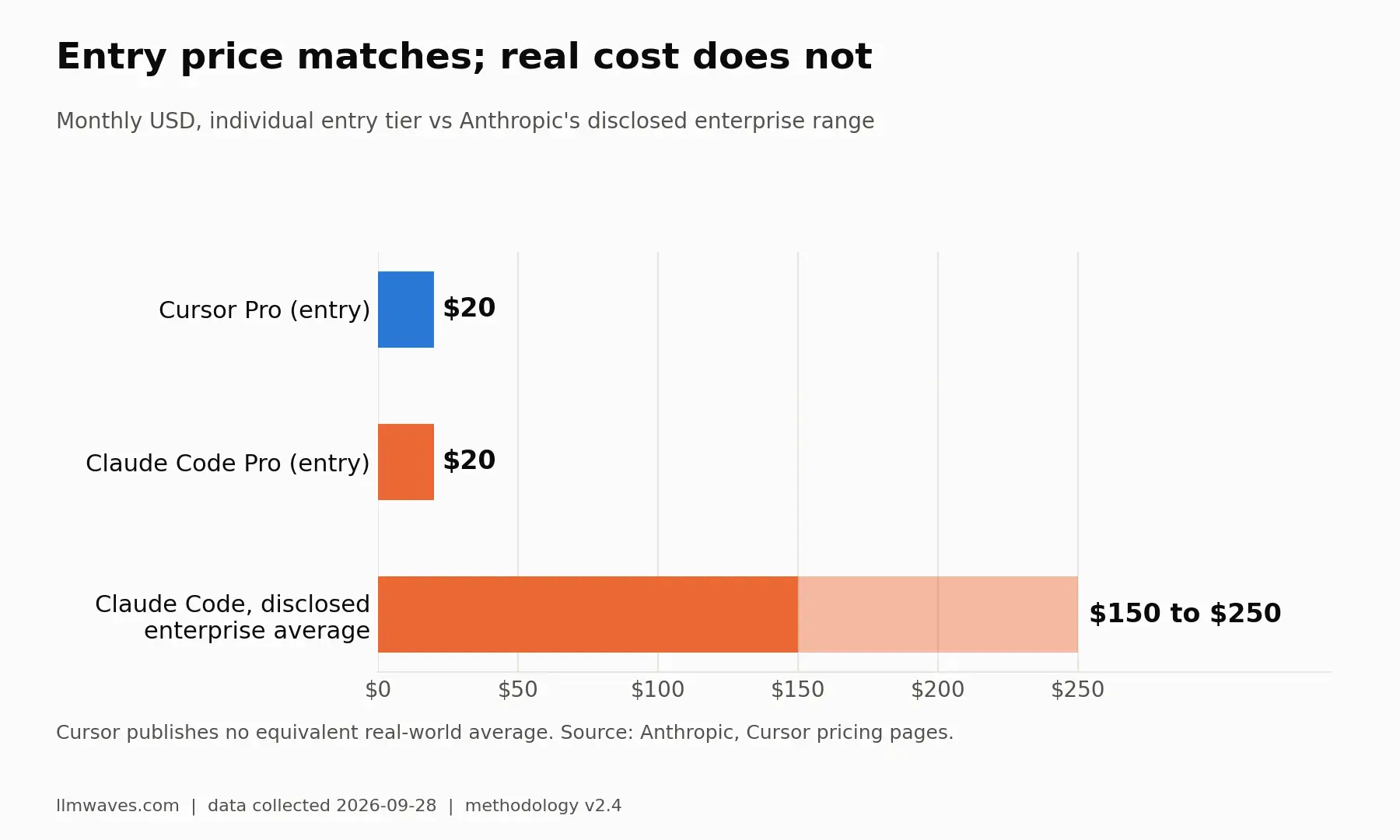
Neither vendor's entry-tier price tells a buyer anything about what a team ends up spending once either tool is running against real work.
Claude Code's flagship model got cheaper, not more expensive
Claude Code's flagship model is Claude Opus 5.5: $4 per million input tokens, $20 per million output tokens, a 1,000,000-token context window, and a 128,000-token maximum output, released September 22, 2026.
It replaced Claude Opus 5, which listed at $5 input and $25 output, so the newer model costs less on both sides of the rate card.
That is the opposite of the usual pattern, where a named successor model raises the price.
Anthropic's own Claude Opus 5.5 model page and the site's own Claude Opus 5 model entry both carry the numbers behind this section.
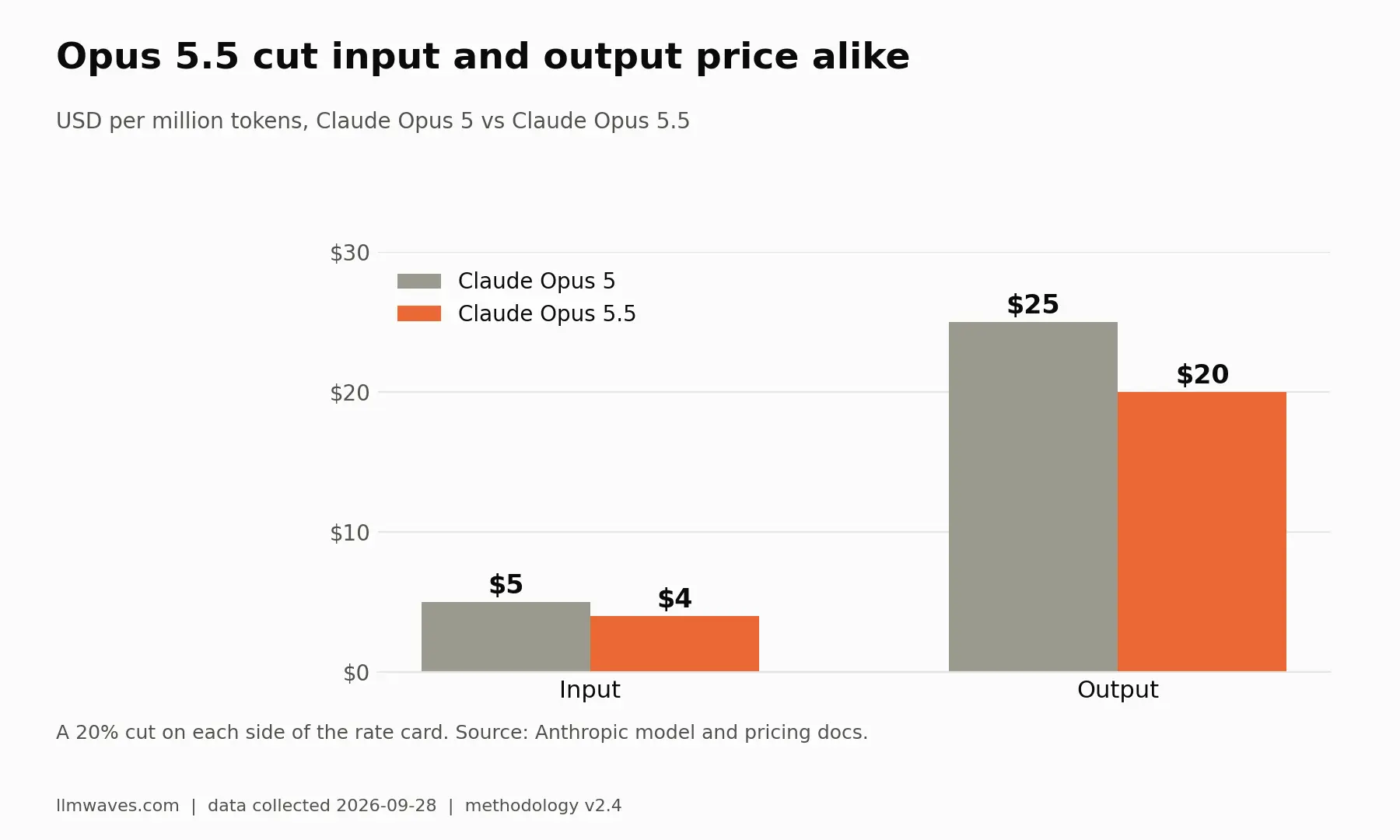
A six-day-old price cut is easy to miss if the comparison a reader lands on was written before September 22.
Claude Code's own extension runs inside Cursor
Anthropic ships an official Claude Code extension for Cursor, installed with a single link, cursor:extension/anthropic.claude-code, the same mechanism used for its VS Code extension.
Anthropic's own VS Code and Cursor extension documentation states the same extension also installs in other VS Code forks through the Open VSX registry, and that the terminal CLI works in any editor that cannot install it.
Cursor and Claude Code are not a strict either-or choice at the tooling level: a developer can run Cursor as the editor and open Claude Code inside it, signed in with any paid Claude plan or a Claude Console account, no separate API key required.
Cursor's team pricing split into two pools in July 2026
Cursor restructured its Teams pricing on July 1, 2026, in effect immediately for new customers and for existing customers whose billing cycle starts on or after that date, per Cursor's own Teams pricing announcement.
The Standard seat is $32 a month billed annually, or $40 monthly.
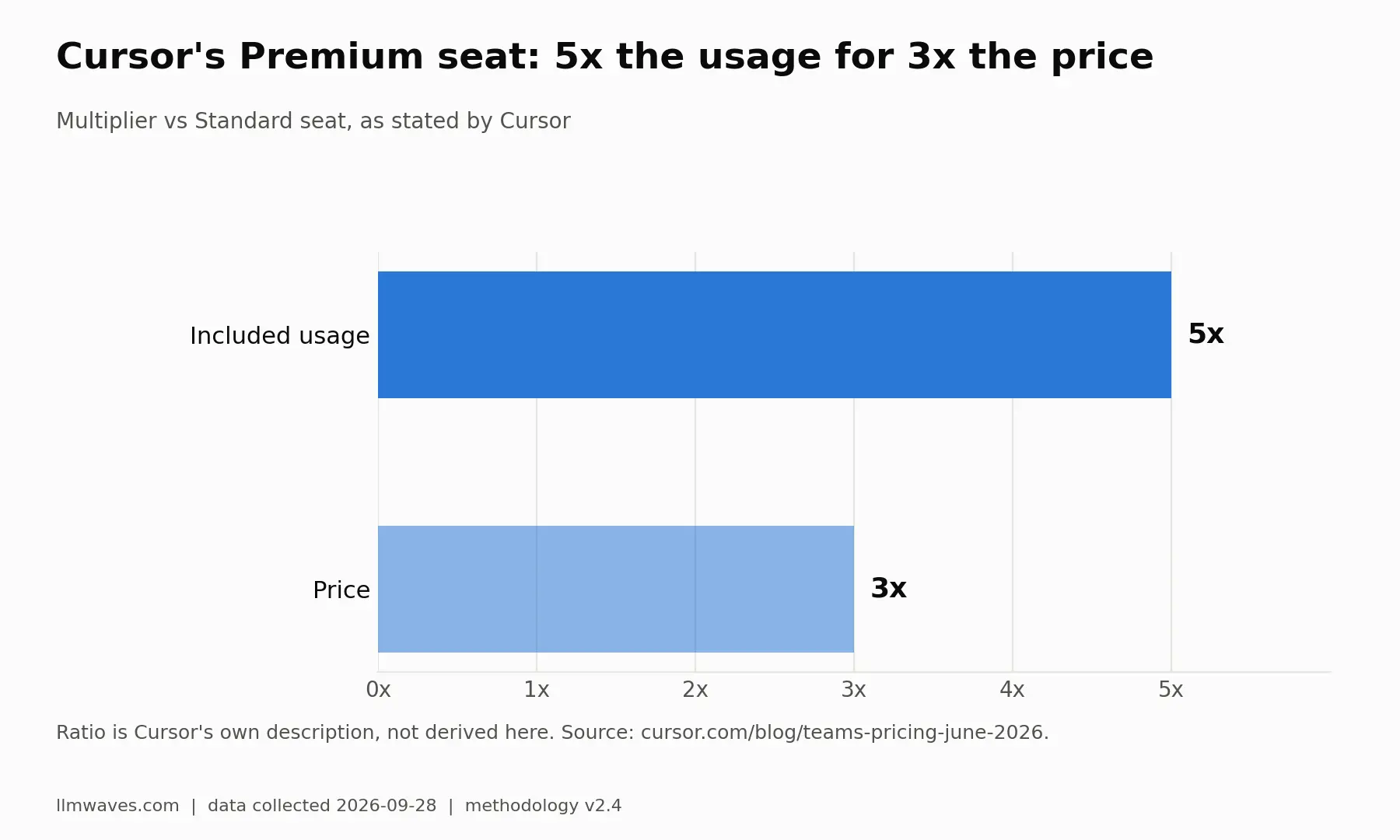
A new Premium seat sits above it at $96 annually or $120 monthly, which Cursor itself describes as five times the included usage of Standard at three times the cost.
Each seat tracks two separate usage pools instead of one combined allowance: a first-party pool covering Cursor's own Auto and Composer 2.5, and a third-party pool for external model providers, shown separately in the usage dashboard.
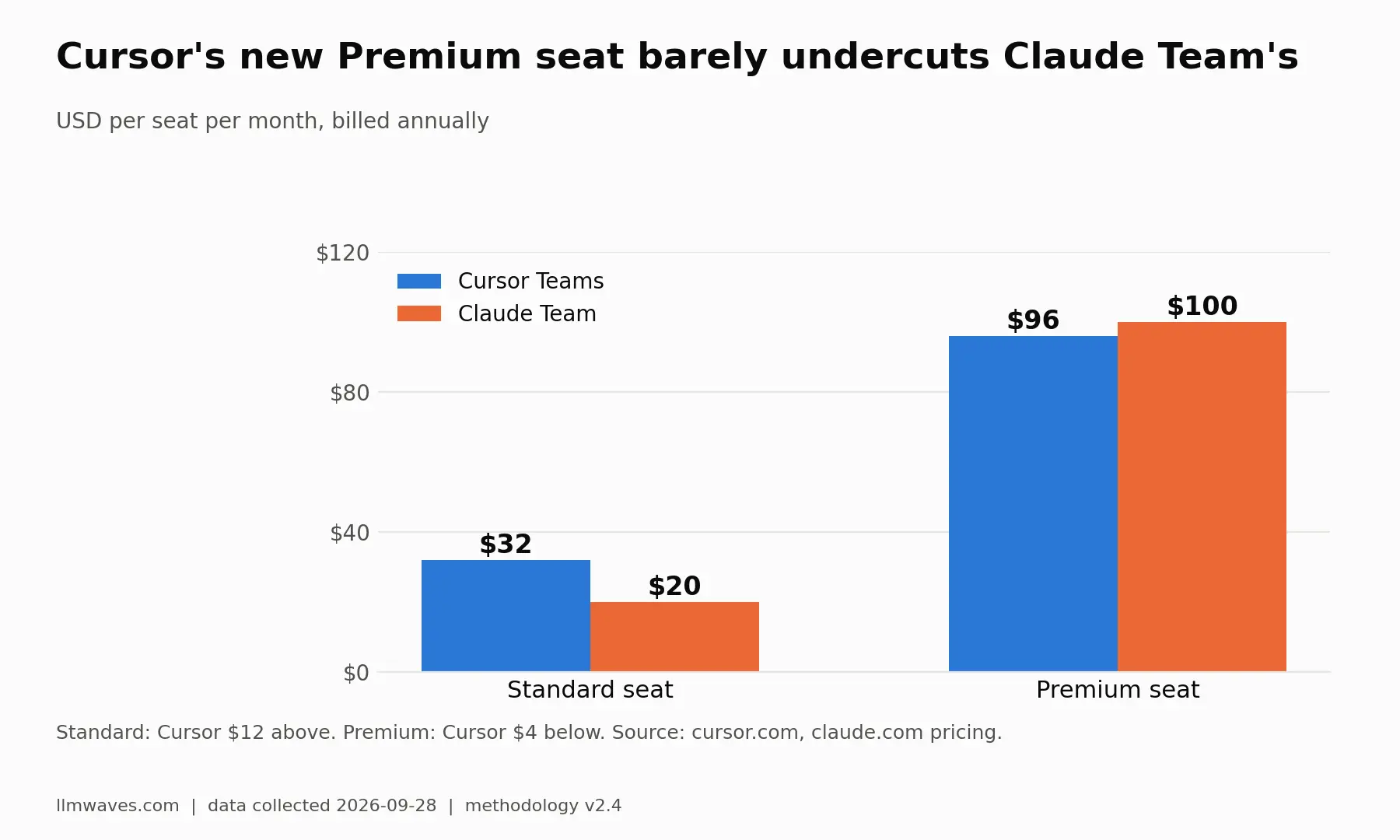
Neither seat price on its own says what a rollout will actually cost; the next section covers the figure that does.
What Anthropic discloses about real Claude Code spending
Anthropic's own cost-management documentation states that per-developer spend varies by model choice, codebase size, and usage pattern, then gives a figure anyway: an average of $13 per developer per active day, $150 to $250 per month across enterprise deployments, with 90% of users under $30 on an active day.
Cursor's own pricing and terms pages publish no equivalent real-world average; its usage caps bound spend in advance rather than report a typical outcome after the fact.
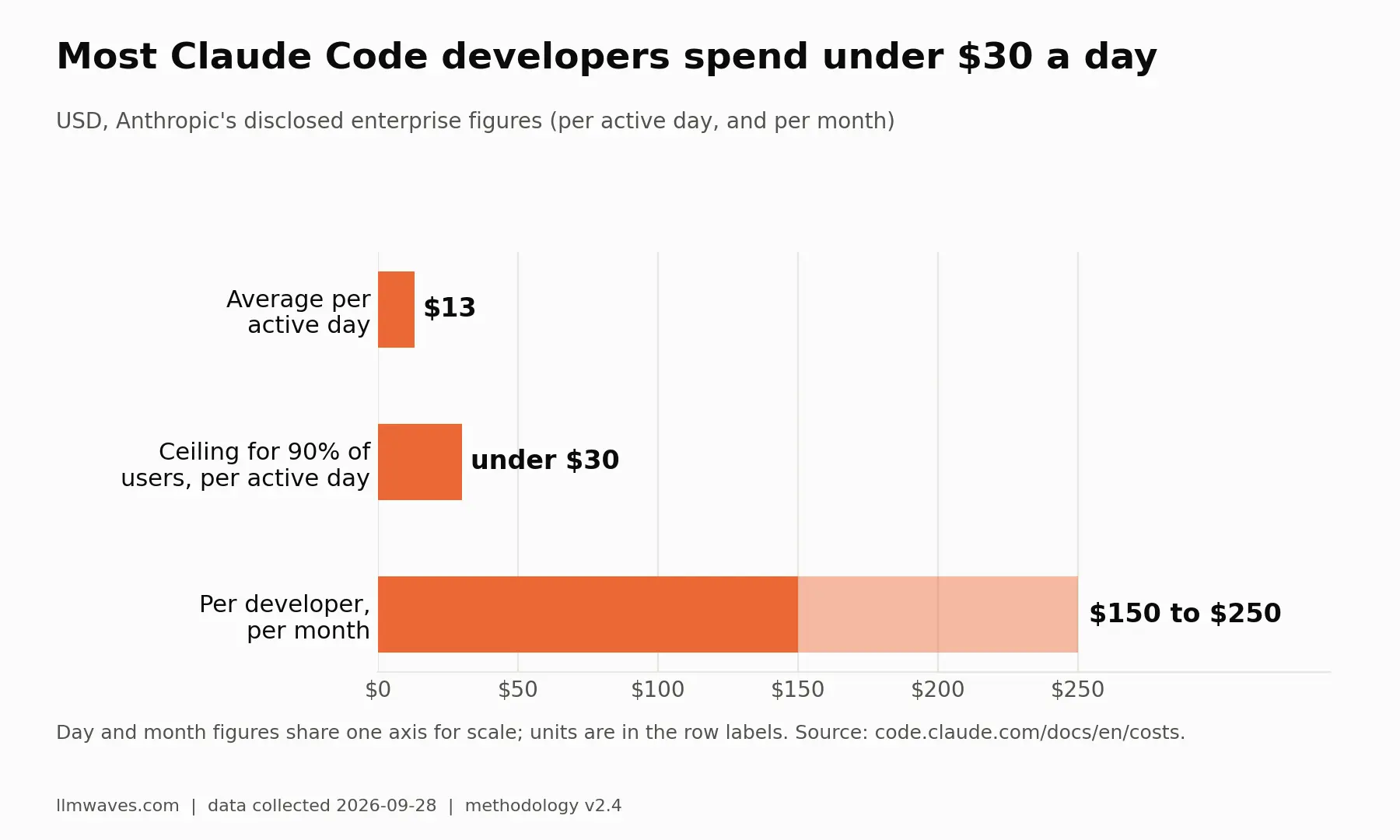
Budget against this disclosed range rather than either tool's seat price, since neither seat price was built to represent a typical month.
How each tool actually meters usage
Cursor meters usage as Total Tokens, its own term for combined input, output, and cache tokens, multiplied by each model's own published rate; administrators can also set hard usage caps.
Claude Code's subscription usage instead draws from one seat allowance shared across Claude chat, Claude Code and Cowork, resetting on a rolling five-hour window plus a separate weekly window sized by seat tier.
A Cursor admin sees, and caps spend in the unit Cursor bills in; a Claude Code subscriber can spend part of a coding session's allowance in an unrelated chat conversation earlier the same day, since the two draw from one pool.
See llmwaves.com's own Claude API pricing breakdown for the full rate card behind Claude Code's token costs.
Neither metering model is wrong. They answer different questions: one bills the unit you can audit call by call; the other bills a shared window you cannot split by task.
The extension and the CLI aren't the same tool
Claude Code's VS Code and Cursor extension and its terminal CLI share conversation history and most commands, but not all.
Two features stay CLI-only: the exclamation-point bash shortcut and Tab completion.
Checkpoints, which record Claude's file edits so a developer can roll them back, work in both; only the extension wraps the rollback in a clickable button with fork options, while the CLI reaches it through a command and a keyboard shortcut.
Plugin installation is similar: both interfaces manage the same plugins from the same marketplaces, and only the extension adds a graphical dialog for it.
What this comparison does not measure
This comparison does not measure coding output, task-completion accuracy, or response latency for either tool.
It compares only what each vendor publishes about price, licensing, and how the two tools connect, collected and arranged by llmwaves.com.
Which one fits your situation
Solo developer or freelancer paying personally
Situational. Both tools charge an identical $20 a month, and neither vendor publishes a quota specific enough to compare value at that tier by the numbers alone.
Pick Cursor for one editor that reaches four providers' models; pick Claude Code for a tool that runs inside whatever editor you already use.
This pick reverses if you specifically want Cursor's own multi-model agent in one interface, since Claude Code's lineup is Anthropic-only.
Engineering lead budgeting a 5-to-50-engineer rollout
Close second, on published seat price alone: Cursor's Premium seat is $96 a month annually against Claude Code's Team Premium at $100, a 4-percent gap either vendor's next price change could erase.
Budget against Anthropic's disclosed $150-to-$250 figure instead; a Cursor-only rollout has no equivalent real-cost average to substitute in its place.
An existing Cursor or Claude Code user deciding whether to add the other
Top pick: run both. Claude Code's official extension installs inside Cursor at no separate licensing cost beyond a Claude account, so trying it costs a few minutes, not a new subscription decision.
This reverses for an organization that restricts sign-ins to non-Anthropic accounts only, since the extension still requires signing in with an Anthropic account, free or paid.
Cost-conscious developer comparing real spend
Situational, on metering transparency. Cursor's per-token rate card is the more auditable unit for seeing what one request cost; Claude Code's shared five-hour and weekly windows are simpler day to day but harder to attribute to one task.
This flips for a Claude Team or Enterprise admin, whose seat-level spend report gives per-user dollars; Cursor's dashboard does not split the same way.
Can you run Claude Code inside Cursor?
Yes. Anthropic's own Claude Code extension installs directly inside Cursor through a single link, cursor:extension/anthropic.claude-code, the same install path used for VS Code.
No separate API key is required; signing in with any paid Claude plan or a Claude Console account is enough.
Which Claude model does Claude Code actually run?
Claude Code's flagship model is Claude Opus 5.5, released September 22, 2026, priced at $4 per million input tokens and $20 per million output tokens.
It replaced Claude Opus 5, which cost more on both sides of the rate card, at $5 and $25.
What does each tool cost per developer per month at team scale?
Published seat prices land close together: Cursor's Premium seat is $96 a month billed annually, Claude Code's Team Premium seat is $100.
Anthropic's own disclosed real-world figure averages $150 to $250 per developer per month across enterprise deployments, well above either seat's price.
Is Claude Code free to use?
No. The free Claude plan does not include Claude Code access; the entry paid tier is Claude Pro at $20 a month. Cursor, in contrast, offers a $0 Hobby tier with limited agent requests before its own $20 Pro tier.
Is Claude Code only usable from the terminal?
No. Claude Code ships a graphical VS Code and Cursor extension alongside its terminal CLI, and the two share conversation history.
Two features stay terminal-only: the exclamation-point bash shortcut and Tab completion.
Check the date on every number here before you budget
Cursor changed its Teams pricing structure once already in 2026, on July 1. Anthropic changed Claude Code's flagship model and its price six days before this article's data was collected.
Treat every figure above as dated the moment it was fetched, not as a permanent rate card.