Claude Pro, ChatGPT Plus and Google AI Pro all cost $20 a month as of September 14, 2026. That number is not the real decision: ChatGPT and Google both sell a tier under $20 that Claude skips, and all three vendors now sell a $100 tier and a $200 tier above it.
Data table
Vendor | Free tier model | Entry tier | Standard tier ($20/mo) | Mid tier (5x, $100/mo) | Top tier (20x, $200/mo) |
|---|---|---|---|---|---|
Anthropic (Claude) | Sonnet 5, Haiku 4.5 | none | Pro: Opus 5, Sonnet 5, Haiku 4.5, Fable 5.1 via credits | Max 5x | Max 20x |
OpenAI (ChatGPT) | GPT-5.6 Luna | Go, $8/mo (US) | Plus: GPT-6 Astra, GPT-5.6 Sol | Pro, $100/mo (5x) | Pro, $200/mo (20x)† |
Google (Gemini) | standard Gemini, tier undisclosed | AI Plus, $4.99/mo | AI Pro, $19.99/mo | AI Ultra, $99.99/mo (5x) | AI Ultra, $200/mo (20x) |
† New signups and upgrades to ChatGPT Pro $200 were paused by OpenAI on September 10, 2026. Existing $200 subscriptions continue; the $100 tier remains open.
Basis and method
This comparison is Basis 2: every figure below is collected from vendor pricing pages, vendor help centers, vendor model launch pages, and, where a vendor page would not resolve, dated press reporting of a vendor announcement. No figure in this article was produced by testing a model. Pricing, tier structure and usage-cap language were collected September 14, 2026 (UTC), Vendor pricing pages for consumer subscriptions render client side and do not expose dollar figures to a static fetch, so several tier prices rest on the vendor's own help-center articles or a dated news report of the vendor's own announcement rather than the pricing page itself. Full sourcing and the site's claim-tier definitions live on the methodology page.
Decision axis: this article ranks the three vendors' consumer subscription products on price per tier, what each tier actually includes, and how fast each vendor's usage caps are reported to run out, not on API token pricing, which the site's per-vendor spokes cover in depth.
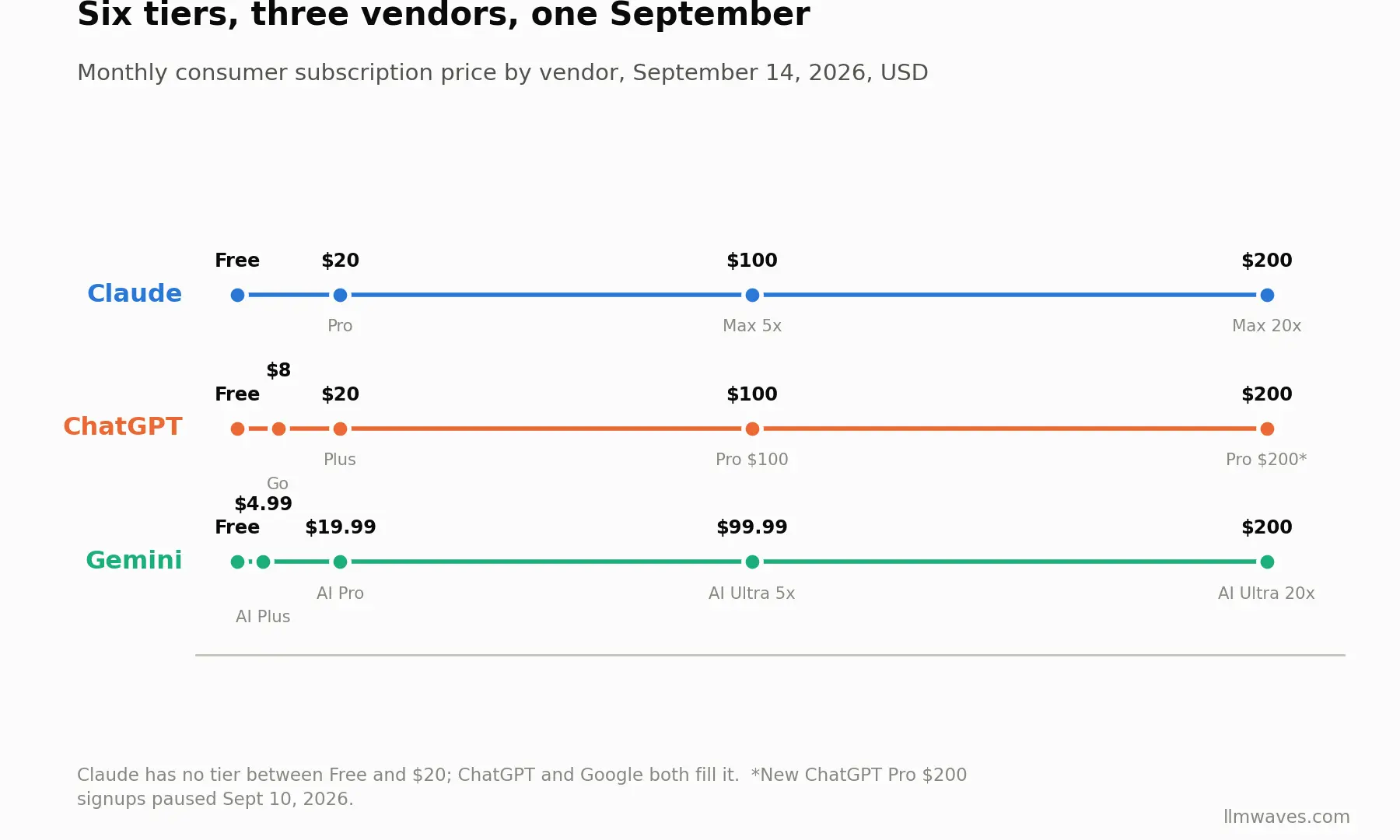
Claude is the only one of the three with nothing between its free tier and $20, while ChatGPT and Google both sell an entry tier under $10. Collected September 14, 2026.
Which one should you actually pay for, if you only pay for one
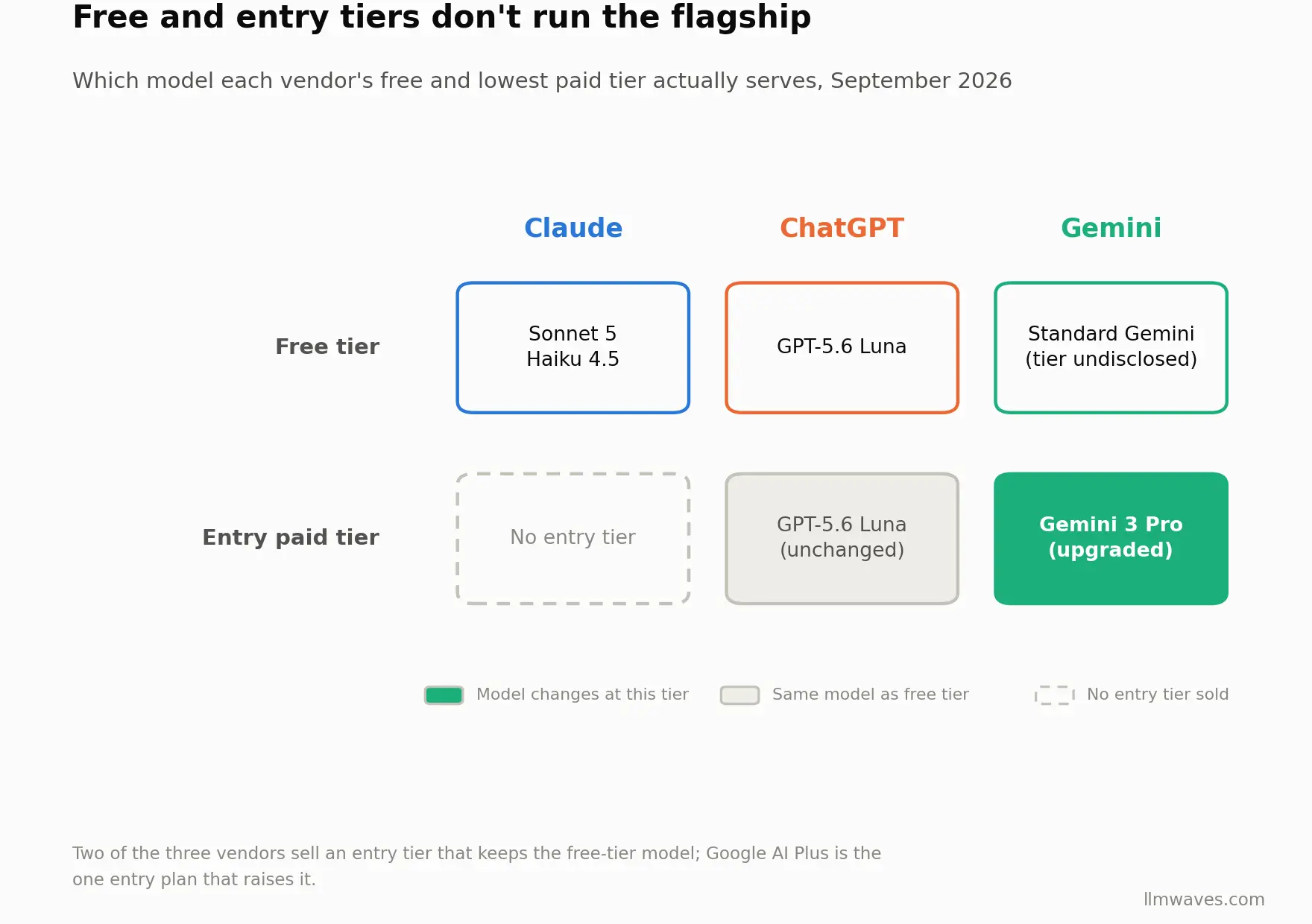
Situational, not universal. Paying for one plan only, at $20, buys a different flagship depending on the vendor: Claude Pro adds Opus 5 and Fable 5.1 access on top of the free Sonnet 5 and Haiku 4.5 models; ChatGPT Plus adds GPT-6 Astra and GPT-5.6 Sol on top of free-tier GPT-5.6 Luna; Google AI Pro raises access to Gemini 3.1 Pro, which Google's own site still labels Preview, not general availability.
If the deciding factor is whether the $20 tier reaches the vendor's actual frontier model, Claude and ChatGPT both clear that bar at $20 and Gemini does with a caveat: the model itself is not out of preview.
The site's separate Gemini vs Claude comparison covers that pairing in more depth, including the pricing cliff Gemini 3.1 Pro carries past 200,000 tokens.
Is there anything cheaper than $20 worth having
Close second, for light use. ChatGPT Go, $8 a month in the US per OpenAI's own help center, promises 10 times the free tier's message, upload and image-generation allowance and runs the same GPT-5.6 Luna model as the free tier, not Sol or Astra. Google AI Plus, $4.99 a month after a June 8, 2026 price cut that also doubled its bundled storage to 400GB, adds Gemini 3 Pro access and Google's Nano Banana Pro image tool.
Claude has no equivalent: the jump from the free Sonnet 5 and Haiku 4.5 models to Claude Pro is a straight $20, with nothing priced in between.
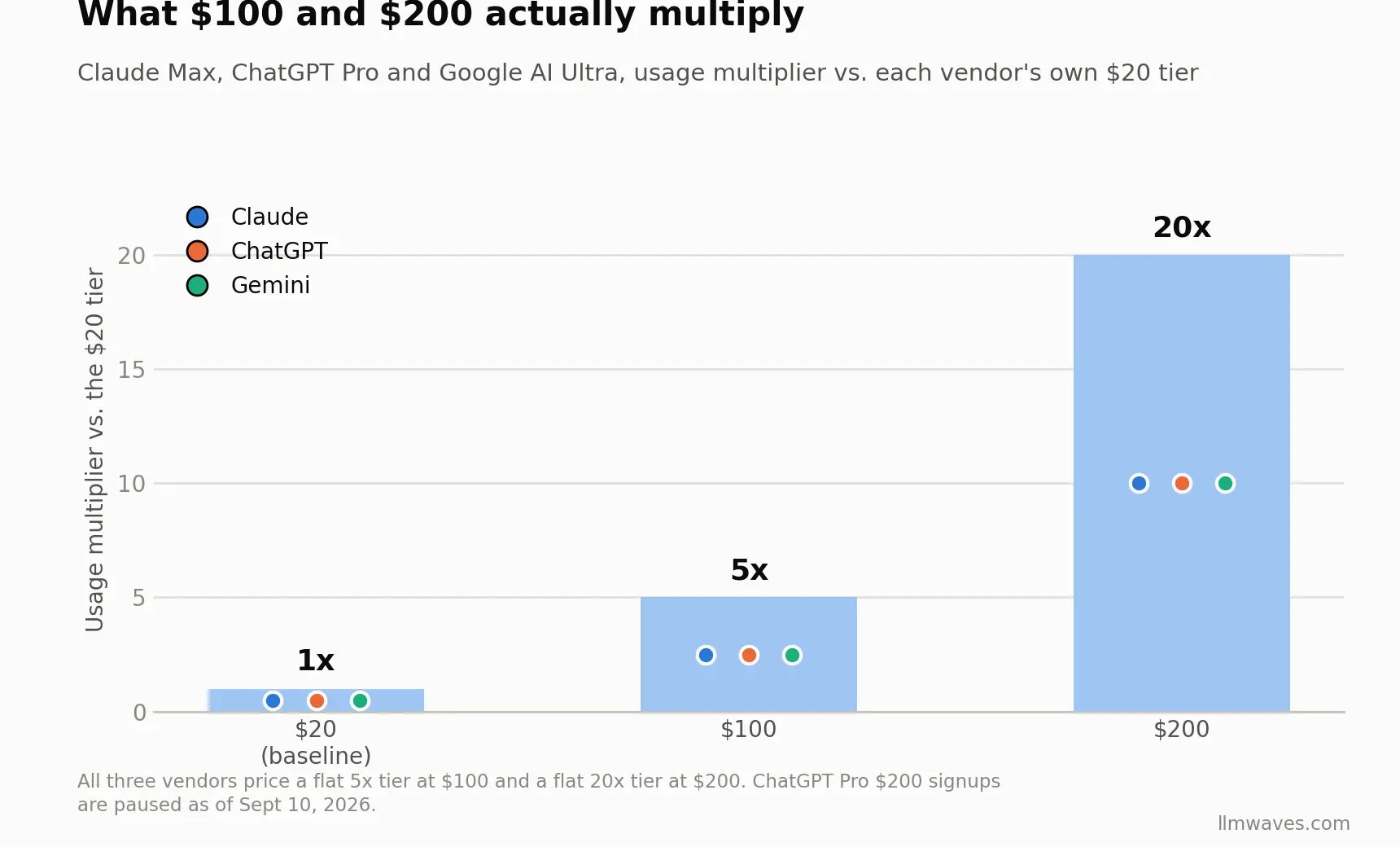
All three vendors now price their $100 and $200 consumer tiers as flat 5x and 20x multipliers of the same vendor's $20 tier, a pattern that only emerges once the three ladders sit side by side. Collected September 14, 2026.
How fast do the usage limits run out, and what actually drains them
The sticker price alone answers none of this. Claude Pro and Max both meter usage in rolling five-hour session windows layered under a separate weekly cap, per Anthropic's own support center; neither the five-hour allotment nor the weekly one is published as a message count, only as a multiple of the tier below it.
ChatGPT frames its caps the same way in relative terms: Go promises 10 times free-tier volume, Plus an unspecified expansion, and Pro "unlimited" use of voice, image creation and deep research subject to what OpenAI calls abuse guardrails, which is not the same as an unmetered plan.
Google states Plus, Pro and Ultra access as 2x, 4x and up to 20x a non-subscriber's usage rather than as any fixed number. None of the three vendors publishes a plain message-per-day figure at any consumer tier. Community discussion of all three plans returns to this gap repeatedly, describing caps that arrive faster than the multiplier language on each pricing page implies.
Claude: caps first, tier second
The missing sub-$20 tier
Per-dimension by vendor. The $20 Claude Pro plan is the cheapest of the three $20 tiers to reach that vendor's most capable non-API model, since Fable 5.1 and Opus 5 both sit behind Pro rather than a separate premium plan, though Fable 5.1 draws on a separate usage-credit pool per Anthropic's pricing page rather than the flat session allowance Opus 5 and Sonnet 5 share.
The structural gap at Claude is the missing sub-$20 tier: a reader who only wants Sonnet 5 with a higher cap than the free plan has no $5 to $10 option and must either accept the free tier's limits or commit to the full $20.
ChatGPT: two flagships, one price, a paused upgrade
Astra and Sol, both behind the same $20
OpenAI runs two current flagships side by side rather than one: GPT-6 Astra, described on its own launch page as a limited rollout with enterprise admin controls off by default, and GPT-5.6 Sol, OpenAI's mainline model, priced at a promotional $4 per million input tokens and $20 per million output tokens on the API through November 21, 2026 per OpenAI's developer documentation. Both are reachable from the same $20 Plus plan.
The paused $200 tier
The more immediate fact for a reader pricing ChatGPT today: OpenAI paused new signups and upgrades to the $200 Pro tier on September 10, 2026, four days before this comparison was written; a $100 Pro subscription still opens the same account tier's tools without the 20x usage ceiling. Existing $200 subscribers keep their plan; a reader who lets one lapse cannot repurchase it while the pause holds.
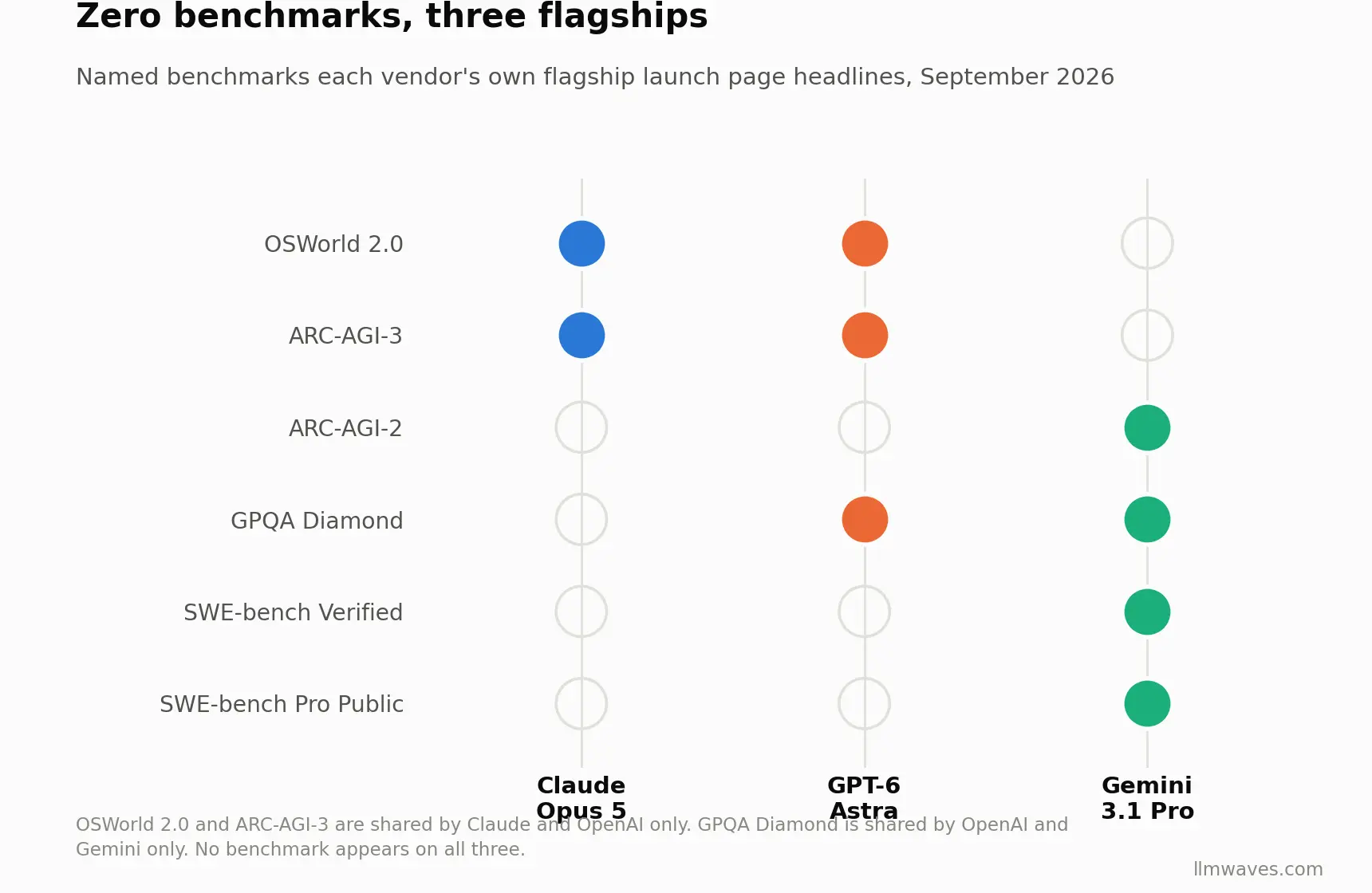
OSWorld 2.0 and ARC-AGI-3 are the only benchmarks Astra and Opus 5 share; GPQA Diamond is the only one Astra and Gemini 3.1 Pro share; no single benchmark appears on all three launch pages, and SWE-bench Verified, the figure most often quoted online as "the coding score," is published by only one of the three vendors for its own flagship. Collected September 14, 2026.
Gemini: the cheapest ladder, the model still in preview
Cheapest rung, widest benchmark dispute
Google prices every rung below the equivalent tier at Claude and ChatGPT: AI Plus at $4.99 against $8 for ChatGPT Go, AI Pro at $19.99 against $20 for Claude and ChatGPT, the new AI Ultra $99.99 rung matching Claude Max 5x and ChatGPT Pro $100 exactly, and AI Ultra $200 undercutting nothing since all three top tiers now land at the same $200.
The gap is disclosure, not price: Gemini 3.1 Pro, the model AI Plus and AI Pro both grant access to, is still labeled Preview on Google's own site, with Gemini 2.5 Pro remaining the only general-availability Pro-tier model at Google.
The Gemini flagship also carries the widest benchmark dispute of the three: Google's own model card puts Gemini 3.1 Pro at 80.6% on SWE-bench Verified, while BenchLM, a third-party model-ranking site, has reported the same model as low as 63.8% on the same benchmark, a 16.8-point gap on a figure one vendor actually discloses.
Output ceilings split 2 to 1
Output ceilings split the same way context pricing does. The 4.6-generation Claude models, including Opus 5, Sonnet 5 and Fable 5.1, share a 128,000-token maximum output and a flat 1-million-token context window with no long-context price premium.
GPT-6 Astra matches that 128,000-token output ceiling on a 1,050,000-token context window, though input and output prices roughly double past a 272,000-token threshold.
The maximum output on Gemini 3.1 Pro is 65,536 tokens, half the ceiling at Claude and OpenAI, on a context window that itself doubles in price above 200,000 tokens.
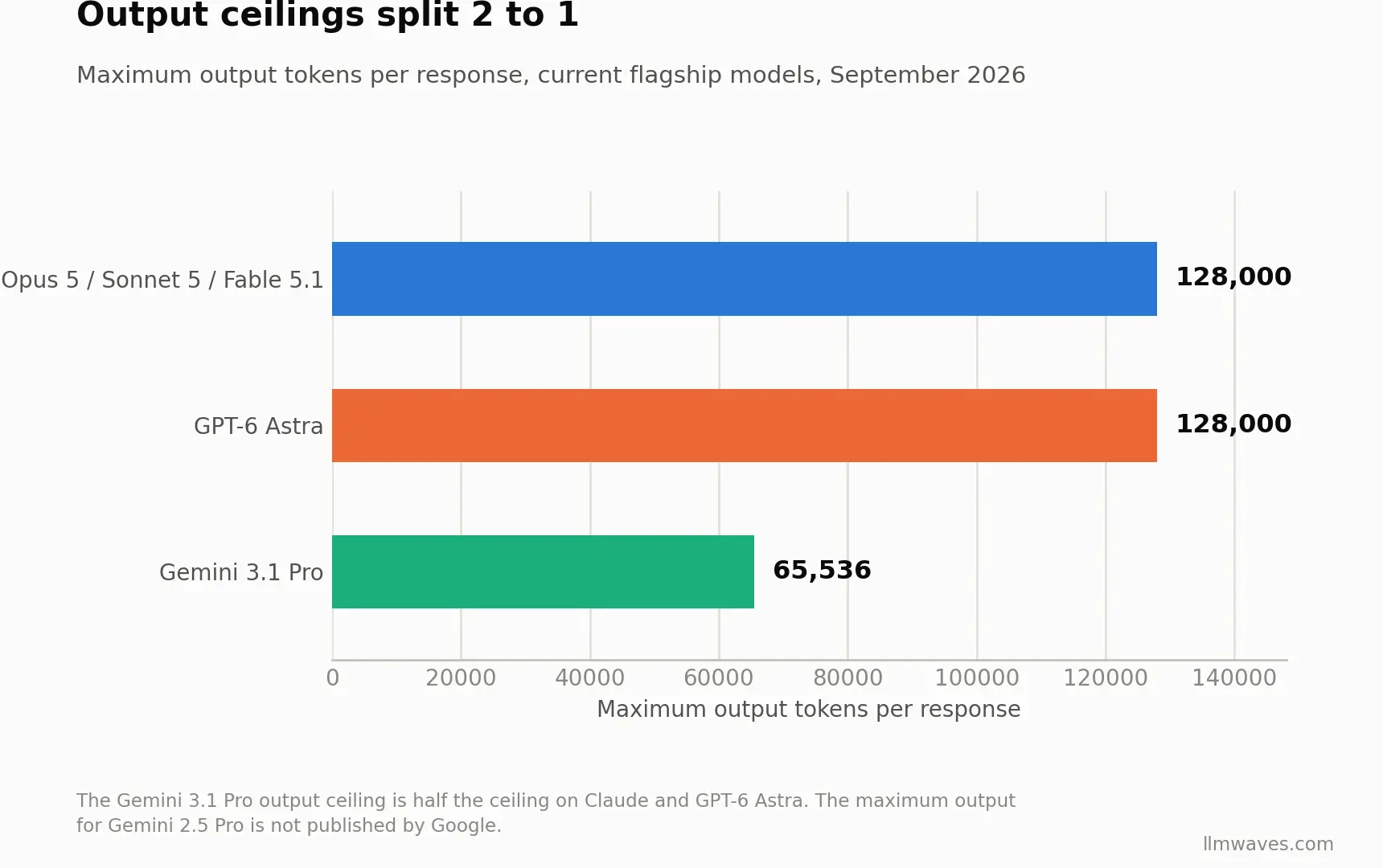
The output ceiling on Gemini 3.1 Pro is half the figure for Claude and GPT-6 Astra, a gap that a reader comparing only input context windows would never see. Collected September 14, 2026.
What this article did not measure
This article did not run a latency test, a throughput test, or an output-quality benchmark against any model discussed. Every benchmark figure above is the vendor's own reported number or, where marked, a third-party tracker's reported number; none was reproduced by LLM Waves Research.
Per-token API pricing, cached-input rates and tool-call fees are outside this article's scope; see Claude API pricing for that level of detail on Anthropic's models.
Why do the benchmark numbers disagree everywhere you look
Reported, not resolved. Anthropic, OpenAI and Google each publish a different benchmark suite on their own flagship's launch page, and only Google's overlaps with a benchmark widely treated as the standard coding score, SWE-bench Verified. Any single "coding" row that puts all three flagships side by side is comparing a published Google figure against an unpublished Anthropic one and a differently named OpenAI one, not three runs of the same test.
Which is cheapest overall
Google AI Plus, at $4.99 a month, is the cheapest paid tier across all three vendors, and each vendor's free tier is cheaper still if a reader can live inside its limits.
ChatGPT Go at $8 is the next-cheapest paid option; Claude has no paid tier below its $20 Pro plan, making it structurally the most expensive entry point into a paid plan of the three, even though its $20 tier itself matches ChatGPT Plus exactly.
Is Gemini 3.1 Pro even out of preview yet
No. Google's own product pages still label Gemini 3.1 Pro Preview as of September 14, 2026, with Gemini 2.5 Pro remaining the only Gemini model carrying general-availability status at the Pro tier.
A subscriber on Google AI Plus or AI Pro is using a model Google itself has not moved to general availability.
Does the $20 plan get you the newest model, or only the $100-plus tier
At Claude and ChatGPT, yes: Claude Pro includes Opus 5 and Fable 5.1, and ChatGPT Plus includes both GPT-6 Astra and GPT-5.6 Sol, all at $20. At Google, the $20 AI Pro tier does reach Gemini 3.1 Pro, but that model carries Preview status regardless of tier, so no Google subscription tier as of September 14, 2026 buys a general-availability Pro-tier Gemini model.
Which is best for coding
Situational, and not decidable from the benchmark scores alone, per the disagreement documented above. Reported evidence: Google publishes a SWE-bench Verified score for Gemini 3.1 Pro; Anthropic and OpenAI do not publish that benchmark for Opus 5 or GPT-6 Astra at all, reporting agentic and computer-use suites instead.
A reader who needs a same-benchmark comparison has, as of this article's September 14, 2026 collection date, one vendor's number and two vendors' silence on it, not three numbers to rank.
Can you use more than one of these at the same time
Yes, and the subscription math changes once you do. Running two $20 plans costs the same as one $100 mid tier at any of the three vendors, which is the comparison a reader choosing between "pay for two flagships" and "pay for 5x usage on one" is actually making, not a quality comparison between the vendors.
The comparison holds until any one of them moves
Three vendors, three release calendars: this comparison expires the day any one of them ships. Recheck the vendor's own pricing and help-center pages before repeating any figure here, particularly the ChatGPT Pro $200 pause, which OpenAI has framed as temporary rather than permanent.