Claude Sonnet 5, priced $2 and $10 per million tokens, leads calls past the 200,000-token context ceiling on Claude Haiku 4.5, or needs effort control.
Haiku 4.5, priced $1 and $5, leads short, high-volume calls at half the price of Sonnet 5, but its context ceiling runs five times narrower.
Model | Context window | Max output | Input price | Output price | Effort levels | Knowledge cutoff | Released |
|---|---|---|---|---|---|---|---|
Claude Sonnet 5 | 1,000,000 tokens | 128,000 tokens | $2.00/MTok | $10.00/MTok | 5 (low, medium, high, xhigh, max) | January 2026 | June 30, 2026 |
Claude Haiku 4.5 | 200,000 tokens | 64,000 tokens | $1.00/MTok | $5.00/MTok | 0 (manual extended thinking only) | February 2025 | October 15, 2025 |
Missing-value note: no cell in this table is estimated. Every figure comes from the sources named in the basis section below, retrieved September 22, 2026.
Basis and method
This is a Basis 2 (aggregated) article. Every figure above and below comes from Anthropic's own published documentation, retrieved September 22, 2026: the Claude models overview page, the Haiku 4.5 model page, the effort parameter guide, the prompt caching guide, and Anthropic's own API and consumer pricing pages. No model discussed here was run this session, and no benchmark was scored. The context-window ratio, the output ratio, and the cached-cost worked example later in this article are arithmetic performed on Anthropic's published numbers, with the formula shown at the point of use. No pre-release access, free credits, or rate-limit exemptions went into collecting these figures, and Anthropic did not see this article before publication. Full sourcing lives on the methodology page.
This comparison ranks Claude Haiku 4.5 against Claude Sonnet 5 on four axes: current per-token price, context window and output ceiling, effort-level control, and which plan or endpoint actually puts each model in front of a person.
Ranked by the criterion in its own row, not by list position
Segment | Verdict | Why |
|---|---|---|
For developers | Situational | Agentic or context-heavy work needs Sonnet 5; short, well-specified calls run fine on Haiku 4.5 |
For startups | Best value | Haiku 4.5 halves the per-token bill at a stage where every call adds up |
For enterprise | Top pick | Sonnet 5 covers context and reasoning-depth needs that Haiku 4.5 cannot fit at any price |
For high volume | Best value | The two-to-one price ratio on Haiku 4.5 holds whether traffic is cached or not, see the calculation below |
For low latency | Insufficient data | This article ran no latency test against either model |
For on-device | Not recommended | Neither model ships as open weights |
For self-hosting | Not recommended | Same reason: no open-weight release exists to self-host |
For non-English | Insufficient data | Anthropic publishes no per-language benchmark for either model |
The pricing pair that is actually current
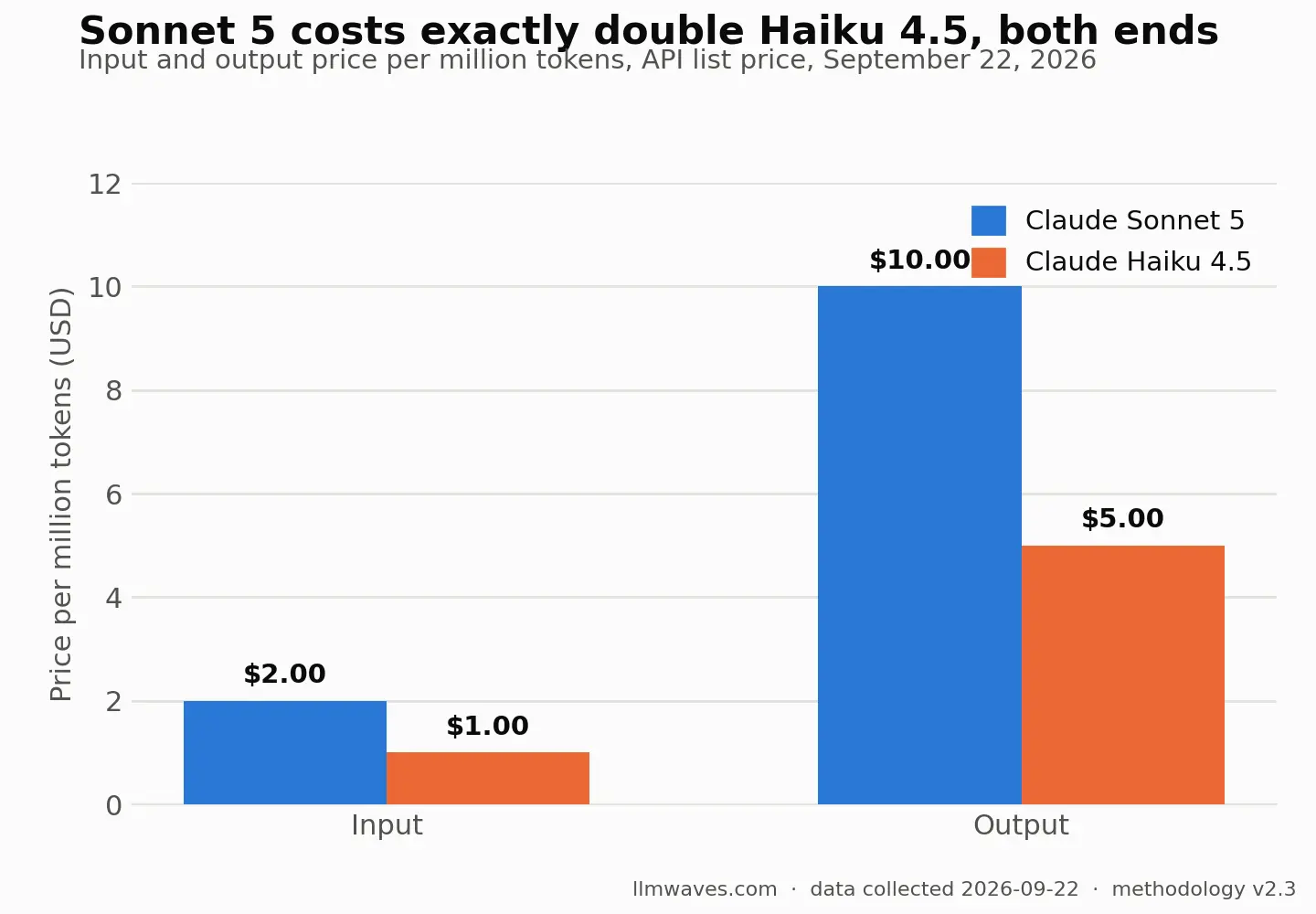
Anthropic's current API price sheet lists Claude Sonnet 5 at $2 per million input tokens and $10 per million output tokens.
Claude Haiku 4.5 sits at $1 and $5, exactly half of Sonnet 5 on both ends. That two-to-one ratio is the number a reader should carry away, not the $3-to-$15 rate still attached to "Sonnet" in older material.
That figure belongs to Claude Sonnet 4, 4.5, or 4.6, not to the current Sonnet 5. Version confusion is common here.
Anthropic's own naming convention flipped generation over generation, so "Claude 3.5 Sonnet" and "Claude Sonnet 5" describe two different eras of the same product line, close to two years apart.
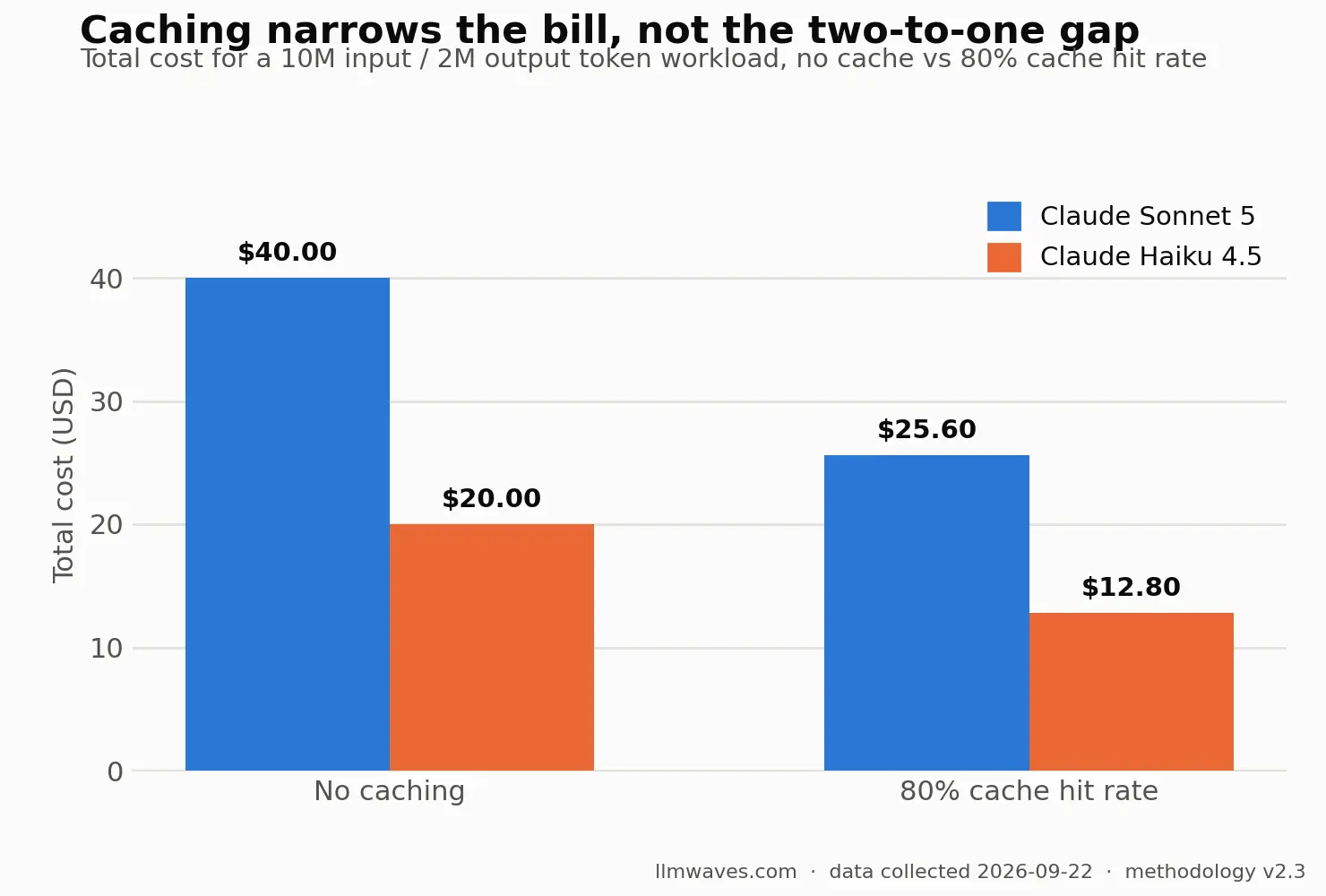
Prompt caching changes what the ratio applies to, not the ratio itself.
A five-minute cache write costs $2.50 per million tokens on Sonnet 5 and $1.25 on Haiku 4.5.
A one-hour cache write costs $4.00 on Sonnet 5 and $2.00 on Haiku 4.5.
Cache reads run $0.20 on Sonnet 5 and $0.10 on Haiku 4.5, exactly ten percent of each model's own base input rate.
The minimum cacheable prompt length differs sharply: 1,024 tokens on Sonnet 5, 4,096 on Haiku 4.5, four times longer.
A short, repeated system prompt that caches cleanly on Sonnet 5 can fall under the Haiku 4.5 floor and never qualify for a discount at all.
Batch processing cuts both models' rates in half, input and output, with no separate batch price sheet to check.
Neither the cache discount nor the batch discount moves the underlying two-to-one price ratio between the two models. It only changes the base the ratio is applied to.
The Claude Sonnet 5 model page on this site tracks the current rate whenever Anthropic changes it.
Pricing errors for this pair run in both directions, not only on Sonnet 5.
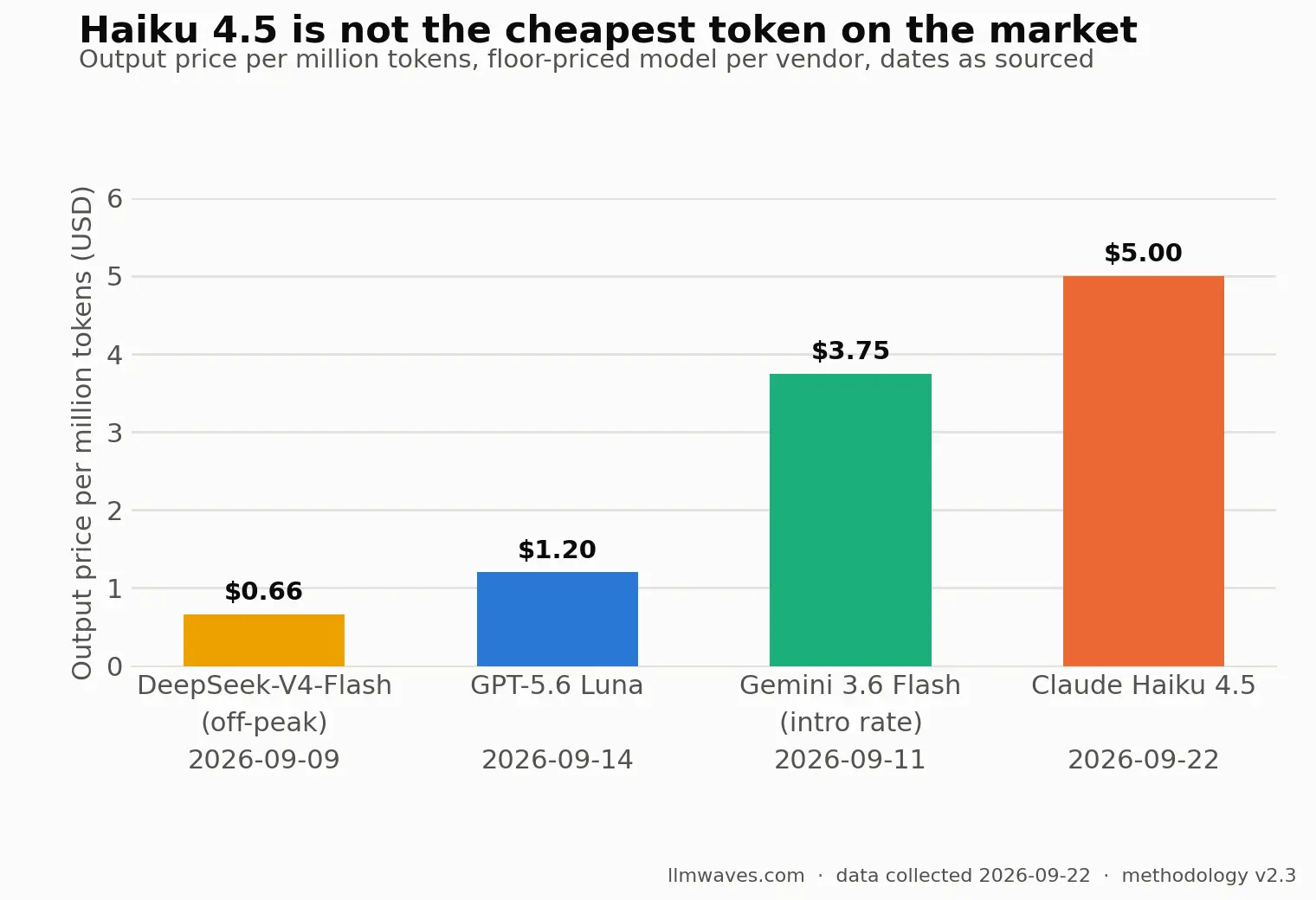
Claude Haiku 4.5 turns up online priced outside its real $1-and-$5 range entirely, in one place around $0.25 and $1.25, in another $0.80 and $4.00, figures that belong to no current Claude tier at all.
A separate error shows up in API identifiers rather than prices: claude-sonnet-4-20250514 still circulates as the current Sonnet snapshot in some places.
That ID points to Claude Sonnet 4, a model two generations behind Sonnet 5, and a developer who copies it into production code gets an old model with none of the warnings a wrong price would trigger.
Both errors trace to the same root cause: Anthropic shipped a new generation under the same short names, Sonnet and Haiku, that the previous generation used, and old material never caught up.
The context and output ceiling nobody prices in
A 200,000-token context window sounds generous until it sits next to a 1,000,000-token window on the same product line, and the Claude Haiku 4.5 model page on this site carries the full spec sheet behind that number.
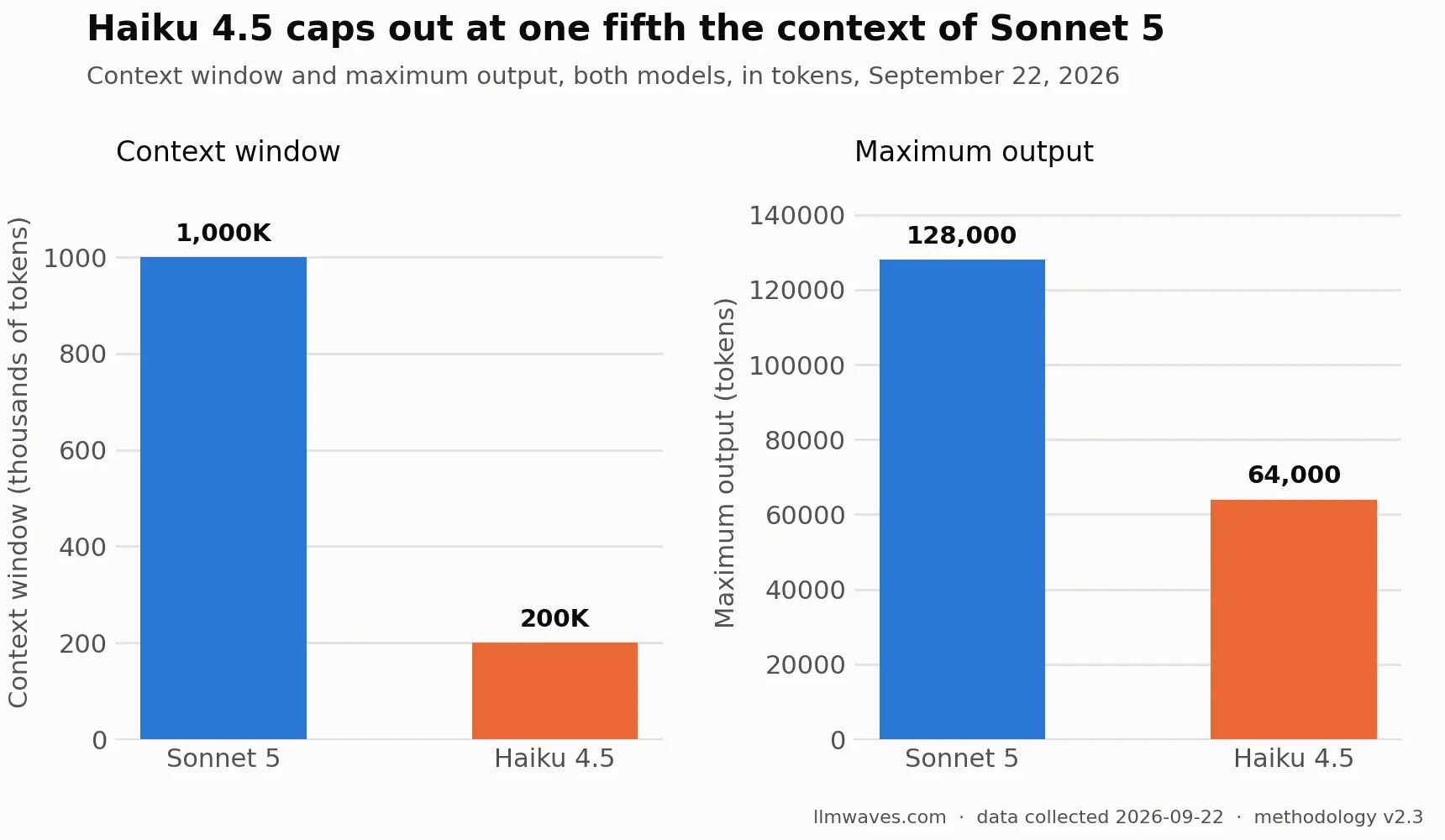
Anthropic's own models overview page lists a 1,000,000-token context window and a 128,000-token maximum output for Sonnet 5. The same page lists 200,000 tokens and 64,000 tokens for Haiku 4.5.
That is a five-to-one gap on context and a two-to-one gap on output, a gap that decides which tasks can run on Haiku 4.5 at all, independent of price.
The gap matters because it is not a price-versus-quality tradeoff. It is a hard wall. A task that needs 300,000 tokens of accumulated context, a long codebase read, a multi-document brief, an agent loop that keeps growing its own transcript, cannot run on Haiku 4.5 at any price.
It has to move to Sonnet 5 regardless of budget. Framed that way, the lower price on Haiku 4.5 only ever applies to work that already fits under 200,000 tokens.
Above that line, the comparison is not two-to-one on price; it is not a comparison at all, because only one of the two models can take the job.
The knowledge cutoff carries a related gap that a two-to-one price ratio also hides. Sonnet 5 carries a January 2026 knowledge cutoff.
Haiku 4.5 carries a February 2025 cutoff, eleven months earlier.
A question about anything that changed in the second half of 2025 or in 2026 lands inside the gap for Haiku 4.5 and outside it for Sonnet 5, independent of context length or price.
Effort levels exist on one of these models, not the other
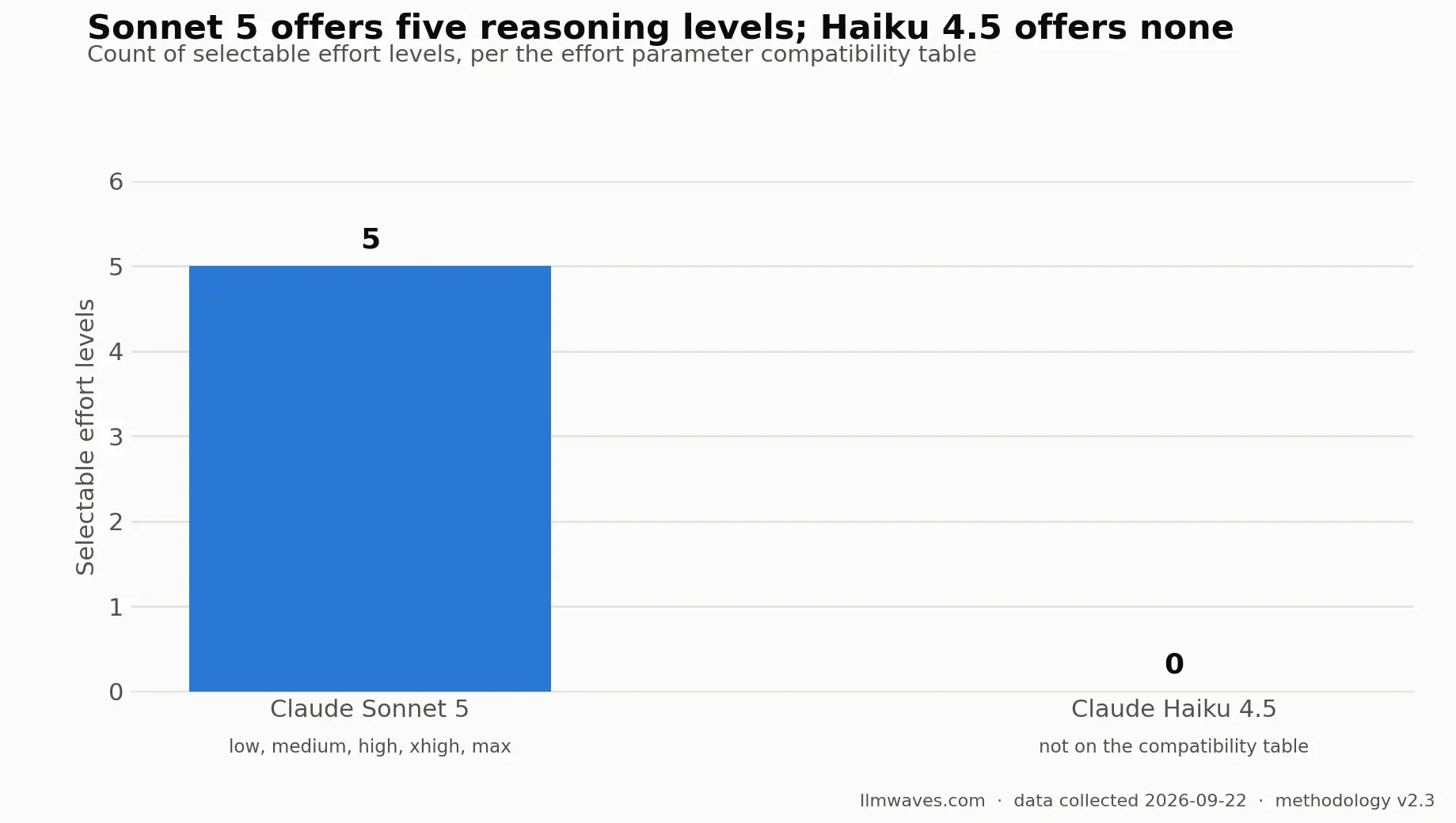
The effort parameter guide lists five selectable levels: low, medium, high, xhigh, and max, with high set as the default.
Sonnet 5 appears on that page with full support for all five. Claude Haiku 4.5 does not appear on the compatibility table at all.
Its only reasoning control is manual extended thinking, a single on-or-off toggle with a token budget attached, not a five-rung ladder a person can dial up or down per request.
That distinction is easy to lose in a sentence like "both models support extended thinking," which conflates two unrelated systems into one claim.
Extended thinking and the effort parameter are two different systems.
A person who wants to trade cost for reasoning depth, or the reverse, on the same model has that option only on Sonnet 5.
Claude Sonnet 5 sits one tier below Claude Fable 5.1, priced at $10 and $50 and compared against Claude Opus 5 in a separate article. Fable 5.1 also carries all five effort levels. On every axis in this table, price included, Haiku 4.5 sits last.
Which model a person is actually using on claude.ai
The Claude pricing page lists Claude Sonnet and Claude Haiku on the Free plan, with Claude Opus added on Pro and Max.
That puts Haiku 4.5 and Sonnet 5 on every consumer tier, including Free, unlike Opus 5, which sits behind a paid plan. On claude.ai, model choice is a menu inside one subscription price. On the API, each model bills separately at the per-token rates in the table above, and a developer chooses per request rather than per session.
That split answers a question worth stating directly: whether a reader's Claude Pro subscription already includes Haiku 4.5, or whether reaching it requires the API.
The answer is that both models sit inside the same chat subscription; the two-to-one price gap only applies to API billing, where each token is metered against the account making the call.
What this article did not measure
This article did not run a latency test, a throughput test, or an output-quality benchmark against any model discussed.
How much cheaper is Claude Haiku 4.5 than Sonnet 5, with current pricing?
Exactly half, on both input and output tokens. Claude Sonnet 5 costs $2.00 per million input tokens and $10.00 per million output tokens. Claude Haiku 4.5 costs $1.00 and $5.00.
The ratio holds through prompt caching and through the 50 percent batch discount, since both discounts apply equally to both models rather than compressing the gap between them.
When should a person pick Haiku 4.5 over Sonnet 5?
Short, well-specified calls that stay under the 200,000-token context ceiling and do not need tunable reasoning depth. High-volume workloads where the per-call price matters more than headroom for a long transcript fit the same profile.
Anything approaching the context ceiling, needing a specific effort level, or depending on information from after February 2025 belongs on Sonnet 5 instead.
Can Haiku 4.5 and Sonnet 5 run in the same application?
Yes. A common architecture sends a call to Haiku 4.5 first and escalates to Sonnet 5 when the task fails, times out, or exceeds the context ceiling on Haiku 4.5.
This article did not build or measure a specific router, and no commercial routing product is named here, since routing logic and its cost tradeoffs depend on the workload running it.
Does Haiku 4.5 support effort levels like Sonnet 5?
No. The effort parameter compatibility table on Anthropic's own documentation lists Claude Fable, Claude Mythos, Claude Opus, and Claude Sonnet lines with effort support; Claude Haiku is absent from that list entirely.
The only reasoning control on Haiku 4.5 is the manual extended-thinking toggle, separate from the five-level effort system.
Two models, one lineup, a ceiling that does not show up on the price sheet
A five-to-one context gap will not close on its own, and nothing about the history of Haiku 4.5 rules out a wider window on its next release. The numbers above describe the lineup as it stood on September 22, 2026, and stop describing it the day either model's spec sheet changes.