On October 15, 2026, OpenClaw leads on licence and model choice: it is MIT licensed and free, while Claude Code needs a paid Claude plan or API key.
An idle OpenClaw on an API key can cost $0.38 to $19.20 a day at the 30-minute default.
If the work is code only, stop here: Claude Code is the pick.
OpenClaw and Claude Code compared on price, licence, Claude plan use, models, and always-on routes.
Tool | Software price (USD per month) | Licence | Claude plan use | Models | Chat channels | Always-on route |
|---|---|---|---|---|---|---|
OpenClaw | 0 | MIT | Claude CLI reuse or setup token † | Anthropic, Ollama and other providers | 31 | Gateway heartbeat, 30 min default, 60 min on Claude plan auth |
Claude Code | 20 (Pro), from 100 (Max) | Anthropic terms | Included in Pro, Max, Team and Enterprise, not in Free | Claude models only | Includes Telegram, Discord and iMessage ‡ | Routines on Anthropic cloud, 60 min minimum ‡ |
† Reported in the OpenClaw docs, not independently verified. ‡ Labelled research preview on the Claude Code pages.
OpenClaw lists a software price of $0 under the MIT licence, and Claude Pro costs $20 a month on monthly billing.
The Claude pricing page lists Claude Code in the Pro, Max, Team and Enterprise plans and not in Free.
Where the figures come from
LLM Waves Research collected every price, limit, and plan rule here from the linked Anthropic and OpenClaw pages on October 15, 2026, and did not run either tool.
The idle cost figures are calculated from those pages: runs per day × tokens per run ÷ 1,000,000 × $4.
The $4 is the Claude Opus 5.5 input price per 1M tokens, with no caching and no output tokens.
Run sizes of 100,000, 5,000, and 2,000 tokens come from the figures printed on the OpenClaw heartbeat page.
What the pick rests on
Software price comes first in the ranking, then licence, positioning, and interoperability with Claude plans and models. Coding output is not ranked.
Idle input cost rises with the tokens in each run, and the 60-minute interval halves every figure.
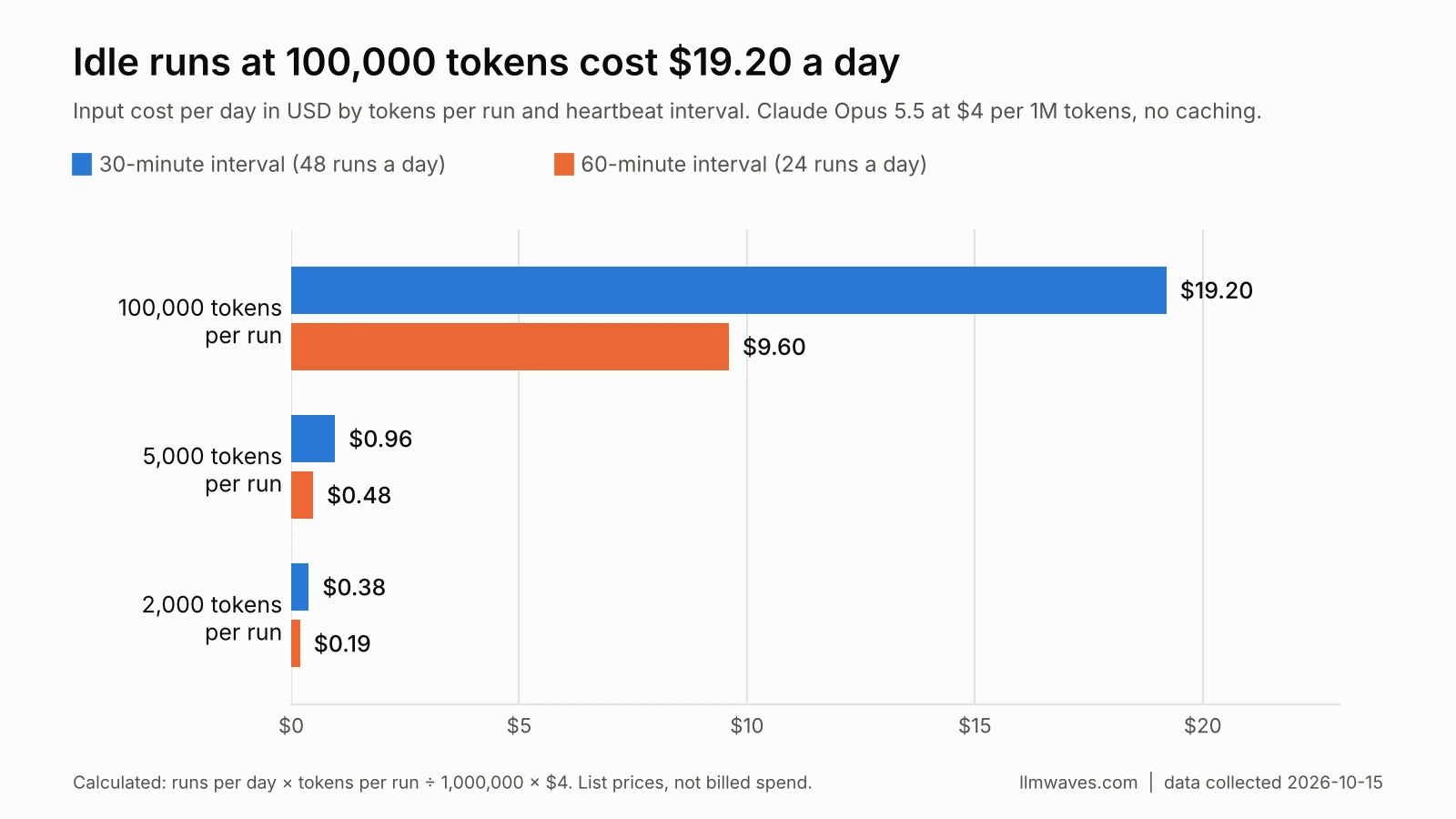
At 48 runs a day, 100,000 tokens per run costs $19.20 against $0.96 for 5,000 tokens and $0.38 for 2,000 tokens.
At 5,000 tokens per run, the 30-minute default costs $0.96 a day, against $19.20 at 100,000 tokens.
Which tool fits which reader
A Pro or Max subscriber
Claude Code is the Top pick for a Pro or Max subscriber who wants coding help, because Claude Pro costs $20 a month on monthly billing and includes Claude Code.
OpenClaw is Situational for the same reader: it fits only when the plan rule described below holds and an API key is ready as the fallback.
On Free, the Claude Code pick fails.
Someone who only edits code
Claude Code is the Top pick when the work is repository edits alone, since OpenClaw adds a gateway host and a heartbeat.
OpenClaw alone is Situational here and can still run Claude Code as a backend.
The Cursor vs Claude Code comparison prices Claude Code against another coding tool.
If the work needs a non-Claude model, the Claude Code pick is wrong.
The Claude Code gateway page states that Anthropic does not support routing Claude Code to non-Claude models through any gateway.
Someone who wants an agent reachable from chat apps
OpenClaw is the Top pick for chat reach, with 31 listed channels.
Claude Code is Situational: it covers the reader who needs Telegram, Discord, or iMessage and keeps a session open.
If the gateway must serve people who do not trust each other, the OpenClaw pick is wrong, since the trust model supports one trust boundary per gateway.
A team lead
Claude Code is the Top pick for a team that needs vendor terms and seat billing, with Team seats at $25 (Standard) and $125 (Premium) a month on monthly billing.
OpenClaw is Situational: it fits a single operator or a mutually trusting team on one gateway.
OpenClaw on one shared Claude plan login for a team is Insufficient data, because no Anthropic page named here addresses that setup.
The Anthropic help page keeps Claude plans open to third-party tools, and the legal page limits routing for other users
The Anthropic help article on the Agent SDK states: "You can still use the Claude Agent SDK, claude -p, and third-party apps with your subscription limits."
A notice dated June 15, 2026 states that Anthropic paused previously announced changes. Agent SDK, claude -p and third-party app usage draw from subscription limits under that notice.
A notice dated October 7, 2026 states that Max and Team plans include monthly API credits that cover the Claude Agent SDK. The page carries no exact update date.
The monthly API credits article lists $100 on Max 5x, $200 on Max 20x, and $20 or $100 per Team seat, pooled up to $500.
The credits cover the Claude API and the Agent SDK. The commands claude -p and the Agent SDK draw the credits only when run with an API key, since a plan sign-in draws plan limits instead.
Interactive Claude Code is not covered. Credits do not roll over and need seven days on the plan.
Credit size depends on the plan, and Pro has none.
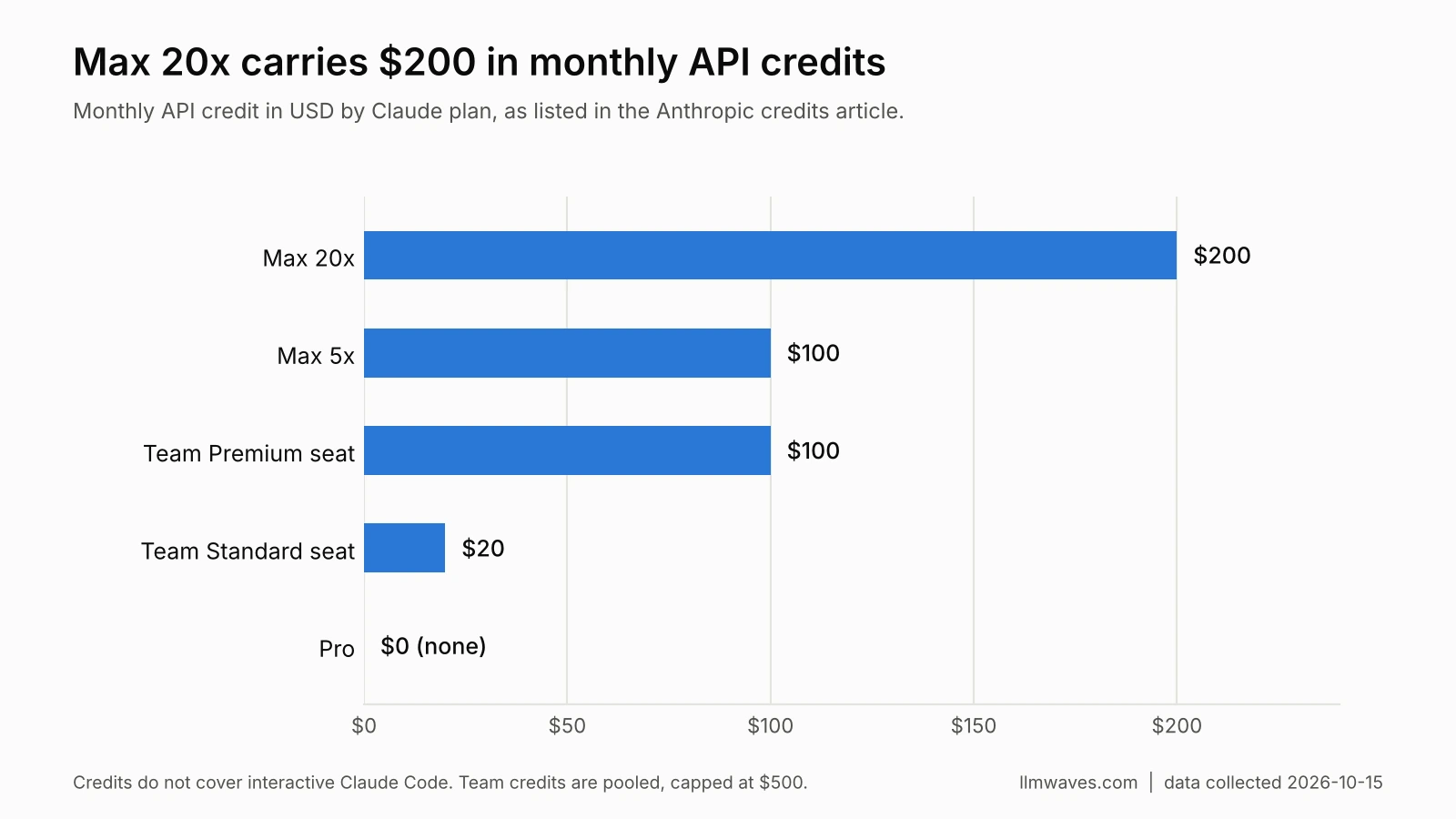
Claude Max 20x carries $200 a month in API credits, ten times the $20 on a Team Standard seat.
The Claude Code legal page states that OAuth is "intended exclusively for purchasers of Claude Free, Pro, Max, Team, and Enterprise subscription plans".
The same page states that Anthropic "does not permit third-party developers to offer Claude.ai login into their own applications, or to route requests through Free, Pro, or Max plan credentials on behalf of their users." Developers are pointed to API key authentication.
The OpenClaw OAuth page states "Anthropic staff told us this usage is allowed again" and treats Claude CLI reuse as sanctioned "unless Anthropic publishes a new policy".
The page also describes API key auth as "the safer recommended path" for production.
The statement carries no date and is secondhand.
An idle OpenClaw on an API key can spend $0.38 to $19.20 a day at the 30-minute default
The OpenClaw heartbeat page states: "Heartbeats run full agent turns. Shorter intervals burn more tokens." The default interval is 30 minutes, or 60 minutes with Anthropic OAuth or token auth, including Claude CLI reuse.
An API key therefore gets 48 runs a day. That is the ceiling.
At the Claude Opus 5.5 input price of $4 per 1M tokens, 48 runs of 100,000 tokens cost $19.20 a day, or $576 over 30 days.
Runs of 5,000 tokens cost $0.96 a day, or $28.80, and runs of 2,000 tokens cost $0.38 a day, or $11.52.
The 60-minute interval halves each figure to $9.60, $0.48, and $0.19.
The OpenClaw docs list isolatedSession: true as the setting that cuts a run from "~100K tokens down to ~2-5K per run".
A run is skipped when the scratch file exists but is effectively empty, so 48 is not a measured count.
Setting heartbeat.every to "0m" turns the recurring cadence off.
Model choice moves the same scenario by a factor of 100.
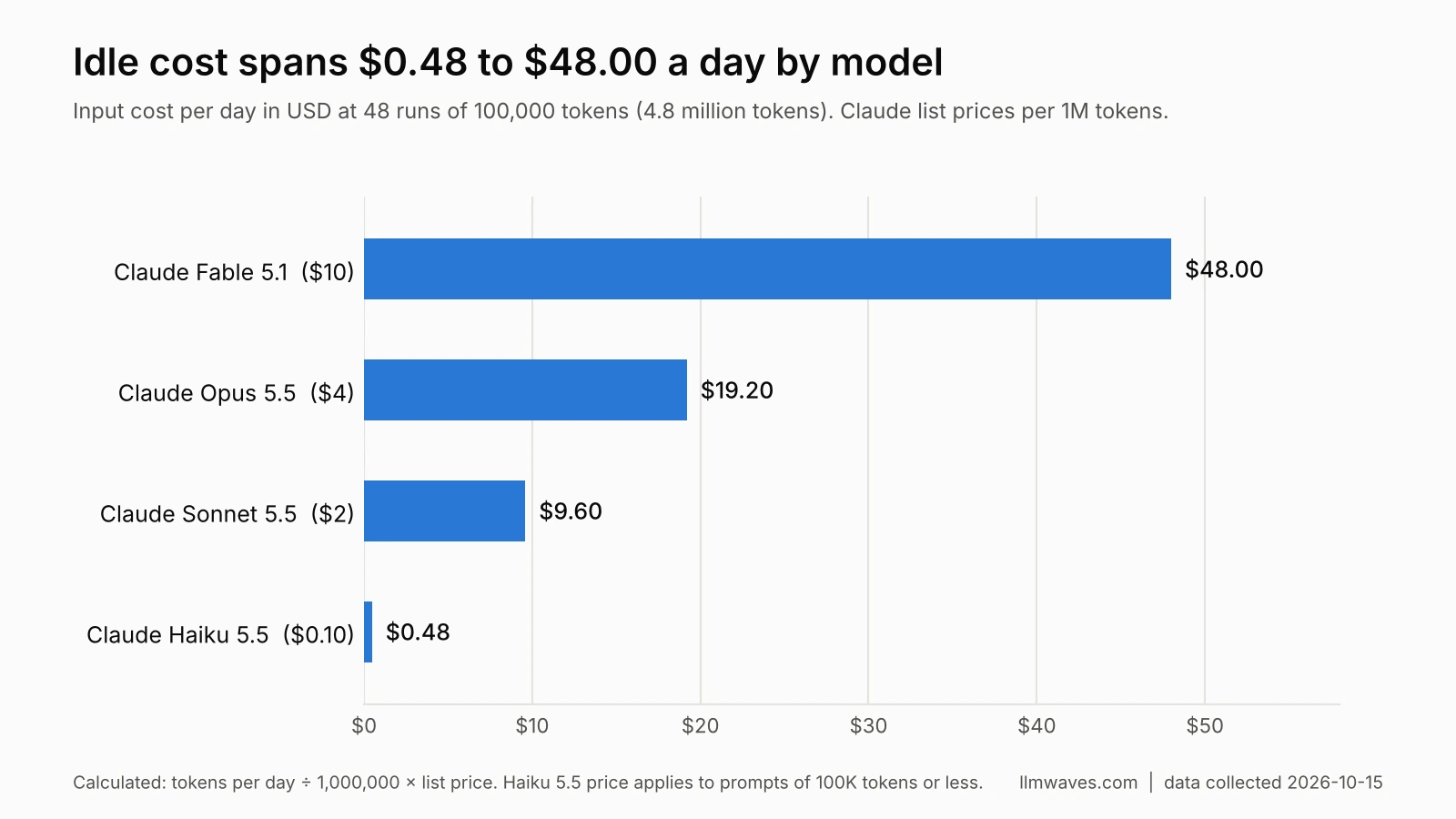
At 100,000 tokens per run, Claude Haiku 5.5 costs $0.48 a day, and Claude Fable 5.1 costs $48.00.
A local model removes the per-token line from this arithmetic.
The LLM Waves ranking of 10 Ollama models for OpenClaw covers that route.
At 100,000 tokens per run, idle OpenClaw costs more per day than the Claude Code average
The Claude Code costs page lists an average of about $13 per developer per active day and $150 to $250 per developer per month.
The page also lists under $30 per active day for 90% of users. Scheduled tasks in Claude Code fire on their interval even while the session is idle, and the page describes each firing as "sending your full context each time".
On an API key, the same formula applies to those firings.
Anthropic reports a daily average for Claude Code, and the scenario gives a daily figure for idle OpenClaw.
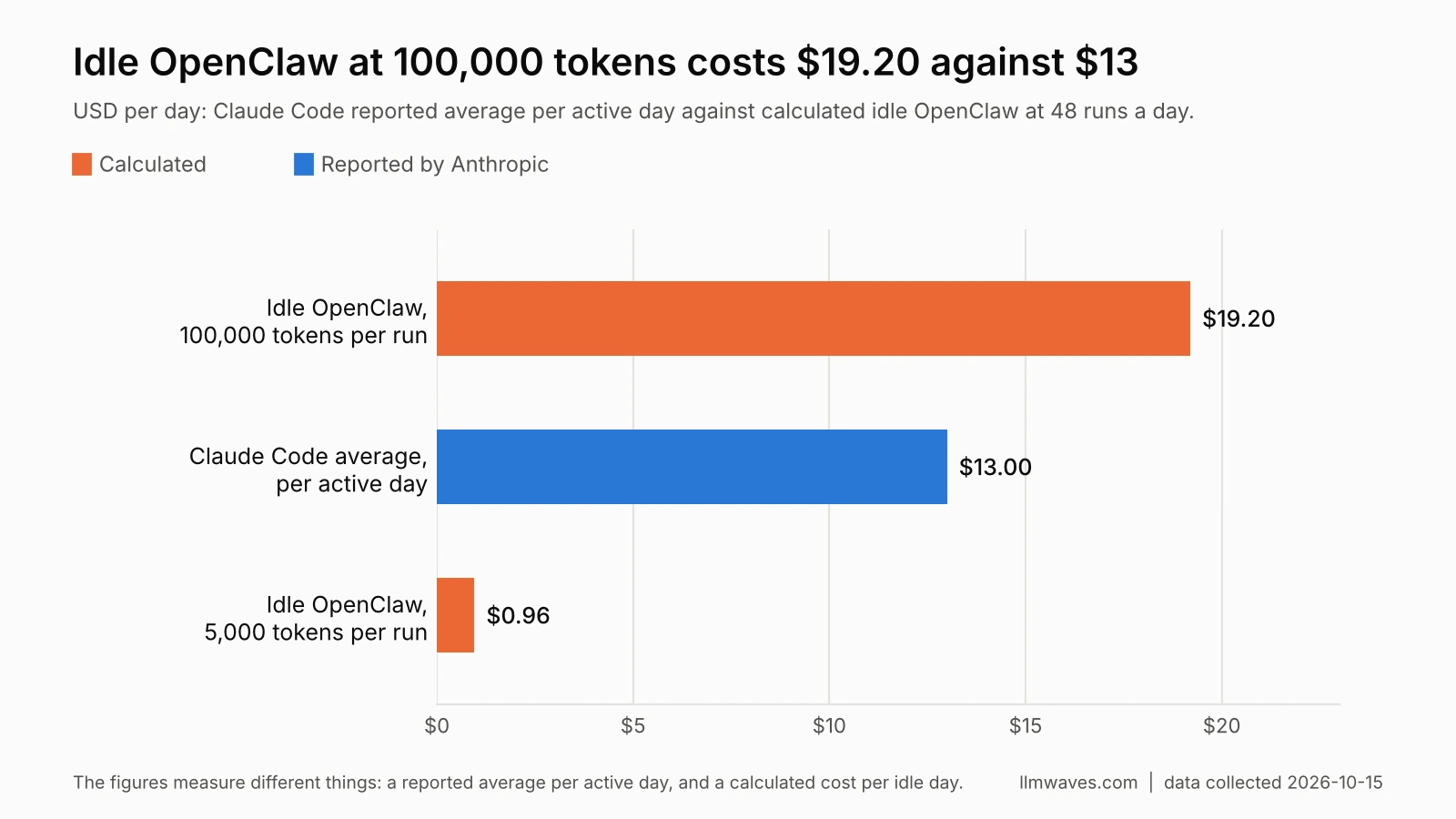
The 100,000-token scenario sits $6.20 above the $13 reported average, and the 5,000-token scenario sits $12.04 below it.
OpenClaw can run Claude Code as a backend through ACP or the Claude CLI
The OpenClaw ACP page lists Claude Code, Cursor, Copilot, Droid, OpenCode and Gemini CLI as supported agents, starting with /acp spawn or sessions_spawn({ runtime: "acp" }).
OpenClaw can also run turns through the local Claude CLI, using the login the Claude CLI already holds.
The OpenClaw authentication page lists claude auth login followed by openclaw models auth login --provider anthropic --method cli --set-default as the Claude CLI route.
The same page calls an API key "the most predictable option" for an always-on gateway host.
Claude Code ships its own always-on routes, and OpenClaw lists 31 chat channels
Routines in Claude Code run on Anthropic cloud infrastructure, so they keep working when a laptop is closed.
The routines page lists Pro, Max, Team and Enterprise plans and sets a minimum interval of one hour.
Routines require a claude.ai plan login rather than an API key, and Anthropic labels the feature as a research preview.
Channels, also research preview, include Telegram, Discord and iMessage, and events arrive only while a session is open, according to the Claude Code Channels page.
The OpenClaw channels page lists 31 supported chat channels.
The official importer moves Claude Code instructions, MCP servers and skills, and archives hooks and permissions
The importer previews with openclaw migrate claude --dry-run and applies with openclaw migrate apply claude --yes, which creates and verifies a backup first.
The OpenClaw migration page lists project and user CLAUDE.md content, MCP server definitions and skills with a SKILL.md file as imported.
Claude command files are converted to skills with disable-model-invocation: true.
Hooks, permissions and broad tool allowlists, environment defaults, CLAUDE.local.md, .claude/rules/subagents, caches and project history, and Claude Desktop extensions and OS-stored credentials are archive-only.
They are copied to a migration report for manual review and not loaded into live config.
A Claude Code setup built on hooks or permission allowlists therefore starts without them in OpenClaw.
OpenClaw is run by a foundation, and one gateway serves one trust boundary
The OpenClaw Foundation announcement of July 8, 2026 states that the foundation is a 501(c)(3) and that the project stays MIT licensed.
The creator joined OpenAI earlier in 2026, and the post gives no exact date.
The OpenClaw trust model page lists one trust boundary per gateway, "a single operator or a mutually trusting team", as supported. One shared gateway for mutually untrusted users is listed as not supported, and operator roles are described as "collaboration guardrails, not tenant isolation".
What we did not measure
LLM Waves Research did not measure coding output from either tool. Coding scores for individual models sit on the LLM Waves leaderboards, and output from neither tool is ranked here.
No billing record from a live OpenClaw account is included, so the idle figures are a calculation from list prices. No run of OpenClaw driving Claude Code through ACP was collected.
Is OpenClaw made by Anthropic?
No. OpenClaw is run by the OpenClaw Foundation, a 501(c)(3), under the MIT licence. Claude Code is the Anthropic product.
OpenClaw reaches Claude models through an API key, the Claude CLI, or a setup token.
Is OpenClaw free?
The software is free under the MIT licence. Model calls are billed by the provider on an API key.
A Claude plan login draws plan limits instead, subject to the dated notices above.
Can OpenClaw use Claude Code?
Yes. OpenClaw lists Claude Code as a supported ACP agent and has a claude-cli backend that runs turns through the local Claude CLI login.
Did Anthropic ban OpenClaw?
The Anthropic help article states that third-party apps can draw subscription limits, and a June 15, 2026 notice paused previously announced changes.
The legal page limits routing plan credentials for other users. The plan section above lists both statements with their dates.
Is OpenClaw safe to run?
OpenClaw documents a trust model rather than a safety rating: one gateway for a single operator or a mutually trusting team.
Shared use by mutually untrusted users is listed as not supported.
Which is better for coding, OpenClaw or Claude Code?
Coding output is not ranked here: the comparison covers price, licence, positioning and interoperability, so it names no winner on coding.
OpenClaw can run Claude Code as a backend.
Where the figures change first
Plan rules, prices and run sizes change on the vendor pages first.