Six 2026 releases lead the open weight field on GPQA Diamond: Kimi K3 at 93.5, Qwen3.8-Max at 92.6, GLM-5.2 at 91.2, DeepSeek-V4-Pro-Max at 90.1, Qwen3.8-27B at 89.2, and Gemma 4 31B at 84.3.
The lead Kimi K3 holds over Qwen3.8-Max sits inside the spread we would expect from differently run evaluations, so treat the top two as tied rather than ranked. The gap that actually decides which model fits a reader: total parameters range from 27 billion to 2.8 trillion, and only two of the six run on a single consumer GPU. Check the license and the VRAM tier before downloading anything, and the rest of this comparison sorts out which of the six survives that check.
Verdict
Qwen3.8-27B is the top pick for a single consumer GPU, beating larger releases on GPQA Diamond at a size fitting 24GB of VRAM.
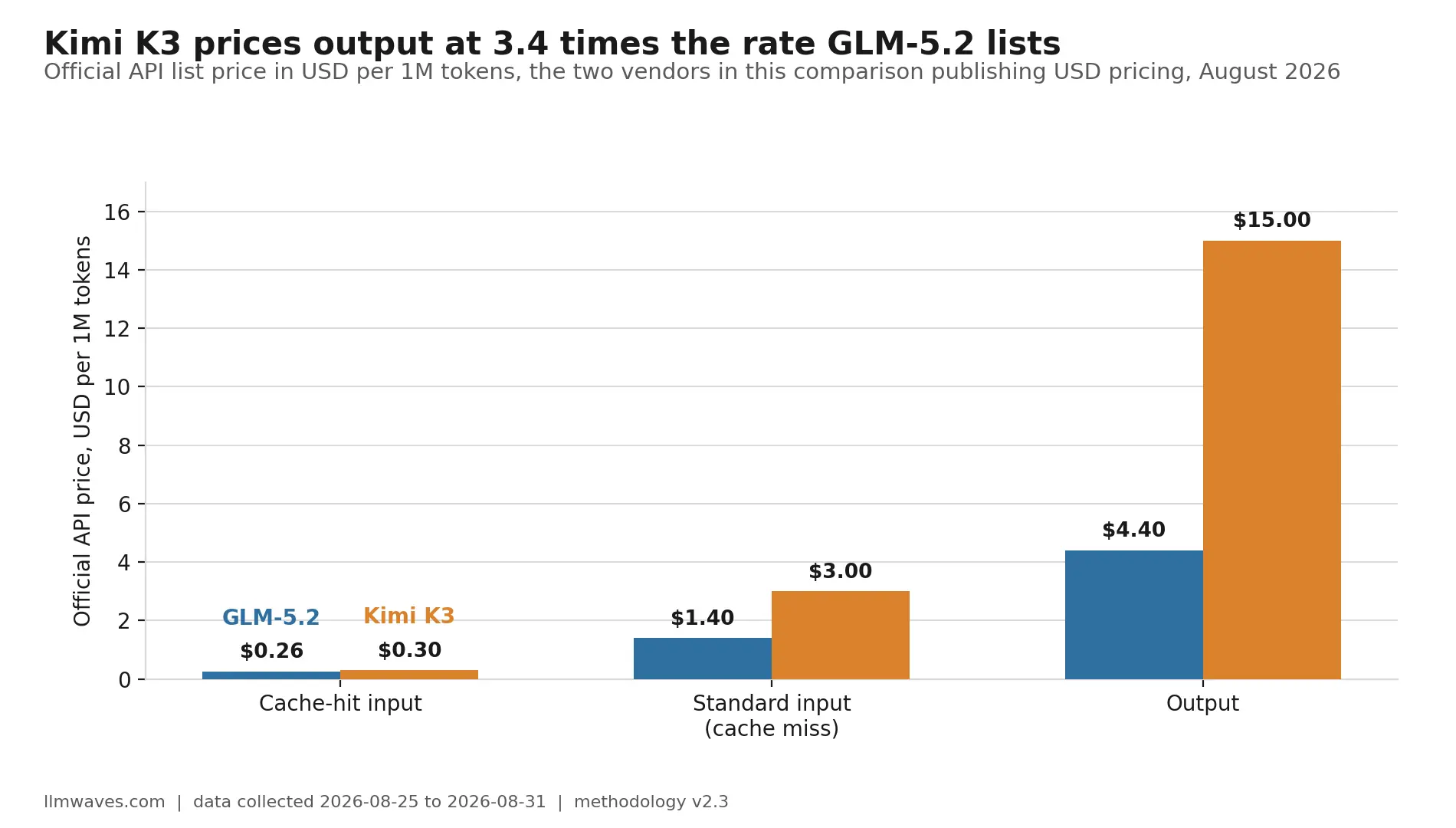
GLM-5.2 is the best value for API work, pricing output at under a third of the rate Kimi K3 lists.
Kimi K3 leads raw reasoning but carries revenue-gated license terms. The use-case section below sorts the rest.
The six models compared
Model | Total parameters | Context window | License | GPQA Diamond (pass@1) | SWE-bench | HLE |
|---|---|---|---|---|---|---|
Kimi K3 | 2.8T total, 104B active (MoE) | 1,048,576 tokens | Kimi K3 License¹ | 93.5 | not published² | 43.5 (56.0 with tools) |
Qwen3.8-Max | 2.4T total, 95B active (MoE) | 262,144 tokens (extends to 1,010,000) | Apache 2.0 | 92.6 | 67.7³ | 43.6 |
GLM-5.2 | 753B total (MoE)⁴ | 1,000,000 tokens | MIT | 91.2 | 62.1³ | 40.5 (54.7 with tools) |
DeepSeek-V4-Pro-Max | 1.6T total, 49B active (MoE) | 1,000,000 tokens | MIT | 90.1 | 80.6⁵ | 37.7 |
Qwen3.8-27B | 27B (dense) | 262,144 tokens | Apache 2.0 | 89.2 | 61.7³ | 30.8 |
Gemma 4 31B | 30.7B (dense) | 256,000 tokens | Apache 2.0 | 84.3 | not published⁶ | 19.5 (26.5 with search) |
DeepSeek-V4-Flash-0731 | ~304B total (MoE) | 1,048,576 tokens | MIT | not published⁷ | not published⁷ | not published⁷ |
Table notes. ¹ Free below $20 million in trailing 12-month "Model as a Service" revenue; above that, or above 100 million monthly active users, the license requires a commercial agreement or in-product branding. ² Moonshot AI publishes SWE-Marathon (42.0) and DeepSWE (67.5%) instead, neither mapped to the standard SWE-bench scale. ³ SWE-bench Pro, a harder and separately scored benchmark than Verified; these three scores compare to each other, not to column ⁵. ⁴ The Hugging Face safetensors index sums to roughly 753 billion parameters; the GitHub README states 744 billion, an unresolved conflict between Zhipu AI's own primary sources. ⁵ SWE-bench Verified, the only Verified score here. ⁶ Google's own card reports LiveCodeBench v6 and a Codeforces rating instead of any SWE-bench variant. ⁷ DeepSeek's own card lists Terminal Bench 2.1, Toolathlon-Verified, and six other agentic benchmarks in place of GPQA Diamond, SWE-bench, or HLE, so it sits outside this ranking rather than last within it.
Basis and method
This comparison aggregates published figures. LLM Waves Research collected every number above from each model's own Hugging Face repository, official GitHub page, technical paper, or first-party API documentation between 2026-08-25 and 2026-08-31 UTC, and performed no independent testing.
Whereas a vendor's own card omits GPQA Diamond, SWE-bench, or HLE, the corresponding cell reads not published rather than a number pulled from a third-party leaderboard, and the two calculations this article performs (VRAM per billion parameters, and the self-hosting breakeven token volume) show their formulas in the sections that use them. Full source names, URLs, and retrieval dates for every figure sit in the raw dataset linked at the end of this article and on the methodology page.
Decision axes
This comparison ranks the six primarily on GPQA Diamond, then separates them on context window, license terms, and total parameters, because a model a reader cannot legally deploy at scale or physically run on their own hardware is not available to them regardless of its score.
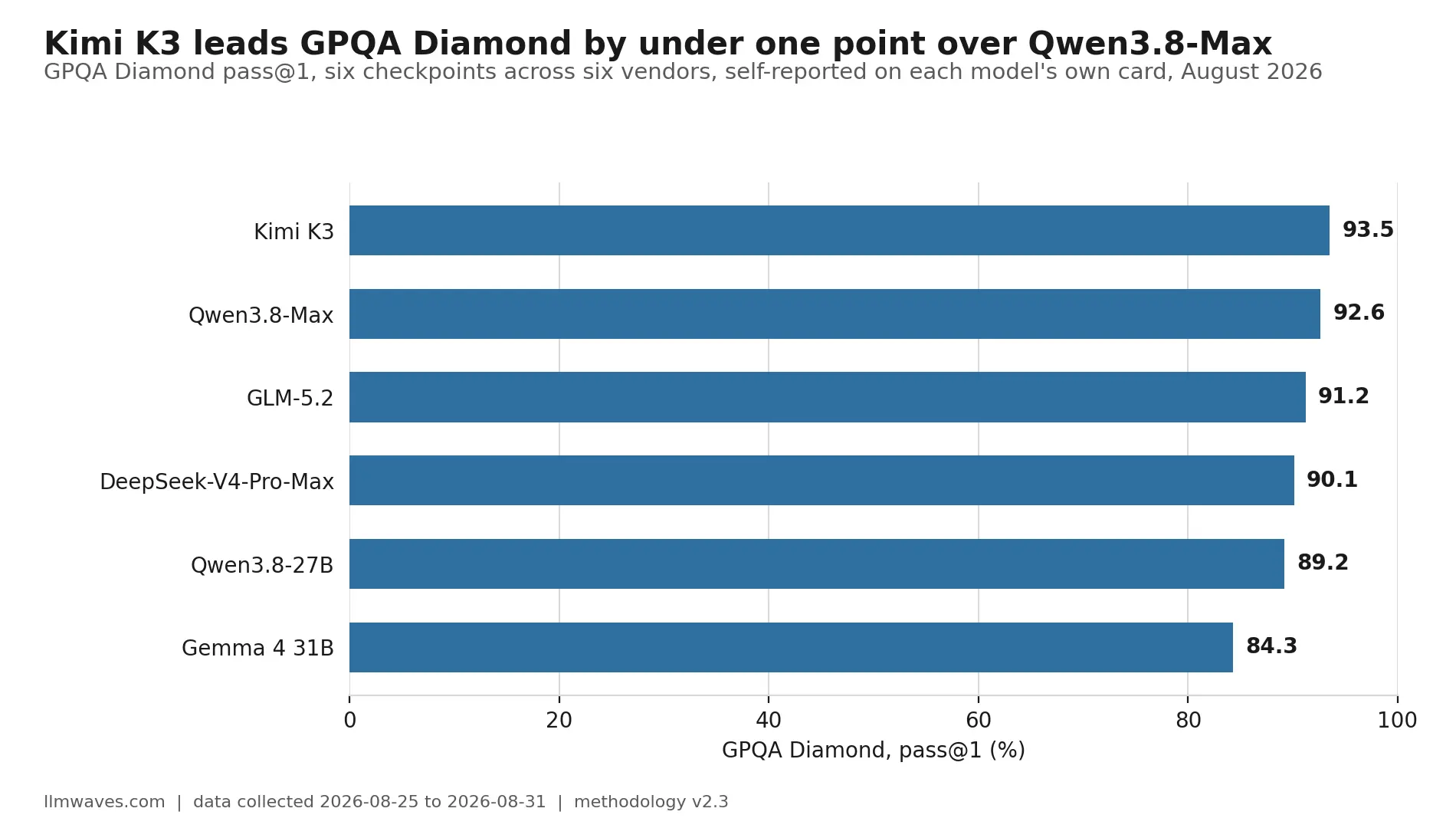
Kimi K3 posts 93.5 on GPQA Diamond against 92.6 for Qwen3.8-Max, a 0.9-point gap that sits inside the range we would expect from two vendors running their own eval harnesses under different sampling settings.
Treat the two as a tied top group rather than a ranked first and second, and treat 91.2 for GLM-5.2 and 90.1 for DeepSeek-V4-Pro-Max as a second tied group roughly two points behind.
License terms and where the commercial risk actually sits
Kimi K3 carries a custom Kimi K3 License, not MIT or Apache 2.0: it stays free until a licensee's own "Model as a Service" business crosses $20 million in trailing 12-month revenue. At this point, Moonshot AI requires a separate commercial agreement, and any deployment above 100 million monthly active users or $20 million in monthly revenue must display Kimi K3 branding.
GLM-5.2, DeepSeek-V4-Pro-Max, and DeepSeek-V4-Flash-0731 ship under a plain MIT license, with no revenue or user threshold in the text. Qwen3.8-Max, Qwen3.8-27B, and Gemma 4 31B ship under Apache 2.0.
No threshold applies to any of the three. The move to Apache 2.0 in Gemma 4 is notable, since Gemma 1 through 3 shipped under a custom Gemma Terms of Use, alongside a separate non-license Prohibited Use Policy still covering illegal activity, harmful content, deceptive content, and sexually explicit material.
None of the six licenses meets the Open Source AI Definition published by the Open Source Initiative, which requires disclosed training data, training code, and inference code alongside the weights; every model here is open weight, and calling any of them open source overstates what the license grants.
Context window and the models built for million-token work
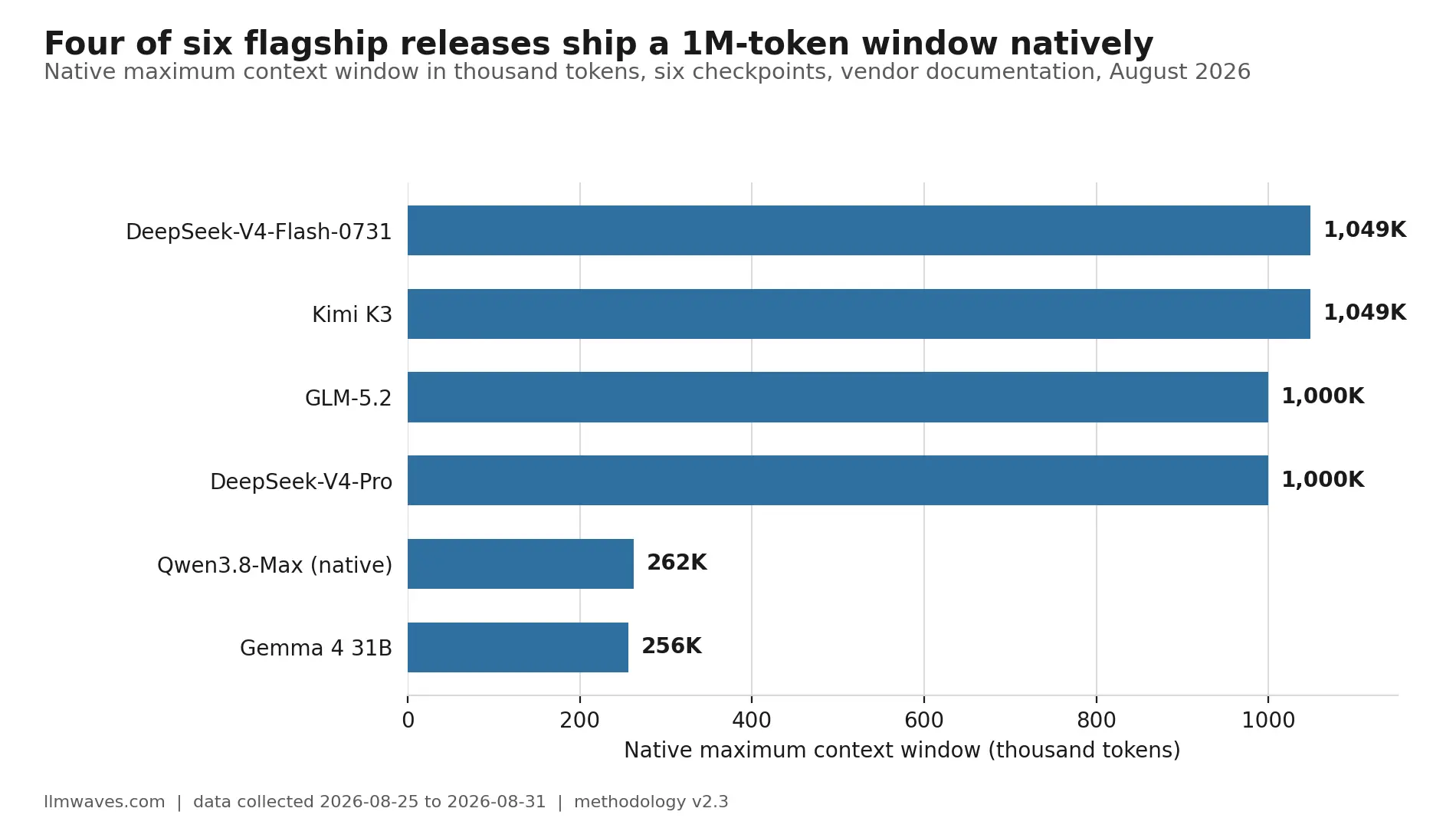
DeepSeek-V4-Flash-0731 and Kimi K3 both cap out at 1,048,576 tokens, GLM-5.2 and DeepSeek-V4-Pro both state a flat 1,000,000, and Qwen3.8-Max and Gemma 4 31B trail at 262,144 and 256,000. Neither comes close.
Qwen3.8-Max extends past its native window to 1,010,000 tokens through YaRN scaling, a documented extension technique rather than a native limit, so treat that figure separately from the four native million-token windows above it.
Release notes for GLM-5.2 attribute its jump from a 200,000-token window in GLM-5.1 to the current 1,000,000 to a sparse-attention scheme the vendor calls IndexShare, stated to cut per-token compute by a factor of 2.9 at that length.
That mechanism, not a larger training run alone, is why GLM-5.2 holds a full-price 1,000,000-token window while the flagship checkpoint in Qwen3.8-Max still ships at roughly a quarter of that natively.
GPQA Diamond, SWE-bench, and HLE: why the six scores are not one scale
Every model here publishes a GPQA Diamond score on a shared 0 to 100 scale, so that column ranks cleanly. SWE-bench does not work the same way.
DeepSeek-V4-Pro-Max alone reports a canonical SWE-bench Verified score of 80.6; GLM-5.2, Qwen3.8-Max, and Qwen3.8-27B instead report SWE-bench Pro, a harder, separately scored benchmark, at 62.1, 67.7, and 61.7.
Comparing 80.6 against 67.7 compares two different tests, not one scale, and no published conversion between Pro and Verified exists. Within the Pro group, 67.7 leads 62.1 by 5.6 points, wide enough to call a real lead. Kimi K3 and Gemma 4 31B publish neither: Moonshot AI's own card reports SWE-Marathon and DeepSWE, and Google's reports LiveCodeBench v6 and a Codeforces rating, so both sit as insufficient data here rather than last place.
Humanity's Last Exam splits further once tool access enters. Kimi K3 posts 43.5 without tools and 56.0 with; GLM-5.2 posts 40.5 without and 54.7 with, both roughly 14 points higher with search or code execution available. Qwen3.8-Max and DeepSeek-V4-Pro-Max report only a single figure each, 43.6 and 37.7, with no tool-augmented number on either card. Gemma 4 31B reports both: 19.5 without tools, 26.5 with search, the lowest pair here.
VRAM by tier: what 8GB, 16GB, and 24GB actually run
Every 4-bit quantized model needs roughly 0.55 to 0.62 gigabytes of VRAM per billion parameters, a ratio drawn directly from llama.cpp's own quantization tables: an 8-billion-parameter model at Q4_K_M quantizes to 4.58 gibibytes, a 70-billion model to 43.1 gibibytes, and a 405-billion model to 249.1 gibibytes, holding across three widely different sizes.
Add headroom on top for the KV cache, which grows with context length and has no single published formula, plus the operating system sharing the card.
8GB and under
None of the six flagship checkpoints fits an 8GB card at usable quality. That tier is empty here. It belongs instead to smaller siblings like the E2B and E4B variants of Gemma 4, not anything ranked above.
16GB
The quantized build Qwen3.8-27B ships runs on 16 to 19 gigabytes at 4-bit, per that model's Hugging Face quantization notes, the only checkpoint here fitting a 16GB card with context headroom to spare.
24GB and up
The 4-bit build of Gemma 4 31B needs roughly 18 gigabytes, fitting a 24GB card with room left over. Every MoE model here sits far past that tier: the smallest published quantization of Kimi K3, a 1-bit build, still needs approximately 594 gigabytes of storage and a stated 450 gigabytes of RAM, and Moonshot AI has released no smaller distilled variant as of this collection window.
GLM-5.2, DeepSeek-V4-Pro, DeepSeek-V4-Flash-0731, and Qwen3.8-Max sit in the same territory: hundreds of gigabytes at the lowest available quantization, needing multi-GPU or CPU-offload setups rather than one consumer card.
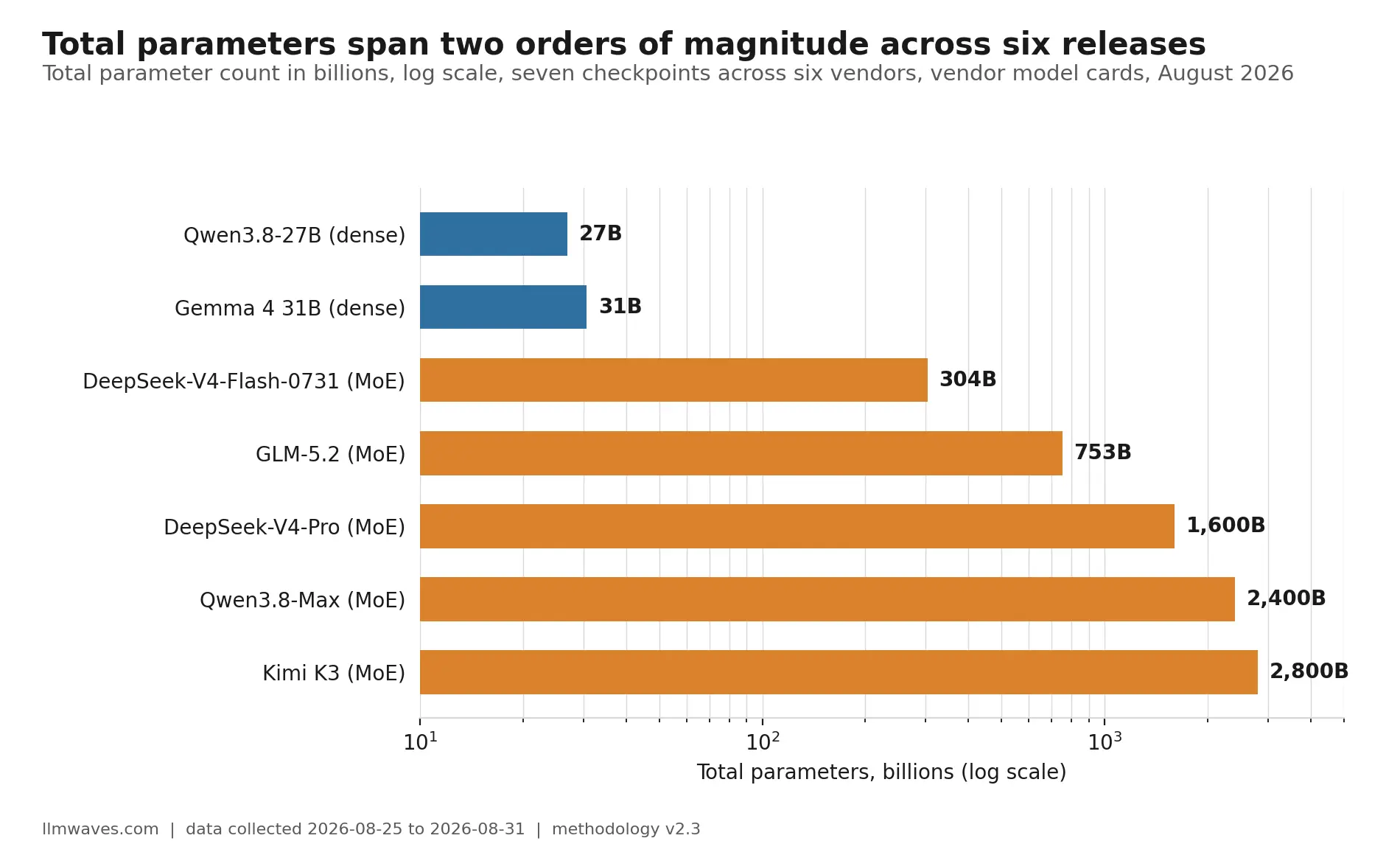
The 2.8 trillion total parameters in Kimi K3 run roughly 104 times the 27 billion in Qwen3.8-27B, and that gap, not the 9-point GPQA Diamond spread between the two, is what actually decides whether a reader's own hardware can run either one.
GGUF, AWQ, and GPTQ: picking a format without breaking the model
The common beginner mistake here is not a bad model choice; it is downloading a full-precision checkpoint that never had a chance of fitting the available card. Llama.cpp's own README shows an 8-billion-parameter model at 16-bit precision running 14.96 gibibytes against 4.58 gibibytes at Q4_K_M, and AutoGPTQ's own benchmark log records a 7-billion-parameter model running out of memory at full precision on hardware where the 4-bit GPTQ build fit and ran at 25.53 tokens per second.
GGUF is a single-file format built for llama.cpp and read directly by Ollama, LM Studio, and GPT4All, bundling quantized weights with metadata for fast local loading. AWQ quantizes weights using activation statistics from a calibration pass; its reference implementation now points toward vLLM's own maintained integration rather than the original AutoAWQ repository, which is archived. GPTQ applies a layer-by-layer error-correction process, with ExLlamaV2 and the GPTQModel project as the maintained runtimes since AutoGPTQ's own repository was archived. Format matters here.
A reader running llama.cpp, Ollama, or LM Studio wants a GGUF build; a reader serving requests through vLLM has both AWQ and GPTQ available, per vLLM's own quantization documentation.
API pricing: what GLM-5.2 and Kimi K3 actually charge
Official pricing for GLM-5.2 lists cache-hit input at $0.26 per 1 million tokens, standard input at $1.40, and output at $4.40. Official pricing for Kimi K3 lists cache-hit input at $0.30, cache-miss input at $3.00, and output at $15.00, putting the output rate of Kimi K3 at 3.4 times that of GLM-5.2.
DeepSeek and Google publish no extractable per-token price for the checkpoints in this comparison: DeepSeek's own pricing page renders its rate table as an image, and Google's Gemma 4 material describes self-hosted and Cloud Run billing without a per-token API rate.
Self-hosting versus API: the token volume where renting a GPU wins
A published API price only answers half the question a self-hosting reader actually has in mind: at what specific monthly token volume does renting a GPU outright beat paying per token. GLM-5.2 and Kimi K3 both sit too large to self-host on consumer hardware, so this calculation uses a comparably sized dense model with public pricing on both sides instead, to isolate the volume threshold rather than any one vendor's rate.
For self-hosting against an API, the arithmetic runs like this: two rented H100 SXM GPUs at RunPod's own listed $3.29 per GPU per hour cost $4,803 across a 730-hour month. Divide that by Together AI's own published $1.04 per 1 million tokens for a comparably sized dense model. The two costs cross at approximately 4.62 billion combined input and output tokens per month.
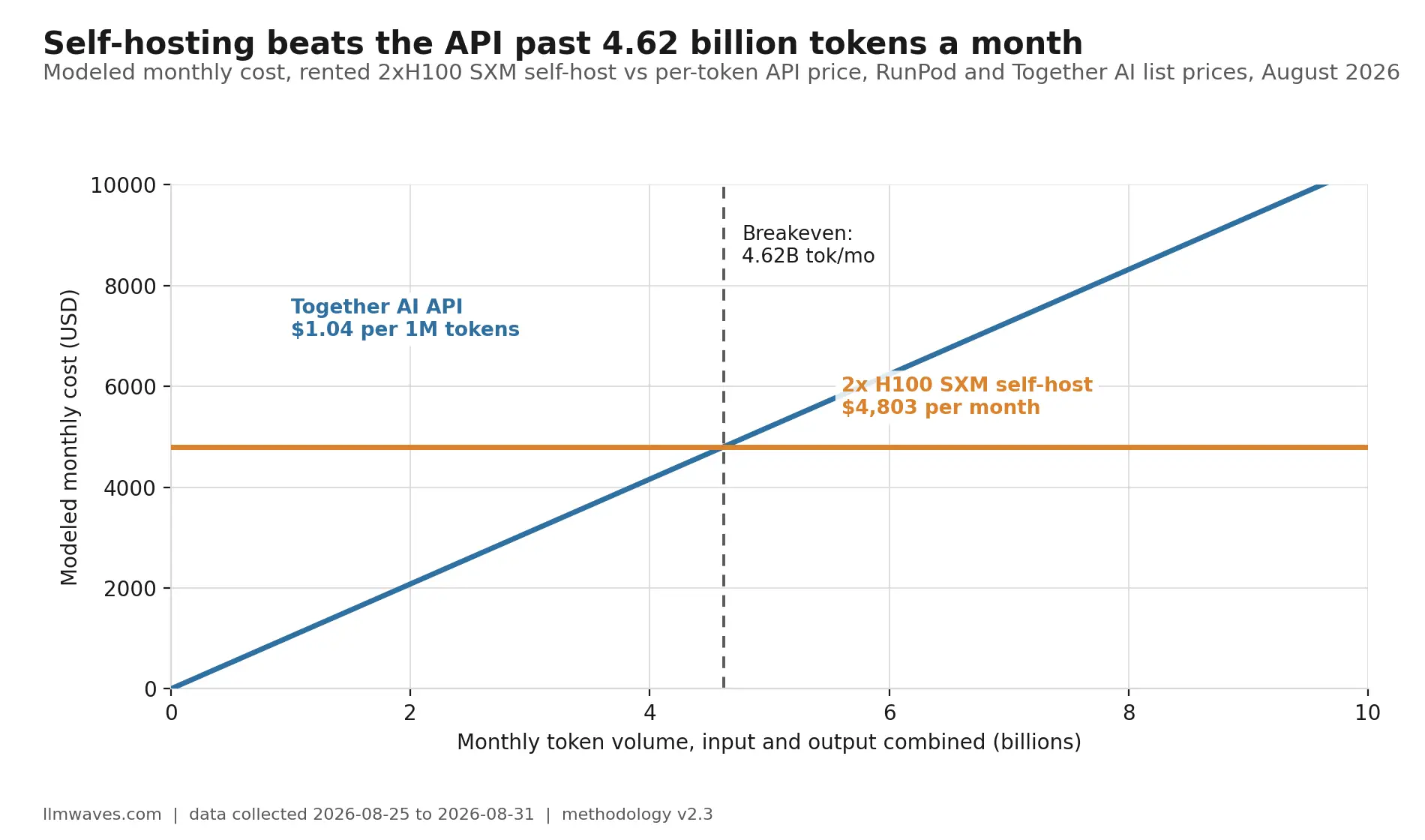
Below that volume, an idle rented GPU costs more per useful token than the API. Above it, renting wins. This estimate assumes near-saturated throughput and ignores engineering time and cold-start overhead, so a real deployment's breakeven point sits higher than 4.62 billion tokens, not lower. A reader who would rather skip self-hosting entirely can compare hosted rates directly on the best LLM API providers page, which tracks several of the same six models.
Picking a model for agents, tool calling, and retrieval
The model card for DeepSeek-V4-Flash-0731 carries no GPQA Diamond, SWE-bench, or HLE score, but it publishes nine separate agentic and coding benchmarks, including Terminal Bench 2.1 at 82.7 and Toolathlon-Verified at 70.3, and states the checkpoint outperforms both the earlier Flash preview and DeepSeek-V4-Pro-Max on every one of those measures.
Materials published for Kimi K3 position the model around orchestrating terminal tools across long coding sessions, and release notes for Qwen3.8-Max describe "autonomous coding" and "long-horizon agentic tasks" as headline capabilities, with a reasoning_effort control for tuning how much computation an agentic loop spends per step.
Three vendor-stated options exist here and no single shared benchmark connects them; match the specific published metric to the workload rather than assuming a high GPQA Diamond score predicts agentic performance.
What this comparison does not measure
This comparison reproduces vendor-published figures and performs no independent testing of accuracy, latency, or output quality on any of the six models. It does not measure non-English or multilingual benchmark performance, retrieval-augmented generation accuracy, quantized-model quality loss relative to full precision, or real-world tool-calling success rates; none of those figures appear on a vendor's own card in a form this comparison could reproduce without running the tests itself.
Readers with those specific requirements should treat every ranking above as a starting point for their own evaluation, not a substitute for it.
Which model fits which reader
A developer building a coding agent gets the most direct fit from the agentic benchmark suite published for DeepSeek-V4-Flash-0731, disqualified if reasoning outside coding also matters, since the checkpoint carries no GPQA Diamond or HLE score.
A startup watching API spend gets the better rate from GLM-5.2, at roughly a third of the output price Kimi K3 lists for a GPQA Diamond score within 2.3 points of it. An enterprise buyer needing a permissive, threshold-free license gets a clean fit from Qwen3.8-Max, Qwen3.8-27B, or Gemma 4 31B, all Apache 2.0, while Kimi K3 needs a revenue and user-count check first.
A team self-hosting on one GPU gets the only real fit from Qwen3.8-27B, the sole checkpoint here combining a top-three GPQA Diamond score with a 16 to 19 gigabyte footprint.
A reader needing maximum context without self-hosting gets it from DeepSeek-V4-Flash-0731 or Kimi K3, both at 1,048,576 tokens, disqualified for Flash-0731 by its missing reasoning benchmark. A reader working outside English gets no dedicated benchmark at all. None of the six vendors here publishes one.
What is the best open-weight model right now?
No single model leads every axis in this comparison. Kimi K3 and Qwen3.8-Max lead reasoning as a tied pair; GLM-5.2 leads cost efficiency for API use; Qwen3.8-27B leads single-GPU deployment. The right answer depends on which of those three axes matters most for a specific deployment.
Can these models run on a single consumer GPU?
Two of the seven checkpoints in this comparison can: Qwen3.8-27B at roughly 16 to 19 gigabytes of VRAM and Gemma 4 31B at roughly 18 gigabytes, both at 4-bit quantization.
The five mixture-of-experts checkpoints, from the 304 billion parameters in DeepSeek-V4-Flash-0731 up to the 2.8 trillion in Kimi K3, all require server-class multi-GPU or CPU-offload hardware even at aggressive quantization.
Are open-weight models free to use commercially?
Four of the six are: GLM-5.2, DeepSeek-V4-Pro, DeepSeek-V4-Flash-0731, Qwen3.8-Max, Qwen3.8-27B, and Gemma 4 31B all carry MIT or Apache 2.0 licenses with no revenue or user-count threshold in the license text. Kimi K3 is the exception, requiring a separate commercial agreement above $20 million in trailing 12-month revenue from a Model as a Service business built on it.
Is Llama actually open source, or only open weight?
Only open weight. Meta publishes the weights for its Llama models, but not the training data or training code the Open Source AI Definition requires, so Llama does not meet that definition despite common usage calling it open source. The same distinction applies to every model in this comparison: all six publish weights, and none publishes the training data or training code needed to qualify as open source under that definition.
What replaced your model, and is an upgrade worth it?
GLM-5.2 replaced GLM-5.1, mainly by extending the context window from 200,000 to 1,000,000 tokens. Kimi K3 replaced Kimi K2, citing roughly 2.5 times the scaling efficiency of the prior generation. GPQA Diamond for Gemma 4 31B, at 84.3, runs almost double the 42.4 that Gemma 3 27B reported. An upgrade makes sense when the prior window, license, or score is the specific blocker, not because a newer checkpoint shipped.
Which model fits non-English or multilingual work?
None of the six models in this comparison publishes a language-stratified benchmark score on its own card as of this collection window, so this is the clearest gap in vendor-published data across the entire comparison. A reader with a specific non-English requirement needs to test candidate models directly against that language rather than relying on any English-language benchmark in the table above, including every number in this article.
The list this comparison will not stay right about
Every figure above reflects each vendor's own card as published between 2026-08-25 and 2026-08-31, and vendor cards change without changelogs. The live, continuously updated version of this comparison sits on the leaderboard page linked above; nothing in this article updates itself once published.
Raw data: download the sourced dataset behind this comparison
Changelog
2026-08-31: Published. Six flagship checkpoints compared on license terms, context window, GPQA Diamond, SWE-bench comparability, HLE, and API pricing where a vendor discloses it.