OpenRouter lists the same per-token price Anthropic, OpenAI, and DeepSeek publish on their pricing pages, then adds a fee on top: 5.5% on a credit purchase, or 5% on usage above a $25,000 monthly BYOK allowance.
A direct API account carries neither fee, and instead climbs rate-limit tiers by cumulative spend. At $30,000 in monthly list-price usage, routing through BYOK adds 0.83%; buying OpenRouter credit adds the full 5.5%. Pick a path by funding method, not by brand.
Direct comparison: OpenRouter and direct APIs
Model | Direct input ($/1M) | Direct output ($/1M) | OpenRouter input ($/1M) | OpenRouter output ($/1M) |
|---|---|---|---|---|
Claude Sonnet 4.5 | $3.00 | $15.00 | $3.00 | $15.00 |
GPT-5.6 Sol (short context) | $2.00 | $10.00 | $2.00 | $10.00 |
DeepSeek-V4-Flash (off-peak, cache miss) | $0.22 | $0.66 | $0.22 | $0.66 |
Figures are vendor-published list prices, reported tier, collected 2026-08-27 UTC. GPT-5.6 Sol carries promotional pricing through November 21, 2026; long-context and peak-hour rates differ and are covered in the body below.
Every OpenRouter cell in that table matches the direct cell beside it, exactly. Claude Sonnet 4.5 costs $15.00 per million output tokens on Anthropic's own pricing page, and $15.00 per million output tokens on OpenRouter's model page for the same snapshot. GPT-5.6 Sol runs $10.00 per million output tokens on OpenAI's documentation and $10.00 on OpenRouter. DeepSeek-V4-Flash holds at $0.66 per million output tokens, off-peak, on both. All three appear on our model index, alongside the full catalog.
Basis and method
Basis 2, aggregated figures, governs this comparison. LLM Waves Research collected every number in this comparison from vendor documentation and pricing pages on 2026-08-27 (UTC); our team sent no inference requests.
The BYOK-versus-credit fee percentages are our arithmetic, applied to published fee schedules, with the formula shown inline where each figure appears.
No figures in this comparison carry the label measured or tested. Full source list, retrieval dates, and version history live on our methodology page.
What this comparison ranks on
OpenRouter and direct provider APIs are ranked on four axes: per-token price parity against the vendor's rate, platform fee overhead by funding path, rate-limit headroom for a new account, and automatic failover across providers. The second axis carries the headline finding, shown below before the per-axis detail.
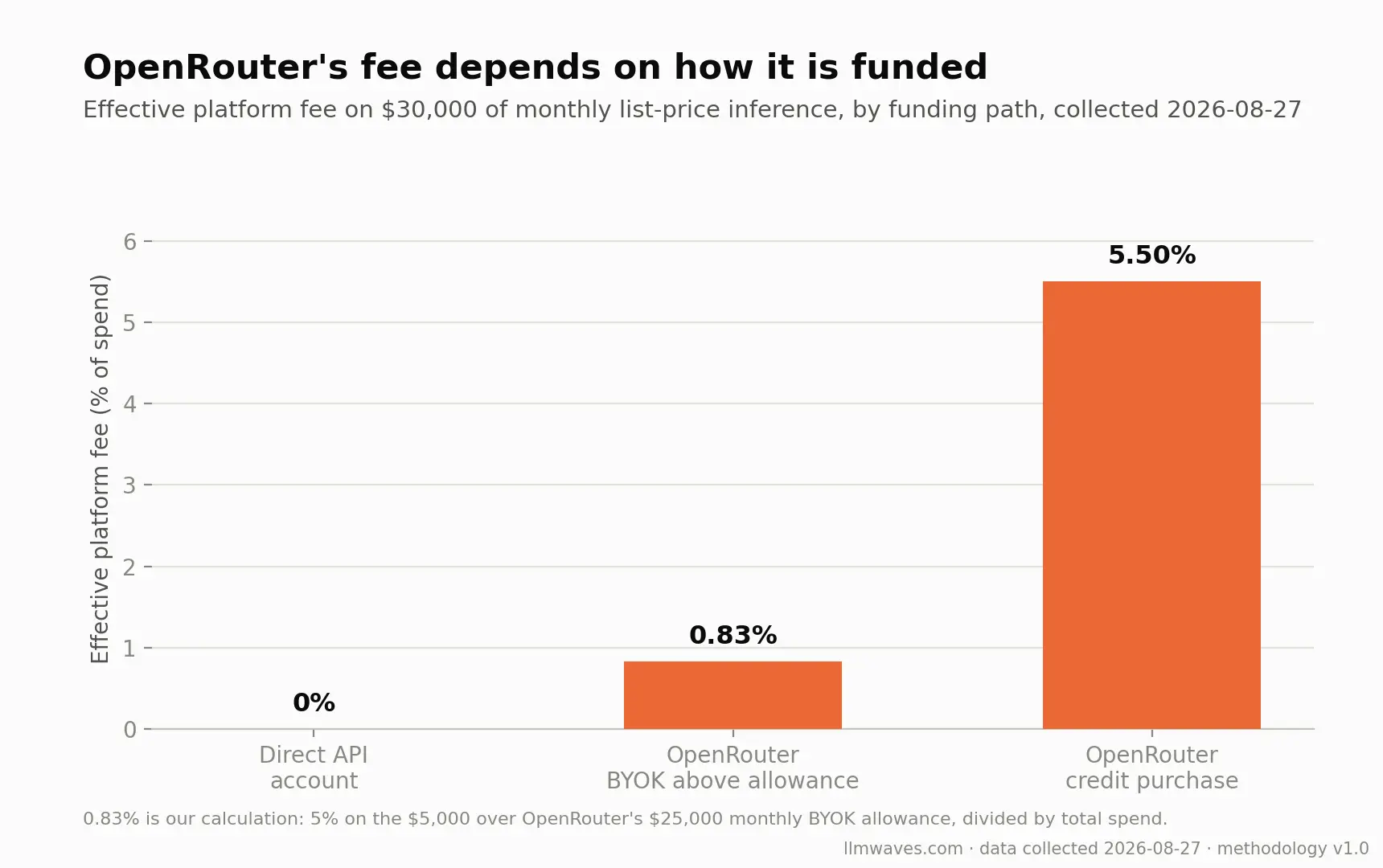
At $30,000 in monthly spend, a card-funded OpenRouter account pays close to six and a half times the fee overhead of the same spend routed through BYOK above the allowance, and a direct account pays none of it.
The fee is the whole story
Per-token price parity closes the first axis before it opens. Anthropic, OpenAI, and DeepSeek set the number; OpenRouter states plainly that it passes that number through "without any markup" on inference itself, a claim the three rows in the table above confirm.
The gap is zero. Treat the two paths as tied on raw list price, because they are. The chart below plots the same three models by output price alone.
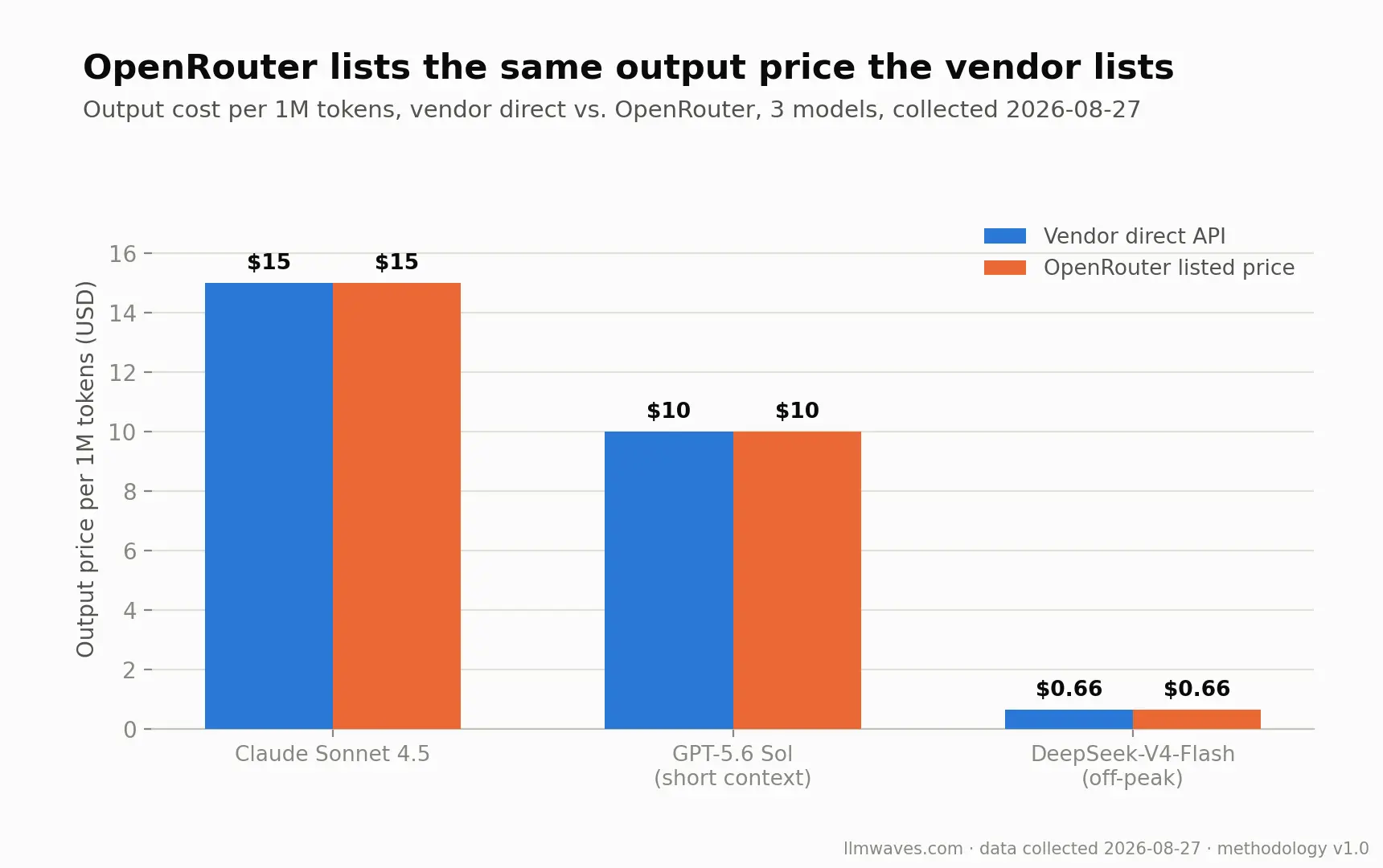
No pair in that chart shows daylight between the two bars. That is the whole finding of this axis.
Overhead is where the paths separate. OpenRouter's own FAQ documents a 5.5% fee on credit purchases paid by card, with an $0.80 minimum per transaction, and a 5% fee on cryptocurrency purchases. That fee applies to funding the account, not to any single request. A direct account, opened straight with Anthropic, OpenAI, or DeepSeek, carries no equivalent charge at any spend level.
BYOK changes the arithmetic. Under OpenRouter's BYOK guide, an organization that supplies its own provider key pays a 5% fee, but only on usage above a monthly allowance: $25,000 in list-price inference for pay-as-you-go accounts, $200,000 for enterprise accounts. Below the allowance, BYOK usage costs exactly the direct rate.
We ran the arithmetic at $30,000 in monthly spend: $5,000 sits above the $25,000 allowance, 5% of that is $250, and $250 against $30,000 total is 0.83%. BYOK above the allowance costs roughly six and a half times less than a credit purchase at the same spend. Below $25,000 a month, BYOK costs nothing extra at all.
The compliment due here: OpenRouter's fee disclosure is specific and dated, not buried in a rate card. A reader can compute the exact overhead for their spend from public numbers alone.
Free tier gates and rate-limit tiers
Testing a new integration exposes the third axis. OpenRouter's free-model documentation sets a 50-request daily cap on ":free"-suffixed models for an account with no credit purchased, and raises that to 1,000 requests a day once the account holds at least $10 in credits. Both tiers cap at 20 requests per minute. No spend history, no waiting period, no application: a $10 top-up is the entire threshold.
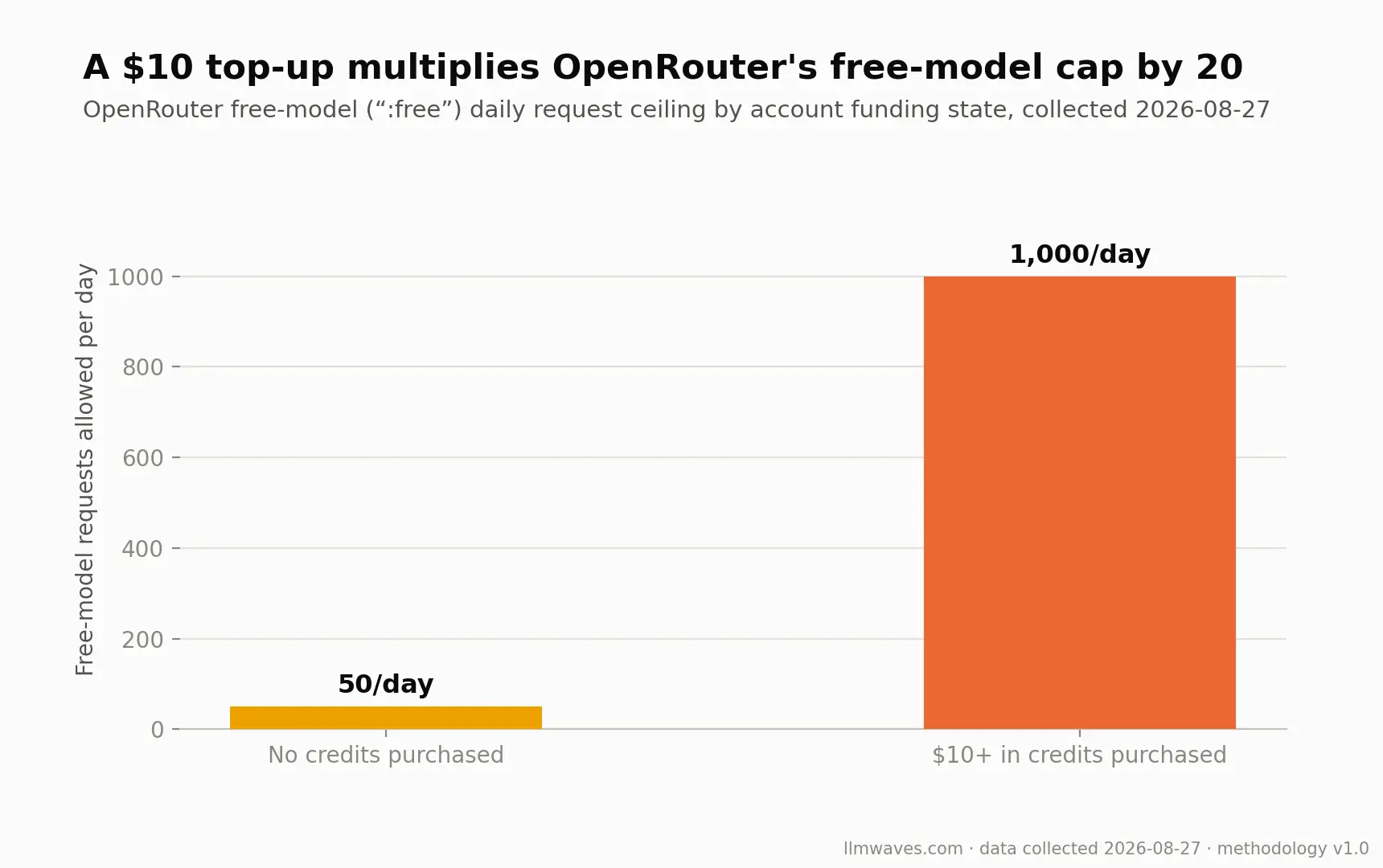
A single $10 purchase multiplies the free-model daily ceiling by twenty, from 50 to 1,000.
Direct accounts gate access differently. OpenAI's rate-limit guide states that Tier 1 opens at $5 in cumulative paid usage, Tier 2 at $50, Tier 3 at $100, Tier 4 at $250, and Tier 5 at $1,000, with request and token limits rising at each step.
Anthropic runs a parallel system. Anthropic's rate-limit documentation places new organizations in an evaluation tier below its standard tiers, then moves them to the Start tier: 1,000 requests per minute, 500,000 to 2,000,000 input tokens per minute depending on model, 100,000 to 400,000 output tokens per minute, and a $500 monthly spend cap.
A direct Start-tier account clears fifty times the requests-per-minute ceiling of an unfunded OpenRouter free model, 1,000 against 20. That gap is not a fair fight between equals: one figure gates a paid, spend-verified account, and the other gates unpaid access to a small slice of free-labeled models.
Failover is the axis price parity cannot show
The fourth axis has no equivalent on a single direct account. OpenRouter's provider-routing documentation states that requests are sent to providers that "have not seen significant outages in the last 30 seconds," and describes a fallback chain: if a first-choice provider fails, a second is tried, and a third after that.
Claude Sonnet 4.5 alone lists seven providers on its OpenRouter model page, including Anthropic directly, Amazon Bedrock, and Google Vertex. A single direct account has no comparable option, unless the calling application already has its own multi-vendor fallback logic. One endpoint down means one dead request.
Fallback can be disabled per call with the allow_fallbacks parameter, which defaults to true.
The trade this axis does not resolve: a fallback that reroutes to a different provider can change which infrastructure actually serves the request, which can shift output characteristics in ways this comparison did not test. Reliability against uptime and consistency against drift are different guarantees, and OpenRouter's documentation only promises the first one.
What we did not measure
LLM Waves Research ran no inference against either path for this comparison, so no data exists here on time to first token, inter-token latency, or end-to-end request latency added by OpenRouter's routing layer. We did not test whether a fallback-routed request returns output that matches the primary provider's output on the same prompt.
We did not test paid, non-free OpenRouter model rate limits, since OpenRouter ties paid limits to credit balance and per-key caps, not a published number. We did not test non-English throughput, on-device deployment, or self-hosted routing tools as an alternative to either path.
Which path for which account
Developers prototyping across many models
OpenRouter, top pick. One endpoint reaches Claude Sonnet 4.5, GPT-5.6 Sol, DeepSeek-V4-Flash, and dozens more without opening a separate account per vendor, and the free-model tier needs a $10 top-up rather than a spend history. Disqualifier: 20 requests per minute on free models will pinch a real prototype fast; a paid key removes that ceiling.
High-volume production on one model family
Direct API through BYOK, best value. Below $25,000 in monthly spend, BYOK costs the direct rate exactly. Above it, the fee holds near 1%. A fully direct account climbs its own ladder instead of paying that fee at all, one spend threshold at a time.
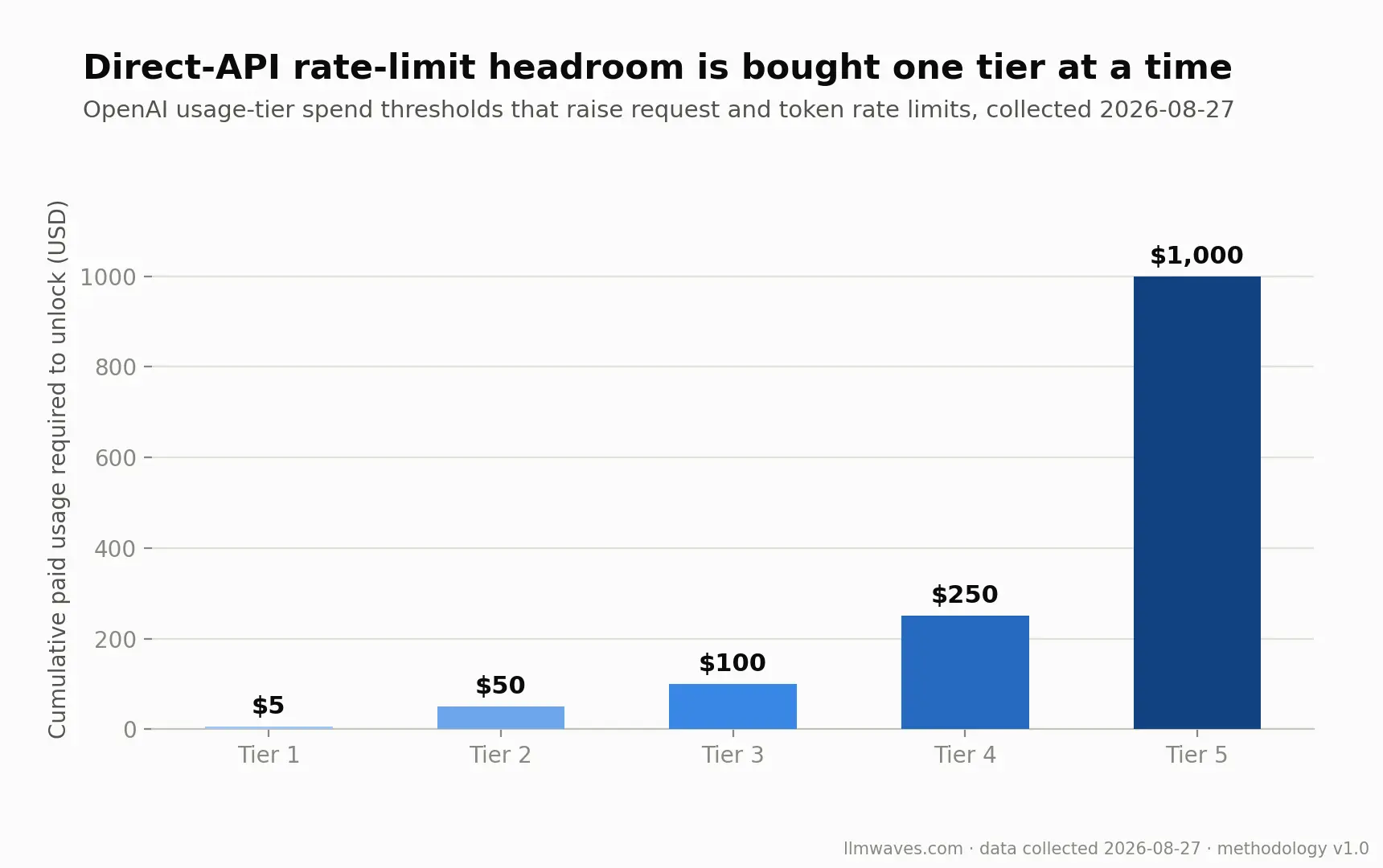
Five dollars in cumulative spend opens Tier 1; reaching Tier 5 takes $1,000. Disqualifier: BYOK still authenticates through OpenRouter's dashboard, so an operation that needs zero dependency on a third party should open the vendor account directly instead.
A startup that cannot absorb one vendor's outage
OpenRouter, situational. Automatic failover across seven documented providers for a single model is a real operational hedge, at no added cost.
No second integration, no on-call rotation built solely to catch one provider's downtime.
Disqualifier: failover changes the serving provider, and this comparison did not test whether that changes output.
An enterprise account already past early rate-limit thresholds
Direct API, top pick. Anthropic's Start tier alone clears 1,000 requests per minute before any custom negotiation, well past what a new OpenRouter free-model account can reach.
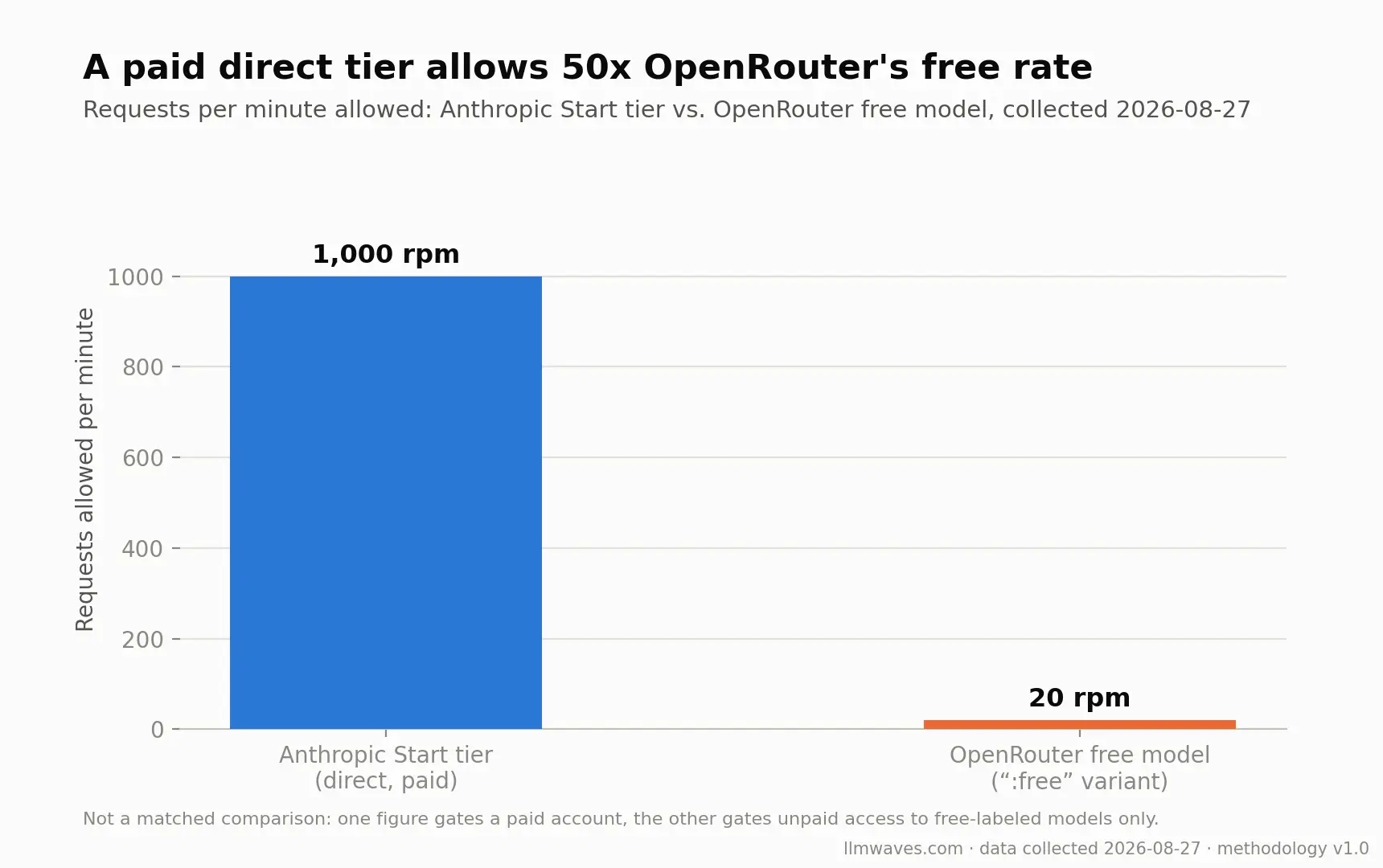
Fifty times the requests per minute sits on the paid, direct side of that chart. Disqualifier: reaching Start tier and OpenAI's Tier 5 still requires cumulative paid spend history, $1,000 of it in OpenAI's case.
Self-hosted routing, on-device deployment, or non-English throughput
Insufficient data. Neither path was scoped or tested against these three conditions in this comparison, and no rank is assigned.
Which is better, OpenRouter or a direct API?
Neither leads on every axis, so no single winner applies across the board. OpenRouter leads on setup speed and cross-provider failover; a direct account through BYOK leads on fee overhead at volume; a funded direct account leads on rate-limit headroom on day one. Match the axis to the account, using the verdicts above.
Is OpenRouter cheaper than a direct API?
At list price, no difference exists: OpenRouter states that it passes provider pricing through unchanged, and the three models in the comparison table confirm that.
A fee applies only on top, and only depending on funding path: 0% below OpenRouter's BYOK allowance, roughly 0.83% above it at $30,000 in monthly spend, or 5.5% if funded through a card-based credit purchase instead.
Is OpenRouter cheaper than Claude bought directly?
No. Claude Sonnet 4.5 lists at $3.00 input and $15.00 output per million tokens on both Anthropic's own pricing page and OpenRouter's listing for the same model, so the token rate is identical. Running that spend through OpenRouter adds the 5.5% credit-purchase fee or the BYOK fee above the allowance; a direct Anthropic account adds neither.
What is the difference between the OpenRouter API and a vendor's direct API?
A direct API is one endpoint, operated by the model's provider, billed and rate-limited by that provider alone. OpenRouter is a routing layer in front of many providers: one endpoint, one dashboard, list-price pass-through with a fee layered on top depending on funding method, and automatic failover across providers when one goes down.
Is OpenRouter or DeepSeek's direct API more cost-effective?
At list price, they match: DeepSeek-V4-Flash runs $0.22 input and $0.66 output per million tokens, off-peak, on DeepSeek's pricing documentation and on OpenRouter's listing alike. DeepSeek's direct account carries no platform fee, ever. An OpenRouter account funded by card purchase adds 5.5% on top of that same rate.
Check this against your own account
Fee schedules, allowance thresholds, and rate-limit tiers are pages that vendors edit without a changelog. Recompute the BYOK-versus-credit math above against your monthly spend before committing to a funding path, and check the current source pages linked throughout this comparison against the version live on the day you read it.
Download the underlying comparison data
Changelog 2026-08-27: Published. Compared OpenRouter against direct APIs from Anthropic, OpenAI, and DeepSeek on price parity, platform fee overhead, rate-limit tiers, and failover coverage.
Published: 2026-08-27 Last updated: 2026-08-27 Data collected: 2026-08-27 (UTC)